
XRP ETFs Outperforming Bitcoin and Ethereum: A Structural Shift in Crypto Investor Sentiment?
ETF Inflows: A Tale of Two Markets
XRP ETFs have captured headlines with record-breaking inflows. Franklin Templeton and Grayscale's XRP ETFs, launched on November 25, 2024, generated $164 million in single-day inflows, with Grayscale's GXRP and Franklin Templeton's XRPZXRPZ-- securing $67.36 million and $62.59 million, respectively. Canary Capital's XRPC further solidified this momentum by amassing $306 million in total investments since its November 21 launch. By contrast, Bitcoin ETFs faced a starkly different trajectory. In November 2025 alone, Bitcoin ETFs bled $3.79 billion in outflows, with BlackRock's IBITIBIT-- leading the exodus with over $2 billion in redemptions. Ethereum ETFs, while showing some recovery in late 2025, recorded $96.67 million in net inflows for November 24, 2025, a fraction of XRP's performance.
This divergence is not merely a short-term anomaly. In 2024, Ethereum ETFs saw a net outflow of $177 million, while XRP ETFs attracted $243 million in net inflows on their first trading day. The broader market context reveals a pattern: as Bitcoin and Ethereum ETFs struggled with outflows amid price declines, XRP ETFs maintained liquidity and institutional interest.
Regulatory Clarity as a Catalyst
The surge in XRP ETFXRPI-- inflows is closely tied to regulatory developments. U.S. regulators' growing acceptance of XRP as a commodity asset has provided a critical tailwind. The launch of nine new XRP ETFs in November 2025-offered by Bitwise, 21Shares, and Franklin Templeton-reflects this confidence, with analysts projecting $4 billion to $8 billion in first-year inflows. This institutional validation contrasts sharply with the regulatory uncertainty that has historically plagued altcoins.
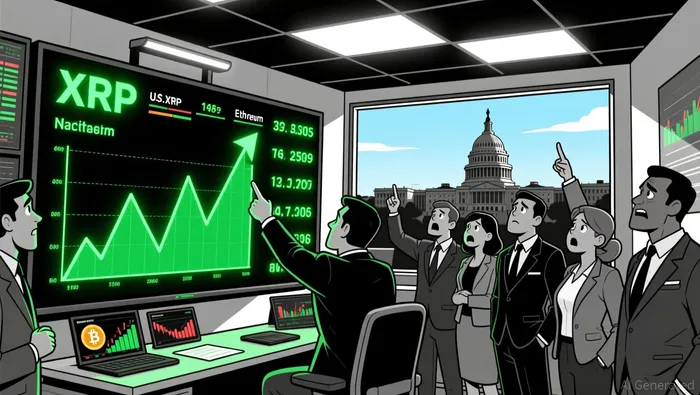 Bitcoin's ETF outflows, meanwhile, highlight the challenges of maintaining dominance in a maturing market. As JPMorgan notes, the reallocation of capital from speculative Bitcoin inflows to utility-driven altcoins like XRP marks a structural shift. XRP's role in cross-border payments and its lower volatility compared to other altcoins may further explain its appeal to risk-averse investors.
Market Dynamics and Institutional Behavior
The interplay between ETF performance and on-chain activity underscores XRP's resilience. Despite a 3.5% positive correlation with the broader altcoin index, XRP has diverged from market weakness, partly due to ETF-driven demand. A $95 million XRP transfer to Binance in late 2025 was interpreted as ETF seeding rather than liquidation. This suggests that institutional investors are accumulating XRP for long-term exposure, even as Bitcoin and Ethereum face short-term headwinds.
Ethereum's mixed performance-$500 million in outflows followed by $96.67 million in inflows-highlights the volatility of altcoin ETFs. However, XRP's consistent inflows, including $128 million in four days for the XRPIXRPI-- and XRPRXRPR-- ETFs, indicate a more sustained institutional interest. Analyst Chad Steingraber has even compared XRP's inflow trajectory to Bitcoin's early ETF days, predicting potential billion-dollar inflow days for XRP funds.
Conclusion: A New Paradigm or a Temporary Fluke?
The data paints a compelling picture: XRP ETFs are outperforming Bitcoin and Ethereum in inflows, driven by regulatory clarity, product innovation, and institutional confidence. While Bitcoin remains the market's bellwether, its ETF outflows suggest a reallocation of capital toward altcoins with clearer use cases and regulatory profiles. For investors, this signals a shift from speculative hype to utility-driven adoption.
However, caution is warranted. XRP ETFs like XRPI and XRPR have experienced sharp declines, with XRPI dropping 8.09% and XRPR 8.27% in recent weeks. The broader crypto market's volatility means that today's inflows could reverse quickly. Yet, for those who see XRP's regulatory progress and institutional backing as a harbinger of long-term trends, the current inflow data may represent the early stages of a structural reallocation.
As the ETF landscape evolves, the interplay between regulatory frameworks, product diversity, and market sentiment will remain pivotal. For now, XRP's ascent in the ETF arena challenges the long-held dominance of Bitcoin and Ethereum, offering a glimpse into a more diversified crypto future.





Comentarios
Aún no hay comentarios