
Why XRP ETFs Are Outpacing BTC and ETH in Institutional Adoption
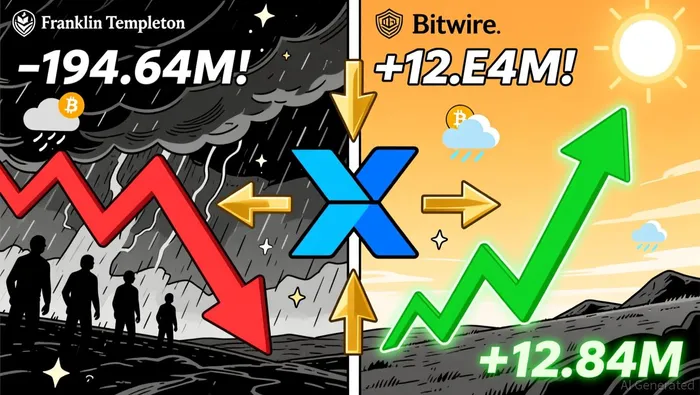
Institutional capital is shifting. While Bitcoin and Ethereum ETFs faced significant outflows on December 4, 2025-$194.64 million and $41.6 million, respectively-XRP ETFs defied the trend, posting a robust $12.84 million inflow. This divergence signals a broader reallocation of institutional capital toward smaller-cap assets, driven by regulatory clarity, product innovation, and strategic positioning. XRP's rapid ETF adoption, led by Franklin Templeton and Bitwise, underscores its unique advantages in a market where BitcoinBTC-- and EthereumETH-- are losing their once-dominant institutional edge.
Institutional Leadership: Franklin Templeton and Bitwise's XRPXRP-- ETFs
Franklin Templeton and Bitwise have emerged as pivotal players in XRP's institutional ascent. Franklin's XRPZ ETFXRPZ--, launched on NYSE Arca, attracted $4.43 million in a single day of trading, while Bitwise's XRP ETF added $5.07 million. Together, these funds contributed to $19 million in trading volume across five XRP ETFs, with total assets under management (AUM) nearing $910 million. This momentum reflects a strategic bet by institutional investors on XRP's utility as a settlement and investment asset, particularly as Ripple's ecosystem expands.
By contrast, Bitcoin ETFs like BlackRock's IBIT saw record outflows, with nearly $113 million in redemptions. Ethereum ETFs, while showing pockets of resilience (e.g., BlackRock's ETHA with $28.35 million in inflows), struggled to offset broader outflows. The contrast highlights a shift in institutional sentiment: XRP ETFs are not just capturing capital but retaining it, with 13 consecutive days of positive net inflows as of December 2025.
Ripple's RLUSD and Strategic Infrastructure
Ripple's institutional credibility has been bolstered by its RLUSD stablecoin and strategic acquisitions. RLUSD, a dollar-backed stablecoin, is now integral to Ripple's institutional offerings, including Ripple Prime-a trading platform that uses RLUSD for collateral and liquidity. This infrastructure positions XRP as both a settlement token and a regulated investment vehicle, addressing institutional concerns about volatility and compliance.
Ripple's acquisition of Hidden Road and GTreasury further solidifies its role in global finance. These moves have expanded XRP's utility beyond cross-border payments, creating a bridge between traditional finance and blockchain. The result? Open interest in XRP futures has surged past $4 billion, reflecting a shift from speculative retail trading to structured institutional exposure.
Regulatory Momentum and Product Innovation
Regulatory momentum is another key driver. 21Shares' TOXR ETF, awaiting SEC approval, could receive automatic clearance by November 27, 2025, according to Bloomberg analysts. This would add to the growing list of XRP ETFs, including leveraged options like 2x XXRP and XRPT, which cater to diverse institutional strategies. By comparison, Bitcoin and Ethereum ETFs face stagnation, with platforms like Vanguard restricting XRP ETF purchases due to conservative policies.
The XRP Ledger itself shows signs of institutional activity, with abnormal spikes in AccountSet and AMM Bid transactions. These patterns suggest large-scale operations are underway, further tightening XRP's supply and supporting its price stability around $2.20. Analysts project that sustained inflows of $100–$150 million weekly could push XRP toward $3.50–$3.80 by 2026, a target far outpacing Bitcoin and Ethereum's current institutional trajectories.
Stablecoin Demand and Market Impact
Stablecoin demand is another tailwind. Ripple's RLUSD is increasingly used in institutional products, providing regulated liquidity within the XRP ecosystem. This dual utility-settlement and investment-has compressed XRP's exchange reserves by 29% in 30 days, reducing available float and creating upward price pressure. Meanwhile, Bitcoin and Ethereum ETFs struggle with liquidity constraints, as outflows erode their market share.
Conclusion: XRP's 2026 Outlook
XRP ETFs are outpacing Bitcoin and Ethereum in institutional adoption due to a confluence of factors: regulatory momentum, product innovation, and strategic infrastructure. With $1 billion in AUM within reach and leveraged ETFs on the horizon, XRP is positioned to redefine institutional crypto investing. As capital reallocates from overhyped giants to underappreciated innovators, XRP's ecosystem-anchored by RLUSD and institutional-grade products-offers a compelling case for 2026.





Comentarios
Aún no hay comentarios