
XRP ETFs and the Institutionalization of Digital Assets: Regulatory Milestones and Market Transformation
Regulatory Milestones: Clearing the Path for XRP ETFs
The U.S. Securities and Exchange Commission (SEC) has long been a gatekeeper for cryptocurrency ETF approvals, but 2025 brought notable progress for XRP. Franklin Templeton's revised S-1 filing for its XRP ETFXRPI--, which shortened Section 8(a) language, signaled a strategic move to reduce regulatory ambiguity and expedite approval. This approach mirrored efforts by Bitwise and Canary Funds, who also streamlined their filings to align with SEC expectations. Crucially, the revised rules allowing ETFs to automatically take effect after 20 days if they meet listing standards further accelerated the process.
A landmark regulatory development occurred in late 2025 when Ripple settled its long-standing SEC case for $125 million, resolving a critical legal barrier. This settlement not only clarified XRP's regulatory status but also catalyzed institutional confidence. Ripple's subsequent acquisition of Hidden Road (rebranded as Ripple Prime) and Palisade, a custody startup, underscored its commitment to building institutional-grade infrastructure. These moves positioned XRP as a viable asset for institutional investors, who previously faced hurdles like custody risks and regulatory uncertainty.
Market Transformation: XRP ETFs and Institutional Inflows
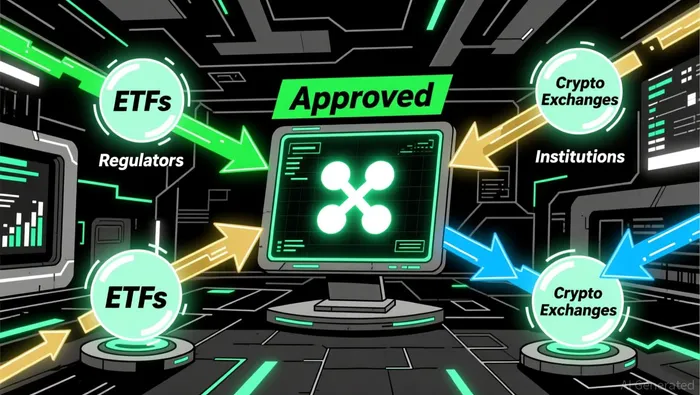
The launch of XRP ETFs in late 2025 marked a turning point in institutional adoption. Canary Capital's XRPC ETFXRPC--, for instance, attracted $58 million in first-day trading volume and exceeded $268 million in cumulative inflows within days. Similarly, Grayscale and Franklin Templeton's XRP ETFs drew significant capital, reflecting growing demand for altcoin exposure beyond Bitcoin and Ethereum. These inflows created new liquidity channels, enabling institutions to access XRP without navigating the complexities of direct token custody.
However, the price of XRP did not immediately reflect this institutional enthusiasm. Despite strong ETF inflows, XRP fell nearly 11% in the days following the ETF launch, driven by large-holder selling and broader market weakness. Analysts attribute this divergence to a lag between capital inflows and spot price adjustments, with some suggesting the effects of institutional adoption may materialize more clearly in 2026. This highlights a key challenge: while ETFs can democratize access, their price impact depends on broader market sentiment and whale activity.
Contrasting Trajectories: XRP vs. Bitcoin and Ethereum ETFs
The regulatory and adoption timelines for XRP ETFs diverge sharply from those of Bitcoin and Ethereum. Bitcoin ETFs, approved in January 2024, initially saw robust inflows but faced significant outflows in late 2025, with BlackRock's IBIT recording $3.5 billion in redemptions over four weeks. Ethereum ETFs followed a similar pattern, with $500 million in weekly outflows by November 2025. These outflows were driven by profit-taking and a "risk-off" market environment as Bitcoin's price declined over 9% in 24 hours.
In contrast, XRP ETFs have attracted consistent inflows, with $179.6 million in weekly inflows as of November 21, 2025. This divergence underscores XRP's unique position as an altcoin gaining traction in a market where Bitcoin and Ethereum ETFs are experiencing volatility. The regulatory clarity post-SEC settlement and Ripple's institutional infrastructure investments have created a more favorable environment for XRP adoption compared to the earlier, more speculative phases of Bitcoin and Ethereum ETFs.
Institutional Infrastructure and Future Outlook
Ripple's strategic acquisitions and partnerships have further solidified XRP's institutional appeal. The collaboration with Mastercard, WebBank, and Gemini to enable on-chain settlement of credit card payments via RLUSD, a regulated stablecoin, demonstrates XRP's utility in real-world applications. Additionally, Ripple Prime's tripling of activity post-acquisition highlights the growing demand for institutional-grade services like clearing and OTC trading.
Looking ahead, XRP ETFs could redefine the asset's role in both traditional finance and decentralized finance (DeFi) ecosystems. If inflows prove durable, XRP may transition from a niche altcoin to a core component of institutional portfolios. However, sustained success will depend on issuers converting short-term enthusiasm into long-term capital flows and navigating potential regulatory shifts.
Conclusion
The 2025 regulatory milestones for XRP ETFs represent a critical inflection point in the institutionalization of digital assets. While Bitcoin and Ethereum ETFs have faced volatility and outflows, XRP's regulatory clarity and institutional infrastructure have enabled a more stable adoption trajectory. As the market evolves, XRP ETFs may serve as a blueprint for how altcoins can gain mainstream acceptance, reshaping the landscape of institutional crypto investing.





Comentarios
Aún no hay comentarios