
XRP ETFs: A New Era of Institutional Demand and Liquidity Dynamics
The institutional adoption of XRPXRP-- through spot ETFs has ignited a seismic shift in the cryptocurrency market, redefining liquidity dynamics and price trajectories for the asset. As of December 2025, XRP ETFs from Grayscale, Franklin Templeton, Bitwise, and Canary have collectively attracted over $756 million in inflows within 11 days, signaling a surge in institutional confidence. This momentum is underpinned by regulatory clarity following Ripple's August 2025 SEC settlement and the rapid approval of XRP ETFs under a disclosure-based framework. The implications for XRP's market structure are profound, with liquidity, price stability, and institutional allocation converging to reshape the asset's trajectory.
Institutional Adoption and Regulatory Clarity: A Catalyst for XRP
The launch of XRP ETFs has been a watershed moment for institutional participation in the asset. Franklin Templeton's XRPZ, for instance, has leveraged fee waivers for the first $5 billion in assets to attract capital, offering a 0.2% fee structure that rivals traditional crypto products. Grayscale's XRP TrustGXRP-- (GXRP), listed on the NYSE, has further institutionalized XRP by providing a regulated vehicle for large-scale investors. These developments align with broader trends in institutional finance, where demand for compliant, yield-bearing digital assets is growing.
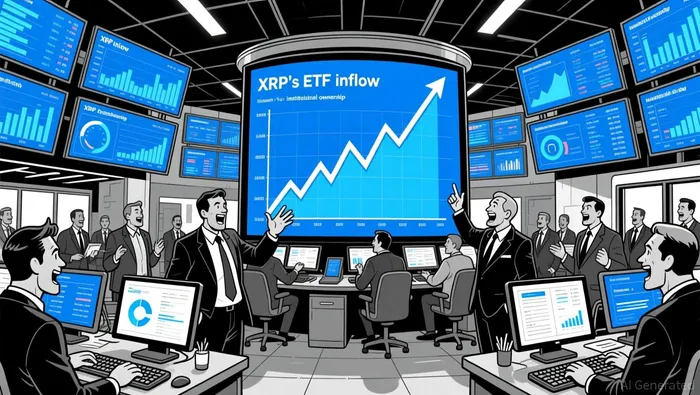
Regulatory advancements have been equally critical. The SEC's Project Crypto, led by Chairman Paul Atkins, has streamlined approvals for XRP ETFs, enabling them to list on exchanges like NYSE Arca and BATS. This clarity has alleviated prior uncertainties, allowing institutions to allocate capital with confidence. As a result, XRP's exchange-held reserves have declined by 29% over 30 days, reflecting a shift of tokens into regulated custodianship.
Liquidity Dynamics and Price Divergence
While XRP ETF inflows have surged, the asset's price has remained range-bound near $2.03, creating a divergence between institutional demand and spot price performance. This phenomenon can be attributed to several factors:
1. Token Centralization: The number of large XRP wallets holding over 100 million tokens has decreased by 20.6% in eight weeks, consolidating supply in fewer hands. This centralization raises concerns about future volatility, as a smaller group of entities now controls nearly half of the available supply.
2. Liquidity Shifting, Not Disappearing: ETFs have drawn XRP into regulated structures, reducing retail liquidity but not triggering a supply shock. Instead, liquidity appears to be migrating to institutional channels, a pattern observed historically with BitcoinBTC-- ETFs before 2025 outflows.
3. Technical Indicators: XRP is currently defending key support levels near $2, with a narrowing Bollinger Band width and a Stochastic RSI bullish crossover suggesting potential for a breakout. Analysts project that sustained inflows of $100–$150 million weekly could push XRP toward $3.50–$3.80 in 2026.
Comparative Analysis: XRP ETFs vs. Bitcoin and Ethereum
The growth of XRP ETFs contrasts sharply with the trajectories of Bitcoin and EthereumETH-- ETFs. While Bitcoin ETFs have seen over $120 billion in assets but faced recent outflows of $3.25 billion monthly, XRP ETFs are on track to surpass $1 billion in AUM within their first month. This divergence highlights XRP's unique positioning as a regulated, non-Bitcoin settlement asset.
Ethereum ETFs, meanwhile, have reached $20 billion in assets but remain secondary to Bitcoin in institutional portfolios according to PowerDrill AI. XRP's rapid adoption, however, is driven by its role in cross-border payments and its alignment with institutional-grade infrastructure. For example, Vanguard's recent decision to offer access to crypto ETFs-including XRP-has opened new capital channels, with its passive investment approach potentially injecting tens of billions into the asset class.
Macroeconomic and Structural Risks
Despite bullish fundamentals, risks persist. A sustained break below XRP's $2 support level could trigger downside volatility, particularly if macroeconomic conditions deteriorate. The Federal Reserve's hawkish stance in late 2025, for instance, exacerbated Bitcoin's price declines by triggering risk-off sentiment. XRP's price resilience will depend on its ability to absorb macro shocks while maintaining ETF inflows.
Additionally, the centralization of XRP holdings raises concerns about liquidity fragility. If large institutional wallets decide to offload tokens, it could overwhelm order books and trigger sharp sell-offs, a pattern observed during Bitcoin's 2025 liquidity crisis.
Conclusion: A Structural Shift in XRP's Market
The institutional adoption of XRP ETFs marks a structural shift in the asset's market dynamics. Regulatory clarity, fee advantages, and growing institutional demand have positioned XRP as a benchmark altcoin for diversified portfolios. While price divergence and liquidity risks remain, the asset's technical indicators and expanding institutional wallet holdings suggest a transition from speculative trading to long-term investment. As XRP ETFs approach the $1 billion AUM threshold, their impact on liquidity and price stability will become clearer. For investors, the key takeaway is that XRP's journey mirrors Bitcoin's early ETF adoption phase but with a faster regulatory and institutional timeline. The coming months will test whether this momentum can translate into sustained price appreciation, but the foundations for XRP's structural growth are firmly in place.







Comentarios
Aún no hay comentarios