
The XRP ETF Surge: A Structural Shift Outpacing BTC and ETH
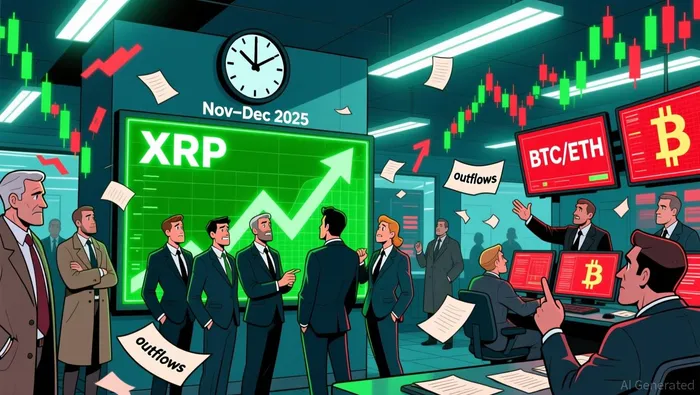
The cryptocurrency market in 2025 has witnessed a seismic shift in institutional investment patterns, with XRPXRP-- emerging as a standout performer. U.S.-listed spot XRP ETFs have attracted a staggering $975–990 million in cumulative net inflows since their launch on November 13, 2025, propelling total assets under management (AUM) to approximately $1.18 billion as of December 12. This surge is not merely a short-term anomaly but a 30-day unbroken streak of net inflows, a feat unmatched by Bitcoin (BTC) or Ethereum (ETH) ETFs, which collectively recorded over $4.65 billion in outflows during the same period. The divergence underscores a broader trend: institutional capital is increasingly favoring XRP as a regulated, utility-driven asset, signaling a structural realignment in crypto investing.
Regulatory Clarity and Institutional Confidence
The catalyst for this shift lies in regulatory normalization. Ripple's resolution with the U.S. Securities and Exchange Commission (SEC) in late 2024 removed a critical barrier to institutional participation, enabling the launch of spot XRP ETFs. This development has been pivotal in attracting capital from asset managers seeking compliance and liquidity. As noted by Bloomberg Intelligence, the legal clarity has transformed XRP from a speculative token into a "regulated, liquid exposure" asset.
Institutional confidence is further reinforced by the CMECME-- Group's expansion of XRP derivatives. In late 2025, CME launched XRP futures options, a move explicitly tied to growing institutional demand. This expansion mirrors the success of the first U.S. spot XRP ETFXRPI-- (XRPR), which reached $100 million in AUM within weeks of its debut. The CME's actions signal a maturing market infrastructure, where XRP is no longer an outlier but a core component of diversified crypto portfolios.
XRP's Utility-Driven Appeal
Unlike BTC and ETHETH--, which remain primarily speculative, XRP's value proposition is rooted in real-world utility. Ripple's cross-border payment network, xRapid, processes millions of transactions annually, leveraging XRP's speed and low cost to disrupt traditional forex markets. This utility has resonated with institutional investors, who view XRP as a "structural allocation" rather than a speculative trade according to CoinDesk.
Brad Garlinghouse, CEO of Ripple, has emphasized this point, stating that XRP is "at the center of everything Ripple does". Under his leadership, the company has expanded into custody services, stablecoin issuance (e.g., RLUSD), and regulatory partnerships, further embedding XRP into global financial systems. Notably, Ripple's conditional approval for a U.S. national trust banking charter in 2025 has bolstered its credibility, attracting institutional clients wary of regulatory risks.
Contrasting ETF Performance: A Tale of Two Markets
The contrast between XRP and BTC/ETH ETFs is stark. While XRP ETFs have defied market slumps with consistent inflows, BitcoinBTC-- and EthereumETH-- ETFs have struggled with volatility. For instance, Bitcoin ETFs recorded $3.39 billion in net outflows between November 13 and December 12, with the largest single-day outflow occurring on November 20 according to CoinDesk. Ethereum ETFs fared similarly, with $1.26 billion in outflows over the same period according to CoinDesk.
This divergence reflects evolving investor behavior. As noted by CoinDesk, capital is increasingly flowing toward tokens with "clear use cases," such as XRP's role in settlement infrastructure. Meanwhile, BTC and ETH remain subject to macroeconomic headwinds and derivatives-driven selling, which have offset ETF inflows according to Ambcrypto. XRP's price, however, has remained range-bound near $2.00–$2.20, suggesting that ETF inflows have yet to fully translate into speculative price action.
Strategic Implications for Investors
 The XRP ETF surge represents more than a market anomaly-it is a harbinger of a new era in crypto investing. Institutional adoption is no longer confined to BTC and ETH but is diversifying toward assets with regulatory clarity and utility. For investors, this trend offers two key takeaways:
1. Regulatory normalization is accelerating, with XRP serving as a test case for how compliance can unlock institutional capital.
2. Utility-driven assets are gaining traction as investors seek real-world applications over pure speculation.
As CME's XRP derivatives and Ripple's regulatory milestones demonstrate, the infrastructure for XRP's institutional adoption is firmly in place. With $1 billion in ETF inflows and a 30-day streak of net inflows, XRP has proven its ability to outpace even the most established crypto assets in terms of structural growth according to Yahoo Finance. For investors, this is not merely a crypto story-it is a glimpse into the future of regulated digital finance.





Comentarios
Aún no hay comentarios