
XRP ETF Regulatory Progress and Market Implications: Strategic Entry Points for Investors as Institutional Adoption Accelerates
Regulatory Breakthroughs and Institutional Confidence
Franklin Templeton's recent revision of its S-1 registration-shortening Section 8(a) language to limit the SEC's ability to delay approval-signals a pivotal regulatory shift, according to a Franklin Templeton S-1 revision. Similarly, Canary Funds has removed the SEC delay clause entirely from its filing, positioning its XRP ETF for automatic approval under Section 8(a) of the Securities Act of 1933, according to a Canary filing. This move could result in the ETF becoming effective as early as November 13, 2025, provided no objections are raised within 20 days, according to a CoinCentral report.
These changes reflect a broader trend of institutional players streamlining the approval process. Franklin Templeton, managing $1.5 trillion in assets, and Canary, leveraging custodians like Gemini and BitGo, are demonstrating confidence in XRP's utility and regulatory viability. Such institutional backing not only accelerates XRP's integration into traditional finance but also mitigates lingering concerns about the SEC's ongoing lawsuit against Ripple, according to CoinPedia.
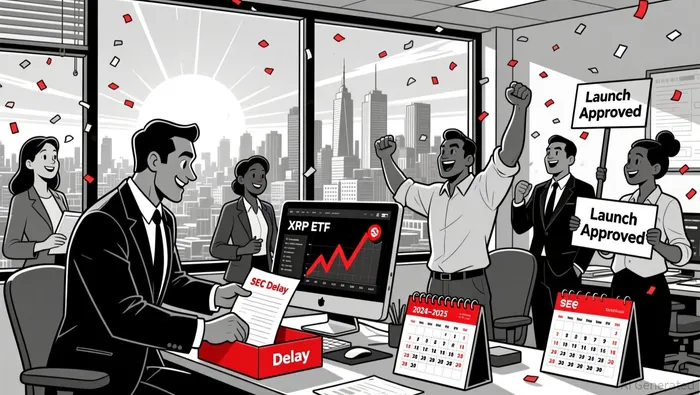
Market Implications: Price Trends and Institutional Inflows
The market is already responding to these regulatory developments. The REX-Osprey XRP ETF (BATS: XRPR) has surpassed $100 million in assets under management (AUM) within a month of its U.S. launch, outpacing international counterparts like Brazil's Hashdex XRP ETF, according to a Coinotag report. Analysts project that XRP ETFs could see prices recover to $20–$22 by early 2025 and rise to $25–$30 by 2026, driven by ETF inflows and Ripple's institutional infrastructure upgrades, according to a TradingNews analysis.
Ripple's strategic moves-such as the launch of Ripple Prime and the acquisition of Hidden Road Partners-have further enhanced liquidity for banks and asset managers, as noted by TradingNews. Meanwhile, XRP-USD is consolidating above $1.90, with price targets of $5 short-term and $8–$10 long-term if ETF inflows accelerate (TradingNews). Derivatives markets are also seeing increased participation, with CME Group reporting $27 billion in notional volume for XRP futures and options since May 2025, as reported by Coinotag.
Strategic Entry Points and Risk Mitigation
For investors, the timing of entry into XRP ETFs is critical. With the SEC's current environment-marked by a government shutdown slowing operations-firms like Bitwise and Grayscale are leveraging the regulatory vacuum to expedite launches, according to a TheCoinRise report. Bitwise's 0.34% fee and Grayscale's 0.35% fee for their XRP ETFs highlight a competitive landscape, while Ripple's acquisition of Palisade to enhance custody solutions underscores its commitment to institutional adoption, as reported by Yahoo Finance.
Historical data from BitcoinBTC-- and EthereumETH-- ETFs offers a blueprint for XRP's potential. The Bitwise SolanaSOL-- Staking ETF, for instance, attracted $55 million in Day 1 trading volume, according to a Solana ETF report, suggesting XRP ETFs could see similar, if not greater, inflows. Analysts like Nate Geraci predict XRP ETF inflows could surpass those of Solana, driven by underestimated demand for altcoin exposure (Coinotag).
Risk management strategies for XRP ETFs include hedging via futures contracts, leveraging prediction algorithms, and diversifying across stablecoins or other cryptocurrencies, as outlined in a OneSafe guide. Additionally, XRP's real-world use cases-such as cross-border payments-provide a stabilizing anchor, reducing speculative volatility (OneSafe).
Conclusion: A Tipping Point for XRP
The convergence of regulatory progress, institutional adoption, and market momentum positions XRP ETFs as a transformative force in 2025. With potential launch dates in November 2025 and projected price targets in the $5–$10 range, investors are faced with a narrow window to capitalize on this momentum. However, strategic entry requires balancing optimism with risk mitigation, particularly given the lingering uncertainties of the SEC's stance.
As the XRP ETF narrative gains traction, the coming weeks will be critical. Investors who act decisively-leveraging the insights of institutional players and historical ETF performance-may find themselves at the forefront of a new era in crypto investing.





Comentarios
Aún no hay comentarios