
XRP ETF Premium and Institutional Demand: A Structural Bull Case Amid Liquidity Shifts
The XRPXRP-- market is undergoing a seismic transformation driven by institutional adoption and technical momentum, creating a compelling near-term investment case. With record ETF inflows, a rare TD Sequential buy signal, and structural liquidity compression, XRP's price dynamics are being reshaped by forces that transcend short-term volatility.
Institutional Adoption: ETFs as a Catalyst for Structural Demand
The launch of U.S.-listed spot XRP ETFs in 2025 has catalyzed unprecedented institutional interest. Cumulative net inflows into XRP-linked ETFs reached $801.7 million in November 2025 alone, with a record $243.95 million surge on November 28. This figure dwarfs inflows into BitcoinBTC-- and EthereumETH-- ETFs during the same period, signaling a shift in institutional capital toward XRP's unique value proposition. Key players like Grayscale, Franklin Templeton, Bitwise, and Canary have collectively driven this demand, while broader market data reveals that nearly 60% of institutions diversified into altcoins like XRP due to regulatory clarity.
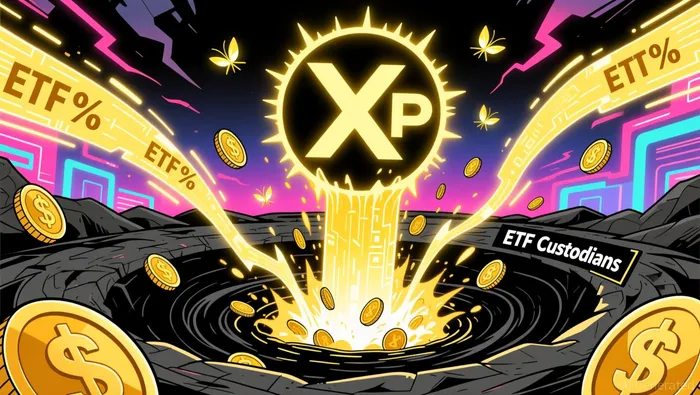
The impact of these inflows extends beyond price action. Exchange liquidity for XRP has compressed by nearly 29% as ETF custodians absorb tokens from circulation. Binance's XRP reserves, for instance, have plummeted to a 12-month low of 2.7 billion tokens, reflecting a structural supply squeeze. Analysts project that at current inflow rates, ETFs could drain 5–6 billion exchange-held XRP in 14–17 months, amplifying price sensitivity to new demand. This dynamic mirrors Bitcoin's post-ETF trajectory, where reduced liquidity amplified price reactions.
Technical Momentum: TD Sequential Buy Signal and Historical Precedents
Amid this structural shift, XRP's technical indicators are flashing bullish signals. A rare TD Sequential "9" buy signal emerged on the weekly chart in late November 2025, a pattern historically associated with trend exhaustion and relief rallies. While the price dipped 7.19% in 24 hours to $2.03, the TD Sequential signal-combined with record $4.19 billion in daily trading volume-suggests a potential stabilization phase.
Historical data underscores the signal's reliability: previous TD setups on XRP have preceded rebounds of 14–18%. Analysts like Ali (@ali_charts) note that such signals often mark short-term trend reversals, particularly in high-volatility assets. On the daily timeframe, XRP has also printed a TD Sequential buy signal, reinforcing the case for easing selling pressure.
Price structure further supports this narrative. XRP has consolidated near its three-month 20-EMA, a critical trend gauge. Maintaining support above this level is essential for the bullish case, as a close below it could trigger extended consolidation. However, the asset's behavior aligns with historical patterns, such as the 2017 euphoric run, where similar cooldowns preceded sharp rallies.
Liquidity Compression and the Path to a Breakout
The interplay between ETF-driven demand and liquidity compression is creating a self-reinforcing cycle. With 8% more XRP held in wallets containing over 10 million tokens since October, institutional accumulation is outpacing retail selling. This dynamic, coupled with reduced exchange reserves, positions XRP for a potential breakout.
Key resistance and support levels are now critical. The $2.40 resistance zone and $2.00 support level will determine whether the TD Sequential signal translates into a sustained recovery. If institutional inflows persist, XRP could target $2.60–$3.00, driven by ETF demand and a tightening tradable supply.
Conclusion: A Structural Bull Case in the Making
XRP's confluence of institutional adoption, technical momentum, and liquidity compression presents a robust bull case. While macroeconomic factors and Bitcoin's performance remain influential, the structural changes in XRP's market dynamics-driven by ETFs-are reshaping its trajectory. For investors, the current environment offers a unique opportunity to capitalize on a market in transition, where supply-side constraints and institutional demand are converging to redefine XRP's price action.






Comentarios
Aún no hay comentarios