
The XRP ETF Paradox: Why Price Stagnation Signals a Looming Supply Shock and Long-Term Institutional Value Capture
The XRPXRP-- market in 2025 presents a paradox: record institutional adoption via ETFs coexists with stubborn price stagnation and persistent selling pressure from large holders. This dissonance reveals a critical tension in structural supply dynamics-a clash between institutional demand and whale-driven distribution that could redefine XRP's trajectory in the coming year.
ETF Inflows: A New Era of Institutional Demand
The launch of U.S. spot XRP ETFs in late 2025 marked a watershed moment for institutional adoption. These funds, led by Canary Capital's XRPC, attracted over $1 billion in inflows within four weeks, with net inflows reaching $897.35 million by late December. This rapid adoption-surpassing even EthereumETH-- ETFs-was fueled by regulatory clarity following the SEC's August 2025 settlement with Ripple.
Institutional demand has structurally tightened XRP's exchange supply, reducing available balances by 45%. ETFs now hold nearly 1% of XRP's circulating supply, creating a "demand floor" as these funds absorb tokens from the float. This dynamic mirrors Bitcoin's ETF-driven supply siphoning but with a critical caveat: XRP's unique supply distribution, where the top 1% control 87.6% of the total supply, amplifies the risk of counteracting whale activity.
Whale Selling: The Unseen Headwind
While ETFs inject demand, XRP's price stagnation reflects a parallel narrative: methodical, large-scale distribution by whales. On-chain data reveals that over 1.18 billion XRP-equivalent to ~0.5% of the total supply-has been moved to exchanges like Binance in the past month. These movements, concentrated in wallets holding 100,000 to 1 million XRP, suggest a deliberate strategy to offload tokens ahead of potential price recovery.
This selling pressure has created a "supply shock" that offsets ETF-driven tightening. Unlike panic-driven dumps, whale distribution has been gradual and calculated, capping price rebounds and forcing lower highs. For instance, XRP's failure to reclaim the $1.95 resistance level-despite ETF inflows-highlights how whale activity has eroded institutional optimism. With 50% of XRP's circulating supply now in a loss position, retail and small-cap investors face a liquidity trap as whales extract value.
The Looming Supply Shock: A Battle for Market Equilibrium
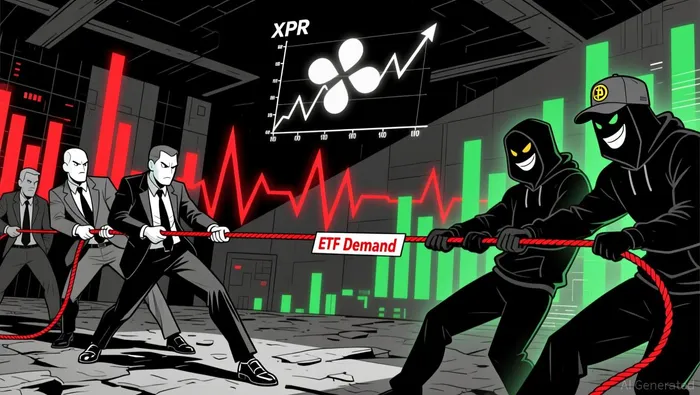
The interplay between ETF accumulation and whale selling creates a fragile equilibrium. ETFs have removed ~1% of XRP's supply from exchanges, but whale-driven inflows to exchanges have added ~0.5%, resulting in a net supply increase. This imbalance risks further price compression, with critical support levels at $1.82–$1.87 and a potential breakdown into the $1.50–$1.66 range if selling persists.
The paradox lies in the timing: ETF inflows signal long-term confidence in XRP's utility and regulatory legitimacy, while whale selling reflects short-term profit-taking amid uncertainty. This duality mirrors Bitcoin's 2022-2023 period, where ETFs initially failed to lift prices due to macroeconomic headwinds and whale distribution. However, XRP's case is more precarious due to its concentrated supply and the SEC's lingering shadow.
Long-Term Value Capture: ETFs as a Structural Anchor
Despite near-term headwinds, XRP's ETF-driven institutional adoption could catalyze a reversal in 2026. Unlike BitcoinBTC-- and Ethereum ETFs, which lost $3.2 billion in inflows during the same period, XRP ETFs have demonstrated resilience, with sustained inflows potentially tightening supply further. Analysts argue that if whale selling stabilizes, ETFs could absorb enough supply to push XRP back toward its July 2025 peak of $3.66.
This scenario hinges on two factors: macroeconomic conditions and whale behavior. If the U.S. Federal Reserve signals rate cuts or the crypto market rebounds, ETF inflows could accelerate. Meanwhile, a slowdown in whale selling-triggered by exhaustion or regulatory scrutiny-would reduce downward pressure.
Conclusion: A Market at the Crossroads
The XRP ETF paradox underscores a broader truth: institutional adoption alone cannot defy structural supply forces. While ETFs inject demand and reduce float, they must contend with a concentrated supply controlled by whales who have historically dictated XRP's price action. The coming months will test whether institutional demand can outpace distribution or if XRP will succumb to a deeper bearish cycle. For investors, the key lies in monitoring ETF inflow velocity and whale activity-a dual lens through which the next chapter of XRP's story will unfold.







Comentarios
Aún no hay comentarios