
XRP ETF Momentum and XRP Tundra: A Converging On-Ramp for Institutional and Retail Capital
Institutional Validation: A Foundation of Trust
XRP Tundra has undergone rigorous institutional validation, addressing a critical barrier for mainstream adoption. According to a Cryptopolitan report, the project has completed six independent audits by firms including Cyberscope, Solidproof, and FreshCoins, with its smart contracts verified for non-editable emission logic and fixed APY schedules. These audits confirm that administrative privileges have been renounced, and minting authority revoked, earning the project a 95% security score from both Cyberscope and Solidproof, as reported by CoinCodex.
Further, the developer team's full identity verification through Vital Block KYC underscores transparency in ownership, a key requirement for institutional participation, as noted in the Cryptopolitan report. This level of scrutiny aligns with the standards set by traditional financial institutions, which are now increasingly scrutinizing crypto projects for governance and operational integrity. With major asset managers like Franklin Templeton, Bitwise, and Grayscale filing XRP ETFs, as Cryptopolitan reports, XRP Tundra's institutional-grade framework positions it to capture a share of the inflows from these vehicles.
Cross-Chain Utility: Bridging XRP's Ecosystem and Solana's Scalability
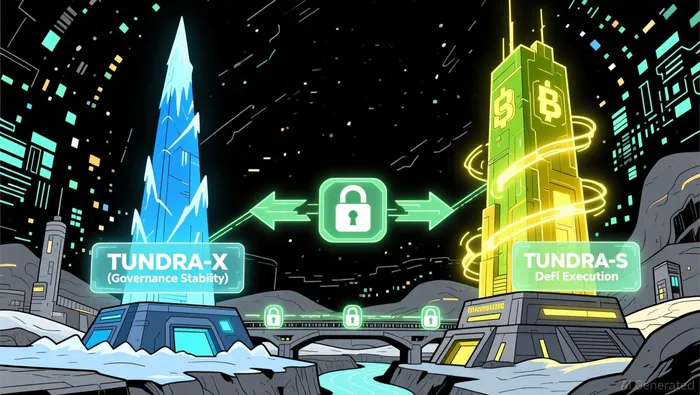
XRP Tundra's dual-chain architecture operates natively on both the XRP Ledger and SolanaSOL--, creating a hybrid model that leverages the strengths of each network. TUNDRA-X provides governance stability on the XRP Ledger, while TUNDRA-S enables high-throughput DeFi execution on Solana. This design ensures cross-chain trust without custodial risk, with both implementations independently verified, as noted in the Cryptopolitan report.
The strategic integration with XRP's ecosystem is particularly significant. As institutional capital flows into XRP via ETFs, XRP Tundra offers a mechanism to operationalize these assets through yield-generating staking functions. This dual-chain model not only mitigates volatility risks but also expands the utility of XRP beyond speculative trading, aligning with the long-term vision of institutional investors.
Verified Security: A Non-Negotiable for Institutional Onboarding
Security remains a paramount concern for institutional investors entering the crypto space. XRP Tundra's audit trail, including FreshCoins' inclusion of the project in its verified registry, provides public accessibility to audit files, further enhancing transparency, as reported by CoinCodex. The project's non-upgradeable contracts and renounced ownership eliminate the risk of governance manipulation, a critical factor in attracting risk-averse capital, as noted in the Cryptopolitan report.
These security features are particularly relevant in the context of ETF-driven inflows. As traditional asset managers seek to mitigate counterparty risks, projects with documented security protocols-like XRP Tundra-will gain preferential treatment. The 95% security scores from leading audit firms serve as a de facto endorsement, reducing due diligence costs for institutional participants, as noted in the Cryptopolitan report.
Network Compounding: A Mechanism for Sustained Value Capture
XRP Tundra's fixed APY schedules and non-editable emission logic create a predictable compounding environment for stakers, as noted in the Cryptopolitan report. This design ensures that yield generation remains uncoupled from governance interventions, fostering trust in the project's economic model. For early participants in the presale, this translates to a compounding advantage as the project scales with ETF-driven liquidity.
The presale itself represents a unique entry point. By allowing investors to lock in exposure before the ETF-driven price re-rating, XRP Tundra's tokenomics align with the principles of capital efficiency. As institutional capital flows into XRP, the dual-chain architecture and verified security of XRP Tundra will likely drive demand for its staking mechanisms, amplifying network effects.
Conclusion: Positioning for the XRP Renaissance
The convergence of XRP ETF momentum and XRP Tundra's institutional-grade infrastructure creates a compelling case for early adoption. With six independent audits, cross-chain utility, and network compounding mechanisms, XRP Tundra addresses the key pain points of institutional onboarding while offering retail investors a structured entry point. As the XRP ecosystem prepares for mainstream integration, XRP Tundra's presale represents a rare opportunity to position capital ahead of a potential re-rating driven by ETF approvals and institutional inflows.






Comentarios
Aún no hay comentarios