
The XRP ETF Launch: A New Era of Institutional Adoption and Liquidity?
Regulatory Breakthroughs and the XRP ETF's Roadmap
The Canary XRP ETF's regulatory journey has been a masterclass in navigating the SEC's evolving framework. On October 10, 2025, the firm filed an amended S-1/A, removing a delaying amendment and setting the stage for automatic effectiveness on November 13, pending Nasdaq's approval of the Form 8-A, according to Blockonomi. This move underscores the growing clarity in crypto ETF regulations, a trend accelerated by recent legal victories for Ripple and the SEC's new generic listing standards, as noted by CoinoTag. Unlike existing XRP ETFs, which operate under the 1940 Act and hold indirect exposure, the Canary ETF will offer direct token ownership, a critical differentiator for liquidity and institutional adoption, according to CryptoBriefing.
Gemini and BitGo's role as custodians further bolsters confidence. These regulated entities provide institutional-grade security, addressing a key barrier to entry for traditional investors. As reported by Bitcoin.com, the ETF's structure-issuing shares in blocks of 10,000-ensures scalability and aligns with the operational needs of large institutional players.
Parallels to Solana's ETF Success and Market Dynamics
The Bitwise Solana ETF's debut on October 28, 2025, offers a compelling case study. The product attracted $69.5 million in first-day inflows, the highest of any ETF launched in 2025, according to CoinoTag. This success was driven by Solana's high-performance blockchain infrastructure and its 7% staking yield, which outperformed alternatives like the Rex-Osprey Solana Staking ETF, as CoinoTag noted. Analysts speculate that a similar trajectory awaits the XRP ETF, particularly given XRP's 27.2% price surge in Q3 2025 and its $170.3 billion market cap, observed by CoinoTag.
What sets XRP apart is its embedded compliance tools, such as Multi-Purpose Tokens (MPTs) and permissioned domains, which cater to regulated investors, as CoinEdition reported. These features, combined with XRP's role in cross-border payments, position it as a utility-driven asset rather than a speculative one. For instance, Evernorth, a treasury management firm, recently announced plans to include XRP in its reserve portfolio to optimize cross-border liquidity, according to ZyCrypto. This shift reflects a broader institutional recognition of XRP's practical value in global finance.
Cross-Border Payments and the XRP ETF's Structural Impact
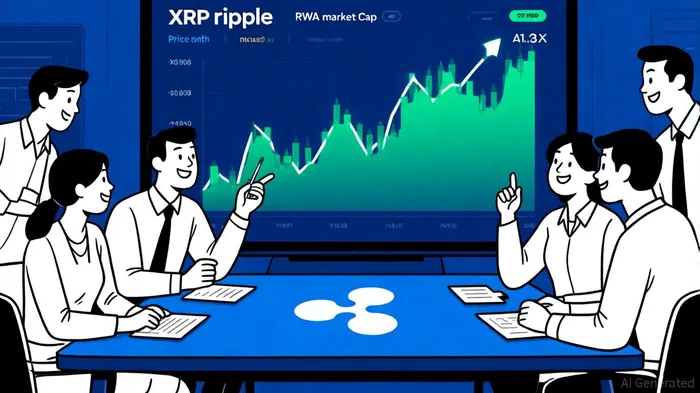
The XRP ETF's launch is not just a product of regulatory progress-it's a catalyst for institutional adoption in cross-border payments. Traditional financial institutions are increasingly treating XRP as a balance-sheet asset, leveraging its near-instant settlement capabilities to reduce costs and counterparty risk. For example, the XRP Ledger's tokenized real-world assets (RWA) market cap surged 215% in Q3 2025, driven by projects like Ondo's OUSG treasury fund and Guggenheim's Digital Commercial Paper, as reported by CoinoTag. This growth is amplified by the REX-Osprey XRP ETF's $100 million AUM milestone, which demonstrates demand for compliant exposure to XRP's utility, according to Blockonomi.
Moreover, CME Group's XRP futures and options-recording $27 billion in notional volume since May 2025-highlight the growing sophistication of institutional trading strategies, as CoinoTag documented. These derivatives, combined with the Canary ETF's direct token exposure, create a robust ecosystem for hedging and liquidity management. As noted by U.Today, this infrastructure is critical for institutional investors seeking to balance risk and reward in a volatile market.
Investor Strategy: Positioning for the XRP ETF Era
For investors, the XRP ETF's launch represents a strategic inflection point. The product's potential to attract inflows exceeding those of the Solana ETF-projected at $217.2 million in AUM-cannot be ignored, according to CoinoTag. However, the focus should extend beyond price speculation. XRP's role in cross-border payments and RWA tokenization offers a unique value proposition, particularly for investors seeking exposure to blockchain's real-world applications.
The key is to differentiate between speculative altcoins and assets with institutional-grade utility. XRP's compliance tools, regulatory progress, and corporate adoption (e.g., Evernorth) suggest it is the latter. As Nate Geraci, a crypto analyst, argues, an XRP ETF could outperform Solana's in terms of inflows due to its underestimated demand and broader market cap growth, per CoinoTag.
Conclusion
The Canary XRP ETF is more than a product-it's a harbinger of a new era. By bridging the gap between institutional compliance and blockchain innovation, it accelerates the integration of digital assets into traditional finance. For investors, the message is clear: the future of finance is not a binary choice between crypto and traditional markets but a convergence of both. As XRP's price and utility continue to rise, the XRP ETF will serve as a gateway for institutions to participate in this transformation, reshaping liquidity, adoption, and investor strategy in the process.





Comentarios
Aún no hay comentarios