
XRP ETF Inflows vs. Price Disconnection: Is Institutional Demand Setting Up a 2026 Bull Case?
The XRPXRP-- market in late 2025 presents a paradox: record institutional demand via ETFs coexists with a price that has fallen nearly 50% from its 2025 peak. U.S. spot XRP ETFs have absorbed $1.1–1.2 billion in net inflows since their November 2025 launch, with over 30 consecutive days of inflows without a single day of outflows. Yet XRP trades near $1.85, failing to break above $2.00 despite this structural buying pressure. This dislocation between institutional demand and price action raises a critical question: Is the current weakness in XRP a buying opportunity for 2026, or a warning sign of deeper structural challenges?
Institutional Buying Mechanisms: ETFs as a Supply-Compression Engine
The rise of XRP ETFs has fundamentally altered the token's market dynamics. These funds operate via a creation/redemption model, where net inflows translate into physical XRP custody, effectively removing tokens from circulation. For example, cumulative inflows of $1.3 billion in 50 days have locked 746 million XRP into ETF custody-1.14% of the circulating supply. This process tightens liquidity, as exchange balances have shrunk by 45% since July 2025, from 3.9 billion to 1.6 billion tokens.
Institutional investors favor ETFs for their compliance-ready custody solutions. Platforms like Coinbase Custody store XRP in cold storage, ensuring institutional-grade security and regulatory alignment. This structural shift reduces the token's availability for speculative trading, creating a "buy pressure floor" as ETFs absorb supply. However, the T+1 settlement cycle complicates price alignment: ETFs settle trades one business day after execution, creating a lag between capital inflows and spot price adjustments. This delay allows short-term volatility to persist even as long-term demand grows.
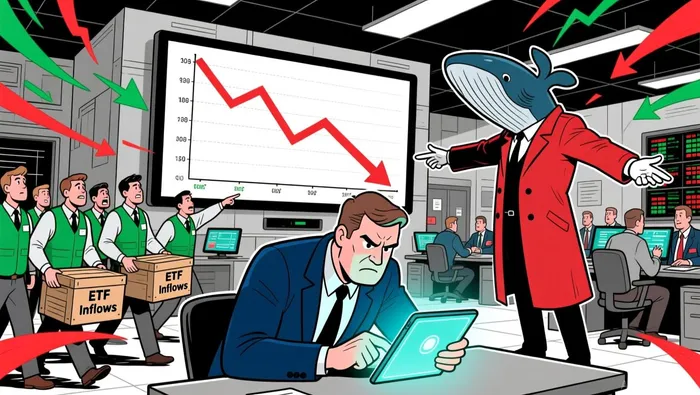
Price Dislocation: The Battle Between ETF Buyers and Whale Sellers
The current price stagnation reflects a tug-of-war between ETF-driven demand and aggressive selling from large holders. On-chain data reveals that whale wallets (holding >100,000 XRP) have offloaded $721 million worth of tokens since Q3 2025. This selling pressure has offset ETF inflows, capping upward price attempts and keeping XRP in a descending channel. Meanwhile, macroeconomic headwinds-such as rising interest rates and risk-off sentiment-have amplified this dislocation.
A key factor is the divergence between ETF inflows and spot liquidity. As billions of XRP move into custodial wallets, on-exchange liquidity has thinned, making the price more sensitive to smaller trades. This dynamic is exacerbated by arbitrage strategies: institutions exploit the price gap between ETFs and futures markets, with XRP futures showing annualized basis readings of 50% in July 2025. While these strategies enhance market efficiency, they also create short-term volatility that masks the ETF-driven supply contraction.
The 2026 Bull Case: Can Institutional Demand Overcome Resistance?
Despite the near-term challenges, the structural case for XRP remains compelling. Standard Chartered projects XRP could reach $8 by late 2026 if ETF inflows hit $10 billion, absorbing 4–5 billion tokens and tightening supply further. This scenario hinges on two critical factors:
Sustained ETF Momentum: Current inflows suggest a path to $10 billion by late 2026. Four XRP ETFs (e.g., Canary Capital's XRPC, Franklin Templeton's EZRP) have collectively attracted $756 million in 11 consecutive sessions. If this pace continues, ETFs could absorb 10% of the circulating supply, creating a powerful tailwind for price discovery.
Macroeconomic Tailwinds: A reversal in risk-off sentiment and lower interest rates could amplify ETF demand. Institutions are increasingly adopting structured yield strategies (e.g., SolStaking's fixed-term contracts) to generate income from XRP holdings. These products reduce reliance on price appreciation, making XRP a more attractive long-term asset for pension funds and insurance firms.
However, the $2.00 resistance level remains a psychological and technical hurdle. Breaking above this would require not only sustained inflows but also a reduction in whale selling. Early 2026 could be pivotal: If ETFs outpace selling pressure and macroeconomic conditions improve, XRP could enter a new phase of accumulation, setting the stage for a multi-month rally.
Conclusion: A Dislocated Market, but a Strong Foundation
The current price dislocation in XRP reflects the clash between institutional demand and short-term selling dynamics. While macroeconomic headwinds and whale activity have dampened price action, the structural shift toward ETF-driven supply compression is undeniable. For investors, the key question is whether this dislocation is temporary or a sign of deeper fragility.
The data suggests the former. ETF inflows have created a durable floor for XRP, while real-world utility (e.g., Ripple's settlement platform) adds a layer of fundamental support. If 2026 brings macroeconomic normalization and a reduction in whale selling, the stage is set for a price re-rating. For now, the market remains in a holding pattern-but the long-term bull case is alive.






Comentarios
Aún no hay comentarios