
XRP ETF Inflows and Institutional Adoption: A Catalyst for Price Trajectory?
Institutional Adoption: Mechanics and Market Implications
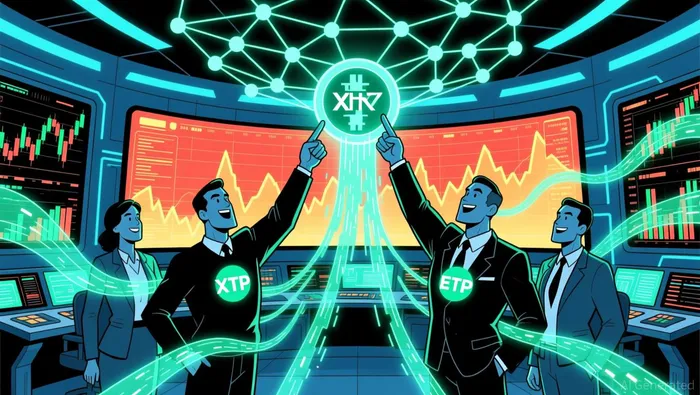
The XRPC ETF operates on a straightforward yet powerful premise: it allows traditional investors to gain exposure to XRP through regulated brokerage accounts, backed by physical token holdings. This structure necessitates custodians to acquire and store XRP to fulfill redemption requests, effectively creating a perpetual demand stream. Unlike retail-driven markets, where sentiment and speculation often dominate, institutional adoption introduces a layer of stability and legitimacy.
Data from CoinGlass underscores this shift: while retail futures Open Interest in XRP has dipped to $3.95 billion from a peak of $8.36 billion in early October, institutional inflows are now outpacing retail activity. This divergence highlights a critical market mechanic-ETFs act as intermediaries, aggregating demand from diverse investors while ensuring compliance with regulatory frameworks. For XRP, this means a transition from speculative trading to a more mature, capital-backed market structure.
Price Trajectory: Historical Parallels and Projections
Analysts are drawing parallels between XRP's ETF-driven adoption and Bitcoin's post-ETF surge. Bitcoin's spot ETFs catalyzed a $1.76 trillion market capitalization increase in early 2024. While Ethereum's response to ETFs has been more muted, XRP's unique supply dynamics may amplify its price sensitivity.
Zach Rector, a prominent finance commentator, posits that XRP could reach $10.70 per token by 2027 under a scenario of steady ETF inflows. In a bullish case, he envisions a $1 trillion market cap, translating to prices between $19 and $20. These projections hinge on the assumption that ETFs will aggressively acquire XRP, depleting the limited retail supply of less than 1.9 billion tokens. As institutions compete for available liquidity, the price could rise sharply to incentivize retail holders to sell, creating a self-fulfilling cycle of demand and scarcity.
Risks and Realities
Despite the optimism, several risks temper the bullish outlook. First, ETF inflows are not guaranteed to continue at current rates. Regulatory scrutiny, macroeconomic shifts, or market saturation could slow adoption. Second, XRP's price is inherently tied to broader crypto market sentiment. A downturn in BitcoinBTC-- or EthereumETH-- could spill over, dampening XRP's gains. Finally, the asset's historical volatility remains a wildcard-while ETFs add stability, they cannot entirely insulate XRP from systemic shocks.
Conclusion: A New Era for XRP?
The Canary XRP ETFXRPC-- represents more than a product launch-it signals a structural evolution in how institutional capital interacts with digital assets. By creating a regulated, scalable pathway for investment, the ETF has positioned XRP to benefit from the same capital flows that have propelled Bitcoin and gold. However, the path to $10 or $20 per token is contingent on sustained institutional demand and favorable market conditions. For investors, the key takeaway is clear: XRP's price trajectory is no longer dictated solely by retail speculation but by the mechanics of institutional adoption.





Comentarios
Aún no hay comentarios