
XRP ETF-Driven Institutional Adoption and the Tundra Protocol: A Liquidity-Led Valuation Revolution
The ETF Catalyst: A New Era for XRP Liquidity
The approval of spot XRP ETFs by firms like 21Shares, Bitwise, and Franklin Templeton marks a watershed moment. According to a Bloomberg report, these ETFs are expected to unlock $10 billion in institutional capital within the first month of trading, creating a liquidity crunch as ETFs purchase XRP directly from exchanges or via over-the-counter (OTC) channels. This dynamic mirrors the BitcoinBTC-- ETF rollout of 2024, where institutional demand outpaced supply, driving prices higher while tightening market liquidity.
The implications are clear: XRP's price is no longer dictated solely by retail speculation but by institutional demand for regulated exposure. As analysts at Zycrypto note, this influx could push XRP to $47 if liquidity constraints persist. However, the true value creation lies beyond price-it's in the infrastructure that supports this new capital flow.
XRP Tundra: Revenue-Backed Staking and Protocol Growth
XRP Tundra, a dual-chain DeFi platform launched on the XRP Ledger (XRPL) and SolanaSOL--, is uniquely positioned to benefit from this liquidity surge. Unlike traditional staking models reliant on token inflation, Tundra generates yield from protocol usage fees-swaps, lending, derivatives, and cross-chain bridges according to analytics. This revenue-backed approach aligns with institutional preferences for transparency and predictability, as highlighted by CoinPedia analysts.
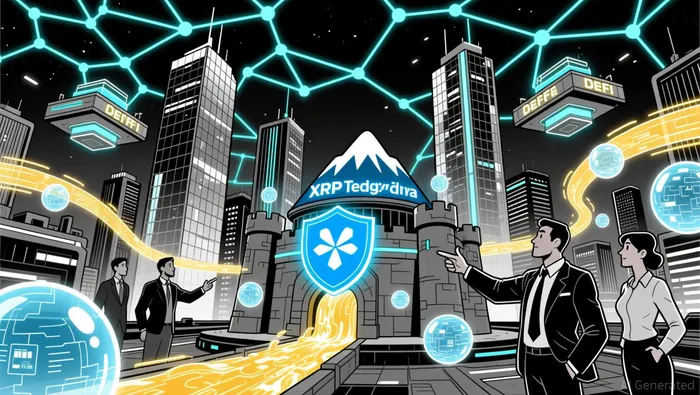
Key metrics underscore Tundra's institutional appeal:
- APY Tiers: Liquid Staking (4–6%), Balanced Staking (8–12%), and Premium Staking (15–20%) cater to diverse risk appetites according to CoinPedia.
- Institutional Backing: A major institution has already acquired early positions, accelerating Tundra's launch and locking in pricing structures to manage liquidity.
- Compliance Infrastructure: Audits by Cyberscope, Solidproof, and FreshCoins ensure alignment with institutional standards according to CoinPedia.
Liquidity-Driven Valuation: The Tundra Model
The valuation of XRP Tundra is inextricably tied to XRPL settlement volume, which has surged due to ETF-driven demand. As institutional capital flows into XRP ETFs, settlement activity on the XRPL expands, directly boosting Tundra's fee-based revenue. CoinCentral analysts note that this creates a flywheel effect: higher settlement volume → increased protocol fees → higher staking rewards → greater institutional participation.
Moreover, Tundra's dual-chain architecture-governance on XRPL and execution on Solana-addresses scalability and throughput concerns, critical for institutional-grade operations. This design, combined with non-inflationary staking mechanics, positions Tundra to capture a significant share of the ETF-driven liquidity. As highlighted by Cryptopolitan, the platform's final retail pricing window at $0.01 represents a last opportunity for discounted access before institutional pricing defines its post-launch valuation.
The Mispricing Opportunity
Despite the clear tailwinds, the market underestimates Tundra's role in XRP's next cycle. Traditional investors remain fixated on short-term price volatility, while overlooking the value of revenue-backed yield and cross-chain utility. As CoinPedia emphasizes, protocols like Tundra introduce governance mechanisms and TVL growth absent in earlier XRP cycles, creating a mispricing that could be exploited by forward-looking investors.
Conclusion: A New Paradigm for XRP
The XRP ETF approvals are not just a regulatory victory-they're a catalyst for institutional adoption and protocol innovation. XRP Tundra exemplifies this shift, leveraging ETF-driven liquidity to build a sustainable, revenue-backed staking model. As settlement volume and institutional participation rise, Tundra's valuation trajectory will be defined by its ability to transform XRP from a speculative asset into a foundational infrastructure layer.
For investors, the message is clear: the next chapter of XRP's story is being written by protocols like Tundra, where liquidity meets yield, and speculation gives way to structure.






Comentarios
Aún no hay comentarios