
XRP's ETF-Driven Bull Case: Why Institutional Onboarding and Regulatory Shifts Make XRP a 2026 Outperformer
In 2026, XRPXRP-- stands at a pivotal inflection point, driven by a confluence of regulatory clarity, institutional adoption, and macroeconomic tailwinds. As the crypto market matures, XRP's unique positioning as a utility-driven asset with growing institutional infrastructure has created a compelling bull case. This analysis explores how ETF inflows, reduced exchange supply, and Ripple's expanding banking network are converging to position XRP as a potential outperformer in the coming year.
Regulatory Clarity: A Catalyst for Institutional Participation
The August 2025 U.S. Securities and Exchange Commission (SEC) resolution marked a watershed moment for XRP. By classifying XRP as a non-security in programmatic transactions, the ruling removed a critical legal barrier for institutions, enabling broader adoption of the asset. This clarity catalyzed immediate action: Ripple's RLUSD stablecoin, a multi-chain solution, surged to a $1.3 billion market cap by January 2026, signaling confidence in XRP's utility beyond speculative trading.
Regulatory developments extended beyond the U.S. Ripple's partnership with SBI in Japan to introduce RLUSD under the country's new stablecoin framework exemplifies how XRP is gaining traction in Asia-Pacific markets. These moves align with the Trump administration's pro-crypto stance and the anticipated CLARITY Act, which aims to normalize digital assets in traditional finance. Such legislative progress reduces institutional risk, making XRP an attractive addition to diversified portfolios.
Institutional Adoption: ETFs and Real-World Utility
The most striking evidence of XRP's institutional appeal lies in its ETF performance. By late 2025, XRP ETFs absorbed $1.3 billion in just 50 days, with 43 consecutive positive inflows. This momentum accelerated in December 2025, when XRP ETFs took in $483 million despite a 15% price drop, contrasting sharply with outflows in BitcoinBTC-- and EthereumETH-- ETFs. Analysts attribute this resilience to XRP's dual role as a speculative asset and a utility token underpinning cross-border payments and real-world asset (RWA) tokenization.
Ripple's XRP Ledger (XRPL) saw a 2,200% surge in RWA tokenization in 2025, growing from $24.7 million to $567.9 million by year-end. Institutions like Archax and abrdn have tokenized substantial assets on XRPL, leveraging its compliance framework and scalability. Meanwhile, Ripple's On-Demand Liquidity (ODL) service has demonstrated real-world utility, enabling instant, low-cost international transactions for banks such as SBI Remit, CIBC, and Santander. These use cases reinforce XRP's value proposition beyond price speculation.
Supply Dynamics: Tightening Exchange Reserves and Controlled Emissions
XRP's supply fundamentals have also shifted in favor of bulls. By December 2025, exchange reserves hit an 8-year low, dropping from 4 billion to 1.6–1.7 billion tokens. This decline, particularly pronounced on Korean exchanges like Upbit and Bithumb, mirrors patterns observed before previous price rallies. While historical precedents caution against assuming direct price correlations, the reduced supply creates a more favorable environment for institutional accumulation.
Ripple's controlled release of tokens further supports this narrative. In January 2026, the company released 1 billion XRP from escrow, but only 200–300 million entered circulation due to routine relocking of 60–80%. This disciplined approach limits market dilution, aligning with institutional demand for stable, predictable supply dynamics.
Macro-Driven Demand: A New Era for XRP
The broader macroeconomic context strengthens XRP's bull case. The CLARITY Act, expected to pass in 2026, will provide a regulatory framework for digital assets, reducing uncertainty for institutional investors. Additionally, Ripple's global banking partnerships-such as its collaboration with SBI to expand RLUSD in Japan- highlight XRP's potential to scale beyond niche markets.
Institutional demand is further supported by XRP's inclusion in conservative investment strategies. Major asset managers like Franklin Templeton and Grayscale have normalized XRP's role in portfolios, treating it as a strategic hedge against macroeconomic volatility. This shift reflects a growing recognition of XRP's utility in cross-border payments and enterprise solutions, which are less correlated with crypto market cycles.
Price Projections and Technical Considerations
While fundamentals are robust, XRP's price action remains constrained by technical resistance. As of early 2026, the asset struggles to break above $2.00, a level that has historically acted as a psychological barrier. However, AI-driven price predictions suggest a potential range of $3.00–$6.50 by year-end, driven by ETF inflows and regulatory tailwinds. Analysts like Geoffrey Kendrick of Standard Chartered project XRP reaching $8 by 2026, citing its expanding utility in cross-border payments.
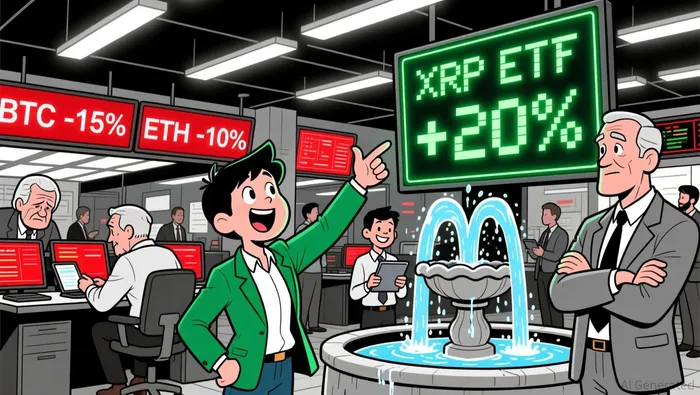
The disconnect between XRP's price and underlying network activity-such as rising RWA tokenization and stablecoin capitalization-suggests that ETF inflows are stabilizing the asset. This divergence indicates that institutional demand is beginning to outweigh retail selling pressure, a trend that could accelerate as macroeconomic conditions improve.
Conclusion: A Compelling Bull Case for 2026
XRP's 2026 bull case is underpinned by a unique convergence of regulatory clarity, institutional adoption, and supply-side dynamics. The SEC's August 2025 resolution, coupled with the CLARITY Act and global regulatory progress, has created a favorable environment for XRP to transition from speculative asset to foundational infrastructure. Meanwhile, ETF inflows and controlled supply reductions are reinforcing demand, while Ripple's expanding banking network is demonstrating real-world utility.
For investors, the key question is not whether XRP can break above $2.00, but whether the broader macroeconomic and institutional trends will continue to drive adoption. With $1.4 billion in XRP ETF inflows by early 2026 and a growing ecosystem of institutional partners, XRP is well-positioned to outperform in a market increasingly focused on utility and regulatory alignment.






Comentarios
Aún no hay comentarios