
Is XRP Entering a Bear Market or Just a Correction?
Technical Bearishness: Death Cross and Liquidity Deterioration
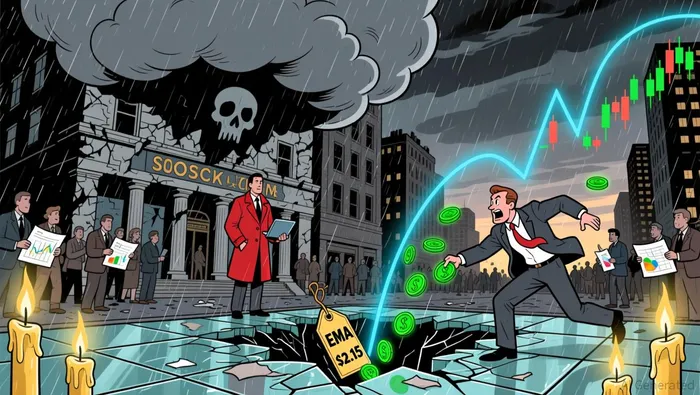
XRP's recent breakdown below the critical $2.15 support level has intensified bearish sentiment. The token's price fell 3.6% to $2.13 amid a 76% surge in trading volume, signaling heavy institutional selling. This move coincided with Bitcoin's death cross-a technical event where the 50-day EMA crosses below the 200-day EMA- further amplifying risk-off flows across crypto markets.
Liquidity profiles also paint a mixed picture. While XRP has traded in a $1.90–$3.40 range for the past quarter according to recent analysis, the futures Open Interest (OI) has collapsed from $10.94 billion in July to an average of $3.61 billion according to data. This decline reflects weak derivatives demand and a lack of conviction among traders, who are hesitant to bet on a short-term rebound. A decisive break above $3.40 could reignite bullish momentum, but current on-chain data suggests the market is in a consolidation phase.
Fundamental Resilience: ETF Inflows and Structural Support
Contrasting the technical bearishness, XRP's fundamental narrative has gained strength. The launch of the Canary XRP ETF on Nasdaq drew $138 million in inflows on its first day, with additional ETFs like XRPC adding $128 million over four days. These inflows signal growing institutional adoption, particularly as XRP's liquidity profile aligns with Basel III requirements for Tier 1 assets. Analysts argue that XRP's instant global liquidity and neutrality make it a digital analog to gold in interbank operations.
Structural support levels also remain intact. Despite the recent drop to $2.14, XRP is still trading above a reclaimed multi-year resistance level that now functions as a key support zone. Crypto analyst Will Taylor emphasizes that this level has held for over a year, calling it "almost unprecedented for XRP and for any asset." He argues that as long as this support remains intact, a bear market cannot be confirmed.
Analyst Perspectives: Taylor's Bullish Case vs. Master's Bearish Outlook
Will Taylor's analysis underscores XRP's relative strength compared to BitcoinBTC-- and EthereumETH--. The token has broken out of a downtrend in dominance metrics and is near the lower end of its established range, where historical risk-reward ratios favor buyers. Taylor also highlights the liquidity map, which shows a dense concentration of resting orders above $4.20–$4.30. This distribution, he argues, statistically increases the likelihood of a rebound toward higher price levels.
Conversely, bearish analyst Master paints a grim picture. XRP's confirmed death cross and broader market weakness have triggered a 54% downside risk, with projections as low as $1.00. He attributes the decline to macroeconomic headwinds, whale selling, and the inability of ETF inflows to offset selling pressure. This view aligns with the technical breakdown below $2.20, which invalidated a key support level and deepened bearish momentum.
Evaluating the Outlook: Correction or Bear Market?
The clash between technical and fundamental analyses reveals a nuanced picture. On one hand, the death cross, declining OI, and ETF outflows suggest a bearish correction. On the other, ETF inflows, structural support, and liquidity profiles indicate a resilient asset with long-term upside potential.
A critical factor will be whether XRP can reclaim the $2.15–$2.30 support zone. A successful defense here would validate Taylor's bullish thesis, while a breakdown below $2.00 could accelerate Master's bearish scenario. Meanwhile, the expansion of the XRP ETF ecosystem-projected to attract $4–8 billion in first-year inflows-suggests that institutional demand remains a tailwind, even amid short-term volatility.
Conclusion
XRP's current trajectory reflects a tug-of-war between technical bearishness and fundamental resilience. While the death cross and liquidity deterioration signal a correction, ETF inflows and structural support levels hint at a longer-term bullish narrative. Investors must weigh these factors carefully: a sustained breakdown below $2.00 would likely confirm a bear market, but a rebound above $2.30 could reignite optimism. As Will Taylor notes, the market is not yet in a bear phase-until the structural support collapses, the case for a correction remains compelling.






Comentarios
Aún no hay comentarios