
Why XRP is Emerging as the Strategic Asset in a Downturn: A Deep Dive into ETF Inflows and Institutional Positioning
In the shadow of a broader market slump in 2025, XRPXRP-- has quietly carved out a unique position as a strategic asset for institutional investors. While BitcoinBTC-- and EthereumETH-- grappled with regulatory uncertainty and outflows, XRP's spot ETFs attracted over $1.25 billion in assets under management, driven by a combination of regulatory clarity, utility-driven demand, and smart money positioning. This divergence in institutional behavior raises critical questions about how capital is reallocating in a crypto winter-and why XRP, despite a 13% annual price decline, is becoming a focal point for long-term positioning.
The ETF Inflow Paradox: Capital Accumulation vs. Price Stagnation
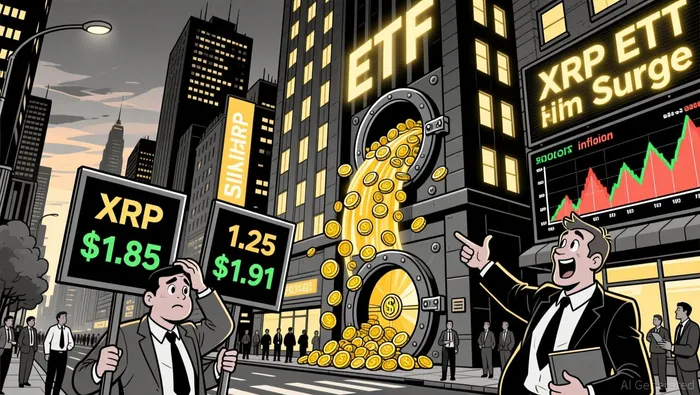
XRP's ETF inflows in 2025 tell a story of institutional confidence decoupled from immediate price action. According to a report by Coindesk, XRP ETF net assets surpassed $1.25 billion by December 2025, with $43.89 million in inflows recorded over two weeks-the strongest stretch since their launch. This momentum was fueled by the resolution of the SEC's lawsuit against Ripple in August 2025, which provided much-needed regulatory clarity. Yet, despite these inflows, XRP's price remained range-bound between $1.85 and $1.91, with selling pressure near $1.90 and buying interest around $1.86.
The disconnect between capital inflows and price action can be attributed to two factors. First, early investors and whales capitalized on ETF-driven liquidity to exit large positions, realizing gains and offsetting institutional accumulation. Second, macroeconomic headwinds-such as U.S. tariff announcements and rising interest rate volatility spewed risk-averse behavior across crypto markets. This dynamic highlights a key insight: institutional demand for XRP is less about short-term speculation and more about long-term strategic positioning.
Capital Rotation: From Bitcoin and Ethereum to XRP
The institutional shift toward XRP contrasts sharply with the outflows observed in Bitcoin and Ethereum ETFs. Data from Yellow.com reveals that Bitcoin ETPs lost $629 million in December 2025, while Ethereum ETFs saw $512 million in redemptions, driven by year-end profit-taking and regulatory ambiguity. Meanwhile, XRP ETFs recorded 28 consecutive days of inflows, accumulating $1.14 billion in assets under management.
This rotation reflects a broader trend of institutional selectivity. Bitcoin and Ethereum, though foundational to the crypto ecosystem, faced valuation challenges and regulatory timelines that created uncertainty. For example, Bitcoin's NVT Golden Cross suggested undervaluation relative to network activity, while Ethereum's institutional withdrawals from exchanges signaled supply tightening. In contrast, XRP's utility in cross-border payments and its reduced custody and compliance risks made it an attractive alternative for institutions seeking regulated, functional assets.
Smart Money Positioning: Institutional Allocations and On-Chain Signals
The role of smart money in XRP's institutional ascent is evident in both portfolio allocations and on-chain activity. Asset managers like Franklin Templeton, Grayscale, and Bitwise were instrumental in driving adoption through newly approved spot XRP ETFs. These products reduced exchange-based XRP supply by 45%, signaling a shift from speculative trading to institutional-grade asset management.
On-chain data further underscores this trend. One wallet alone realized $721 million in gains during XRP's 2025 rally, illustrating how liquidity was used to exit positions rather than sustain price momentum. This activity, however, did not deter institutional buyers. Instead, it highlighted the depth of XRP's market structure, where large-scale exits coexisted with steady accumulation.
Macroeconomic Drivers: Risk Aversion and Regulatory Clarity
The macroeconomic context of 2025 amplified institutional demand for XRP. Rising interest rates and geopolitical tensions-such as U.S. tariff announcements-spurred risk-averse behavior, pushing capital toward assets with clear regulatory frameworks. XRP's post-SEC victory status positioned it as a "safe haven" within crypto, particularly for institutions wary of the legal gray areas surrounding other tokens.
Moreover, XRP's role in cross-border payments provided a tangible use case that resonated with institutional investors. Unlike Bitcoin and Ethereum, which face scalability and regulatory hurdles in financial infrastructure, XRP's real-world adoption by banks and payment providers offered a compelling narrative of utility-driven value. This differentiation became critical in a downturn, where assets with clear economic functions outperformed speculative narratives.
Conclusion: A New Paradigm for Institutional Crypto Allocation
XRP's 2025 performance underscores a paradigm shift in institutional crypto investing. While price stagnation might suggest underperformance, the sustained ETF inflows, regulatory clarity, and smart money positioning paint a different picture: XRP is emerging as a strategic asset for institutions seeking regulated, utility-driven exposure in a volatile market. As macroeconomic headwinds persist and regulatory frameworks evolve, the lessons from XRP's institutional adoption may redefine how capital allocates risk in the crypto space.






Comentarios
Aún no hay comentarios