
XRP's Emerging Market Structure: A 'Purer' Indicator of Institutional Interest in Crypto
In 2025, XRPXRP-- has emerged as a compelling case study in the crypto market's evolving institutional dynamics. Unlike BitcoinBTC-- and EthereumETH--, which dominate headlines for speculative demand and macroeconomic hedging, XRP's institutional adoption is rooted in its utility-driven infrastructure and regulatory clarity. This unique positioning has made XRP a "purer" indicator of institutional interest-a currency where on-chain activity directly correlates with real-world financial infrastructure adoption, rather than abstract sentiment or speculative fervor.
Institutional Adoption: From Payments to ETFs
XRP's institutional narrative is anchored in its role as a cross-border payment solution. Ripple's On-Demand Liquidity (ODL) service processed $1.3 trillion in transactions in Q2 2025 alone, with Santander reporting a 40% surge in payment volumes via XRP in key corridors like Europe to Latin America [4]. This utility is further amplified by Ripple's RLUSD stablecoin, now integrated into tokenized funds like BlackRock's BUIDL and VanEck's VBLL, creating a flywheel of institutional demand [5].
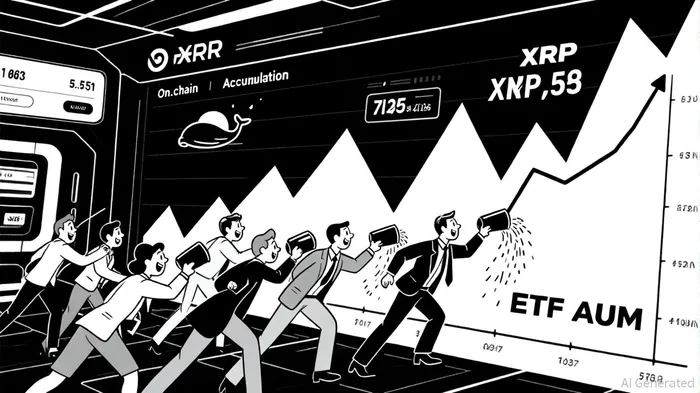
The regulatory landscape has also shifted dramatically. The U.S. court's 2025 ruling reclassifying XRP as a commodity unlocked $1.2 billion in ETF inflows during Q3 2025, with products like the REX-Osprey XRPR ETF reaching $33.57 million in assets under management within days of its launch [1]. By October 2025, institutional inflows hit $210 million, while over 439 million XRP (worth $1.2 billion) were moved to cold storage, signaling long-term commitment [3].
Technical Patterns: A Breakout on the Horizon
From a technical perspective, XRP's price action in 2025 has formed textbook bullish patterns. The ascending triangle and bull-flag formations suggest a potential breakout above the $3.65 resistance level-a threshold that, if cleared, could propel XRP toward $4–$8 [1]. On-chain data reinforces this narrative: tightening price compression and sustained whale accumulation (large holders controlling 60% of circulating supply) are often precursors to sharp price expansions [5]. Historical backtests of XRP's ascending triangle patterns from 2022 to 2025 show that a buy-and-hold strategy following confirmed breakouts generated a peak return of approximately 10% within nine days, though the results lacked statistical significance and exhibited variability across events.
Analysts at CoinCodex project a 2025 price range of $2.46–$2.96, while Egrag Crypto maintains a $27 long-term target based on historical chart patterns [5]. The XRP Ledger's average daily transaction volume of 2 million in 2025-driven by fintech adoption-further underscores its utility in high-volume, low-cost applications [2].
XRP vs. Bitcoin: A Tale of Two Use Cases
While Bitcoin's institutional adoption is driven by its role as a "digital gold" hedge against inflation, XRP's appeal lies in its operational efficiency. In 2025, XRP outperformed Bitcoin and Ethereum in returns for long-term holders, delivering 900% gains for those who entered during the 2022 bear market, compared to Bitcoin's 82% and Ethereum's 89% [2]. This divergence stems from XRP's regulatory clarity and its integration into financial infrastructure, whereas Bitcoin's demand remains tied to macroeconomic cycles and ETF speculation [1].
Institutional inflows also highlight this contrast. Bitcoin's spot ETFs attracted $3.2 billion in a single week in October 2025, but XRP's $1.1 billion in institutional investment for Ripple's payment network reflects a more targeted, utility-driven adoption [1]. XRP's average transaction fee of $0.0002-far below Bitcoin's $1.35 and Ethereum's $2.80-further cements its role in high-volume, low-margin applications [2].
Sentiment and Risk: Fear, Greed, and the Road Ahead
Market sentiment for XRP in 2025 remains mixed. The Fear & Greed Index oscillates between 38 (fear) and 57 (greed), with volatility averaging 5.63% over 30 days [1]. However, technical indicators like the 14-day RSI (56.66) and bullish moving average crossovers suggest a near-term breakout [3]. Analysts caution that a $3.02 resistance level in October 2025 could trigger a rally toward $3.61, nearing XRP's all-time high of $3.66 [3].
The risks, however, are not trivial. Regulatory shifts, macroeconomic headwinds, and competition from Ethereum's tokenization efforts could dampen XRP's momentum. Yet, its unique position as a commodity-backed, utility-driven asset-coupled with Ripple's privacy tools (zero-knowledge proofs, MPT standard)-positions it to capture a niche in institutional DeFi and real-world asset tokenization [3].
Conclusion: A 'Purer' Indicator for a New Era
XRP's 2025 trajectory exemplifies how institutional adoption can be decoupled from speculative hype. Its on-chain metrics-cold storage inflows, ETF demand, and cross-border transaction volumes-offer a clearer, more actionable view of institutional interest than Bitcoin's macro-driven narrative. For investors, this makes XRP not just a speculative play, but a barometer of crypto's maturation into a utility-driven asset class.
As the XRP Ledger continues to evolve with AMM integrations and privacy enhancements, its role as a "purer" indicator will likely solidify. In a market where sentiment often overshadows fundamentals, XRP's institutional story is one of substance-and that's a rare commodity.







Comentarios
Aún no hay comentarios