
XRP's Emerging ETF Momentum and Institutional Adoption: A Strategic Entry Point in Crypto's Next Phase
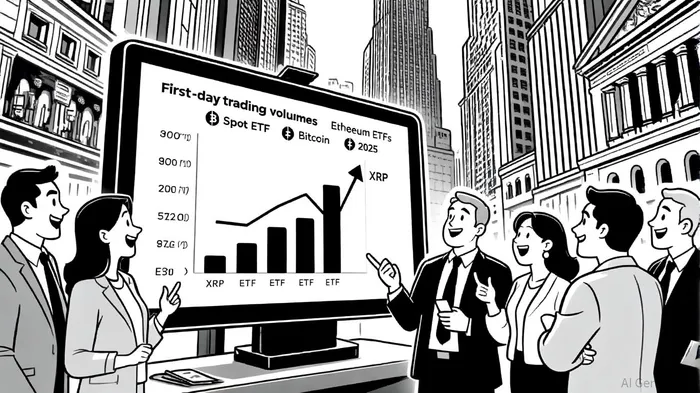
The launch of the REX-Osprey XRPXRP-- Spot ETF (ticker: XRPR) on September 18, 2025, marked a watershed moment in cryptocurrency's journey toward mainstream acceptance. With a record $37.7 million in first-day trading volume[1], the ETF not only shattered expectations but also signaled a paradigm shift in how institutional and retail investors perceive altcoins. This figure, surpassing the previous benchmark set by the Wedbush AI Revolution ETF (IVES), underscores XRP's growing legitimacy as a regulated, utility-driven asset class[2]. For investors, the implications are clear: XRP is no longer a speculative bet but a strategic cornerstone in a diversified crypto portfolio.
The Significance of $37.7M: Beyond a Record
The XRP ETF's debut was distinguished by its “natural” trading volume—generated by genuine investor demand rather than artificial inflows[3]. Within 90 minutes of trading, the fund attracted $25 million in turnover, a velocity unmatched by BitcoinBTC-- or EthereumETH-- ETFs in their early days[4]. This surge reflects a critical mass of institutional confidence, particularly in XRP's role as a bridge between traditional finance and blockchain innovation. Ripple's partnerships with global banks like SantanderSAN-- and Standard Chartered, leveraging XRP's On-Demand Liquidity (ODL) solution, have already demonstrated the token's utility in cross-border payments[5]. The ETF's success now amplifies this narrative, offering a regulated vehicle for investors to tap into XRP's infrastructure-driven value proposition.
Institutional Adoption: A Multi-Layered Traction
Beyond ETFs, XRP's institutional adoption is accelerating through Ripple's 2025 roadmap. The company's focus on regulatory compliance—such as introducing a permissioned decentralized exchange and automated market makers on the XRP Ledger (XRPL)—has attracted players like Guggenheim and Ondo Finance[6]. These partnerships enable tokenization of real-world assets (e.g., U.S. Treasuries) and stablecoins like Ripple USD (RLUSD), further cementing XRP's role in institutional portfolios[7]. Notably, XRP's settlement efficiency and low-cost structure make it a compelling alternative to traditional forex systems, particularly in Asia, where Ripple's ecosystem is expanding[8].
Performance Edge: XRP ETFs Outpace BTC/ETH Counterparts
While Bitcoin and Ethereum ETFs dominated headlines in 2025, XRP's risk-adjusted returns tell a different story. A $10,000 investment in XRP six months prior to the ETF launch would have grown to $40,101, outperforming Bitcoin's $13,275 and Ethereum's $7,516[9]. This outperformance is supported by XRP's Sharpe Ratio (4.28) and Sortino Ratio (1.49), both exceeding Bitcoin's metrics[10]. The emergence of leveraged products like the ProShares Ultra XRP ETF (UXRP) and the Teucrium XRP ETF—now managing $397 million in assets[11]—further diversifies access, catering to both conservative and aggressive investors.
Strategic Entry: Why Now?
The confluence of regulatory clarity and institutional demand creates a unique entry window. The SEC's adoption of generic listing standards for commodity-based ETFs has streamlined approvals, paving the way for future XRP ETFs and altcoin products[12]. Meanwhile, XRP's price remains anchored near $3.03, offering a floor supported by structural demand from ETF inflows and cross-border use cases[13]. Analysts project a near-term target of $5 and a long-term ceiling of $15, contingent on sustained institutional adoption[14].
Conclusion: Positioning for the Altcoin Era
The XRP Spot ETF's $37.7M debut is more than a record—it is a harbinger of crypto's next phase. As institutional players deepen their integration of XRP into payment systems, asset tokenization, and regulated investment vehicles, the token's utility and price discovery will align with broader market dynamics. For investors seeking resilience and growth, XRP's ETF-driven momentum, coupled with its foundational role in blockchain finance, presents a compelling case for strategic allocation.






Comentarios
Aún no hay comentarios