
XRP's Emerging Dominance in the ETF Era Amid Crypto Volatility
The cryptocurrency market in 2025 has been defined by a seismic shift in capital flows, regulatory clarity, and the rise of structured investment vehicles. While BitcoinBTC-- and EthereumETH-- remain the dominant assets by market capitalization, XRPXRP-- has emerged as a surprising leader in the ETF-driven reallocation of capital. This article examines the structural forces propelling XRP's ascent, the macroeconomic tailwinds shaping the crypto landscape, and the implications for investors navigating a volatile yet transformative market.
ETF Inflows vs. Price Performance: A Tale of Structural Demand
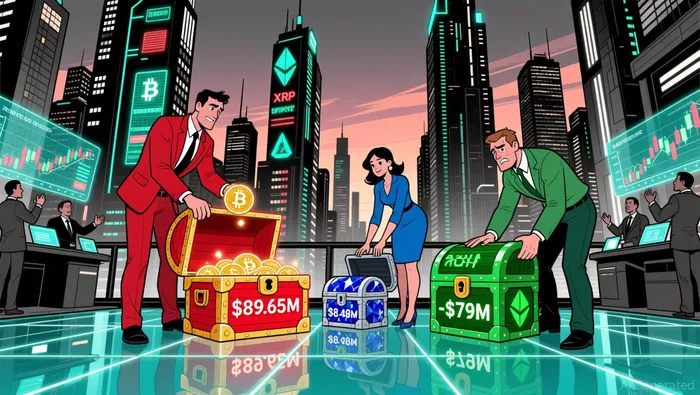
Despite a 7% decline in XRP's price year-to-date as of late 2025, the token has attracted $1.13 billion in net inflows through U.S.-listed ETFs, pushing total assets under management to $1.25 billion. This dislocation between inflows and price action highlights a critical nuance: ETFs are creating structural demand that outpaces speculative trading activity. For context, Bitcoin ETFs, which launched earlier in 2024, saw $57.7 billion in cumulative inflows by December 15, 2025, but their daily inflows paled in comparison to XRP's. On December 1, 2025, XRP ETFs recorded $89.65 million in inflows, dwarfing Bitcoin's $8.48 million and Ethereum's net outflows of $79 million.
This trend is not merely a function of timing. XRP's ETFs have leveraged a unique value proposition: real-world utility in cross-border payments, a leaner blockchain infrastructure, and regulatory alignment. As stated by a report from Bitcoinist, XRP ETFs have become a "category leader in ETF-driven capital flows," even as Bitcoin and Ethereum maintain larger market caps. The token's price volatility-down 49% from its July 2024 high-has not deterred institutional adoption, with Franklin Templeton, Bitwise, and Grayscale managing significant portions of inflows.
Structural Advantages: Why XRP ETFs Outperform
XRP's structural advantages stem from its alignment with both regulatory frameworks and practical use cases. Unlike Bitcoin and Ethereum, which face ongoing debates over energy consumption and scalability, XRP's consensus mechanism and low transaction costs position it as a bridge between traditional finance and blockchain innovation. According to , XRP ETFs have capitalized on this by offering investors exposure to a token with tangible, enterprise-grade applications in global remittances and institutional settlements.
Regulatory tailwinds have further amplified XRP's appeal. The U.S. Securities and Exchange Commission's September 2025 approval of generic listing standards for commodity-based trusts removed a key barrier for ETFs targeting non-Bitcoin and non-Ethereum assets. This shift allowed XRP and SolanaSOL-- ETFs to launch under clear guidelines, attracting $883 million and $92 million in inflows, respectively, by December 15. The inclusion of staking rewards in some XRP ETFs-though less prominent than in Solana-has also added a layer of yield generation, appealing to income-focused investors.
Macroeconomic Tailwinds: Interest Rates and Regulatory Clarity
The broader macroeconomic environment has played a pivotal role in XRP's ETF-driven resurgence. As central banks signaled a pivot toward rate cuts in late 2025, liquidity in risk assets-including crypto-improved. Data from indicates that lower inflation and accommodative monetary policy have spurred capital inflows into crypto ETFs, with altcoins like XRP benefiting from reduced competition for investor attention. Conversely, periods of high inflation and restrictive rates in 2023–2024 saw outflows from crypto, as investors prioritized safer assets.
Regulatory clarity has been equally transformative. The SEC's approval of in-kind redemptions for Bitcoin and Ethereum ETFs in 2025 not only enhanced liquidity but also set a precedent for XRP and other tokens. This development has enabled institutions like Vanguard and BlackRockBLK-- to expand their crypto offerings, democratizing access to a market once dominated by retail speculation.
The Road Ahead: Volatility, Institutional Adoption, and Price Projections
While XRP's ETF-driven momentum is undeniable, challenges remain. Active transacting addresses on the XRP Ledger have plummeted to a monthly low of 34,005, signaling reduced retail participation and heightened concentration among institutional holders. This dynamic raises questions about the sustainability of ETF-driven demand in a market still prone to volatility.
Analysts, however, remain cautiously optimistic. A report from suggests that sustained inflows could push XRP to $3.60 by 2026, a level last seen in July 2024. This projection hinges on two factors: continued institutional adoption and the token's ability to maintain its structural advantages in a crowded ETF landscape.
Conclusion: A New Paradigm for Crypto Investing
XRP's journey in the ETF era underscores a broader shift in the crypto market: the transition from speculative trading to structured, institutional-grade investment. While Bitcoin and Ethereum will likely retain their dominance in terms of market cap, XRP's ETF performance demonstrates that capital reallocation is increasingly driven by utility, regulatory alignment, and macroeconomic conditions. For investors, this means diversifying beyond the "big two" and scrutinizing tokens with clear use cases and regulatory tailwinds.
As the SEC continues to refine its approach to crypto ETFs, the market will likely see more entrants vying for a slice of the $1.25 billion XRP ETF pie. But for now, XRP's structural advantages and institutional backing make it a compelling case study in the evolution of crypto investing.





Comentarios
Aún no hay comentarios