
XRP's Dominance in South Korea and the Strategic $2.70–$2.80 Range
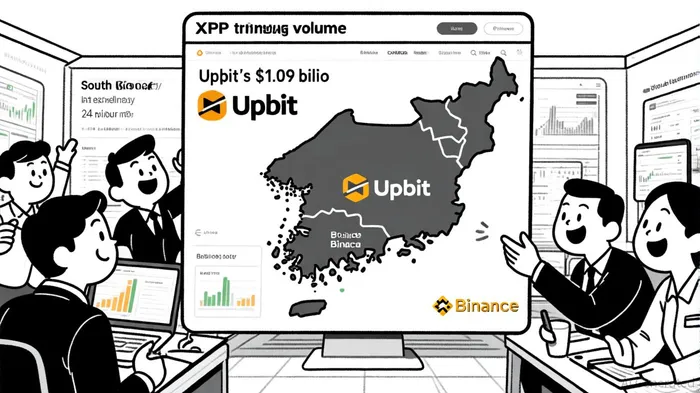
XRP's recent surge in South Korea has redefined its global market dynamics, with the country now accounting for 22.39% of global XRPXRP-- trading volume[1]. This dominance is driven by a confluence of factors: favorable regulatory conditions, cross-border payment utility, and high retail participation. On Upbit, South Korea's largest exchange, XRP trading volume reached $1.09 billion in a single 24-hour period, surpassing Binance's $966.80 million and cementing the region's role as a liquidity hub[1]. The XRP-KRW pair alone contributed over 484 million XRP in daily trading, with Upbit holding 5.9 billion XRP tokens—more than double Binance's 2.9 billion[4]. This liquidity concentration has positioned South Korea as a critical driver of XRP's price discovery and volatility.
Institutional Adoption and Regulatory Tailwinds
South Korea's institutional adoption of XRP has accelerated in Q3 2025, marked by the launch of custody services by BDACS, a licensed crypto custodian. This development, part of a February 2025 partnership with Ripple, allows institutional investors to securely store and trade XRP under a government-compliant framework[1]. BDACS's integration with major exchanges like Upbit, Coinone, and Korbit has further streamlined institutional access, aligning with South Korea's Financial Services Commission (FSC) roadmap to expand digital asset participation[2]. Analysts note that this infrastructure could stabilize demand, as institutions now account for a significant portion of XRP's trading volume[4].
Regulatory clarity has also played a pivotal role. The resolution of the U.S. SEC case against XRP in late 2024 reinvigorated market sentiment, triggering a FOMO-driven rally in South Korea[1]. Additionally, South Korea's strict capital controls and demand for efficient cross-border payment solutions have made XRP a preferred asset for both retail and institutional investors[2]. The Kimchi Premium—a phenomenon where Korean crypto prices outpace global benchmarks—has further amplified XRP's appeal, with South Korean investors withdrawing 16 million XRP tokens ($45.5 million) in a single day[3].
Technical Analysis: The $2.70–$2.80 Make-or-Break Range
XRP's price action has been tightly correlated with South Korea's market dynamics, particularly within the $2.70–$2.80 support zone. This range forms the base of a descending triangle pattern, with technical indicators suggesting a potential breakout is imminent[1]. As of September 2025, XRP trades at $2.76, with buyers defending the $2.80 level—a critical Fibonacci support zone—while sellers test the $2.70 threshold[4].
On-chain metrics reinforce the significance of this range. Glassnode data reveals that 2.036 billion XRP tokens are held in the cost basis range of $2.806–$2.822, indicating heavy investor exposure[1]. A breakdown below $2.70 could trigger a deeper retracement toward $2.00, while a successful defense of the $2.80 level may catalyze a bullish reversal toward $3.18[1]. Analysts like Ali Martinez emphasize that holding this zone could tip momentum in favor of buyers, leveraging South Korea's surging trading volume and institutional demand[1].
South Korean trading activity has historically correlated with bullish price behavior. For instance, XRP's $330 million trading volume on Upbit in September 2025—surpassing Bitcoin's $137 million and Ethereum's $258 million—coincided with price consolidation near $2.96[2]. Cumulative volume delta metrics suggest that buyers are accumulating XRP ahead of a potential breakout, with reduced leverage and normalized funding rates signaling a cooling of speculative fervor[4].
Regional Factors as Price Catalysts
The interplay between South Korea's market structure and XRP's technical levels is evident in recent price movements. For example, the August 2025 launch of BDACS custody services coincided with XRP trading near $2.96, a Fibonacci support level[2]. Institutional access to XRP via regulated custodians has likely stabilized demand, reducing volatility and reinforcing the $2.70–$2.80 range as a psychological battleground[4].
Moreover, South Korea's demographic trends—25% of South Koreans aged 20–50 hold crypto assets—underscore the region's influence on XRP's adoption curve[1]. With XRP accounting for 14% of these investors' portfolios, sustained retail participation could provide a floor for the asset even amid broader market corrections[1].
Conclusion: A Bullish Crossroads
XRP's trajectory in the $2.70–$2.80 range hinges on South Korea's continued dominance in trading volume, institutional adoption, and regulatory clarity. If buyers defend this zone, XRP could rally toward $3.05 or even $3.15, leveraging the region's liquidity and cross-border utility[1]. A breakdown, however, risks a slide toward $2.64, deepening bearish momentum[3]. Investors must monitor South Korean trading activity and institutional demand through BDACS, as these factors will likely dictate XRP's near-term direction.






Comentarios
Aún no hay comentarios