
XRP's Divergence: ETF Inflows vs. On-Chain Sell Pressure
The XRPXRP-- market in Q4 2025 has become a textbook case of structural divergence, with institutional demand surging through ETF channels while on-chain sell pressure and retail disengagement deepen. This split between long-term positioning and short-term capitulation reveals a complex interplay of market forces, where institutional actors appear to be methodically accumulating the asset even as retail investors and whale wallets offload holdings.
Institutional Demand Surges via ETFs
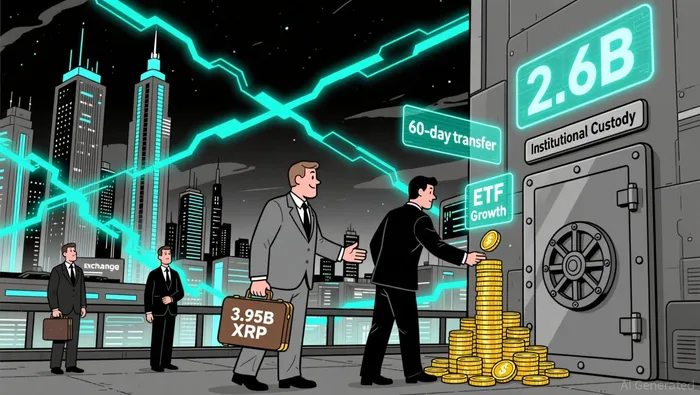
U.S. spot XRP ETFs have emerged as a critical driver of institutional demand, with net inflows exceeding $1.1–1.2 billion in just weeks of operation. A single-day inflow of $43.9 million in late December marked the highest since early December, underscoring the asset's appeal to institutional portfolios according to reports. These inflows have been remarkably consistent, with XRP ETFs recording 30–33 consecutive days of positive flows without a single day of net outflows. This institutional adoption is further reinforced by on-chain data showing a 60-day reduction in exchange-held XRP balances-from 3.95 billion to 2.6 billion-indicating increased custody by ETFs and whale accumulators.
Despite this robust institutional interest, XRP's price has struggled, trading between $1.85 and $1.88 by late December 2025. The asset has fallen 47% from its 2025 peak near $3.50 and 11–12% from a year ago. This disconnect between inflows and price action suggests that macroeconomic headwinds-such as broader market volatility and interest rate uncertainty-are temporarily overshadowing the asset's fundamentals.
On-Chain Sell Pressure Intensifies
While institutional buyers are accumulating XRP, on-chain data paints a starkly different picture of retail and whale dynamics. Active transacting addresses hit a monthly low of 34,005 in December 2025, signaling weak network participation and liquidity. This decline in retail engagement exacerbates downward pressure, as fewer traders are willing to absorb selling volumes.
Whale wallets, meanwhile, have aggressively offloaded holdings. Wallets holding between 100 million and 1 billion XRP reduced their stake by approximately 100 million XRP over the same period, while mid-sized wallets also cut positions. This selling pressure has trapped XRP in a two-year trading range of $1.58–$3.50, with recent price action forming a descending channel that favors further downside. Analysts warn that a breakdown below $1.79 could trigger a cascade toward $1.27, compounding the bearish scenario according to market analysis.
Market Structure and Positioning: A Tale of Two Sides
The divergence between ETF inflows and on-chain selling highlights a structural shift in XRP's market dynamics. Institutional players, as noted by Pumpius, are leveraging derivatives and OTC markets to manage exposure discreetly while maintaining control over price ranges. This strategy allows them to accumulate long-term positions without triggering immediate price appreciation, effectively decoupling XRP's valuation from short-term sentiment.
Retail investors, conversely, are caught in a cycle of loss aversion and liquidity constraints. With active addresses at multi-month lows, the network's ability to absorb institutional buying is constrained, creating a self-reinforcing bearish loop. This dynamic is further amplified by macroeconomic factors, which have dampened risk appetite across asset classes, including crypto.
Path to Resolution: Conditions for a Breakout
For XRP to escape its entrenched range, three critical conditions must align:
1. Price must hold above $1.79 to avoid triggering the descending channel's bearish breakdown.
2. ETF inflows must continue to stabilize demand and offset whale selling.
3. Whale offloading must ease, reducing downward pressure on liquidity.
Failure to meet these conditions could prolong XRP's stagnation or accelerate its decline. Conversely, sustained institutional accumulation and a stabilization in macroeconomic conditions could catalyze a re-rating of the asset, particularly if ETF inflows outpace selling pressures.
Conclusion
XRP's current divergence between institutional demand and on-chain sell pressure reflects a broader structural realignment in the crypto market. While ETF inflows signal confidence in the asset's long-term utility and scalability, retail disengagement and whale selling underscore near-term fragility. Investors must closely monitor both sides of this equation: the quiet accumulation by institutions and the fragile equilibrium of retail and macro dynamics. In a market where positioning often matters more than price, XRP's next move will hinge on whether institutional resolve can outlast the bearish momentum of its retail and whale counterparts.






Comentarios
Aún no hay comentarios