
XRP: The Disruptive Force Reshaping Cross-Border Payments and Challenging SWIFT's Dominance
The global cross-border payment system has long been dominated by SWIFT, a network that, while reliable, is plagued by inefficiencies: slow settlement times, high fees, and operational complexity. Enter XRPXRP--, the digital asset developed by Ripple, which has emerged as a compelling alternative. Over the past five years, XRP has leveraged its speed, cost efficiency, and regulatory clarity to disrupt traditional paradigms, positioning itself as a serious contender in the race to modernize global finance.
XRP's Technological Edge: Speed, Cost, and Liquidity
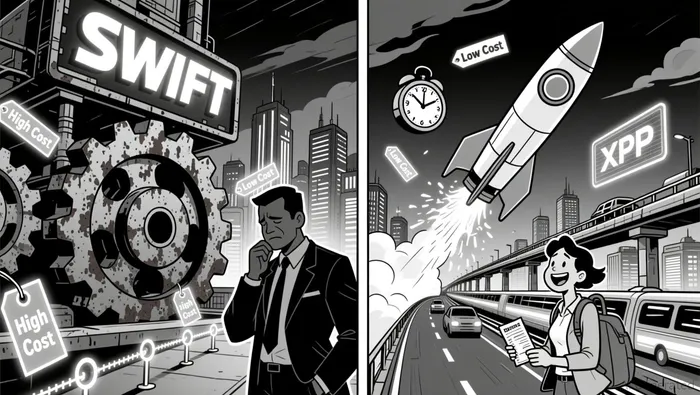
At its core, XRP's value proposition lies in its ability to settle transactions in 3–5 seconds with fees of approximately $0.0002 per transaction. This contrasts sharply with SWIFT's 2–5 day settlement windows and fees ranging from $25 to $50 per transfer. Ripple's On-Demand Liquidity (ODL) service further amplifies this advantage by using XRP as a bridge currency, eliminating the need for pre-funded nostro accounts. According to a report by , this innovation has unlocked $27 trillion in previously dormant liquidity for financial institutions. For high-volume, low-to-mid value payments-such as remittances or B2B transactions-XRP's cost savings can reach 85%, making it an attractive option for institutions seeking operational efficiency as detailed in the analysis.
Institutional Adoption: From Partnerships to Real-World Impact
Ripple's institutional adoption has grown exponentially since 2020. The company now partners with over 300 financial institutions, including global giants like Santander, PNC, and American Express according to Financial Planning Association. These partnerships are not theoretical; they translate into tangible use cases. For example, Santander's use of Ripple's solutions for cross-border payments in the UK and Latin America has reduced processing times from days to seconds while cutting costs by over 70% as reported in the journal. Similarly, American Express's integration of XRP for USD-to-MXN transactions in Mexico has demonstrated the asset's scalability and reliability in real-world scenarios according to the same analysis.
Regulatory Clarity: A Turning Point for XRP
Regulatory uncertainty has historically been XRP's greatest hurdle. The U.S. Securities and Exchange Commission (SEC) lawsuit against Ripple, which began in 2020, cast a shadow over the asset's legitimacy. However, a pivotal court ruling in July 2023 clarified that XRP sales on exchanges were not securities transactions as stated in . This was followed by a final judgment in October 2024, which largely exonerated Ripple and deemed XRP itself not a security, despite a $125 million fine for past violations according to the same report. These developments have been transformative. As noted in The Standard, the regulatory resolution has spurred XRP ETF filings and bolstered institutional confidence, with the asset's market capitalization reaching $128 billion by mid-2025 as detailed in the article.
XRP vs. SWIFT: A Metrics-Driven Comparison
The comparative advantages of XRP over SWIFT are stark. Traditional SWIFT transfers rely on intermediary accounts and local clearing systems, often requiring multiple compliance checks and pre-funding. In contrast, XRP's blockchain offers real-time visibility and eliminates the need for pre-funded nostro accounts, optimizing working capital as explained by . Data from Web3 Enabler highlights that XRP-based solutions achieve landed costs as low as 1.6%, compared to SWIFT's 10.2% according to the analysis. For institutions handling billions in cross-border transactions annually, these metrics represent a seismic shift in cost structures and operational efficiency.
Future Outlook: CBDCs and the Next Frontier
Ripple's ambitions extend beyond SWIFT. The company is actively exploring partnerships with central banks to integrate XRP into central bank digital currency (CBDC) frameworks as reported by . This aligns with a broader trend of central banks seeking faster, cheaper, and more transparent payment systems. With its controlled supply model and growing network of adopters, XRP is well-positioned to become a foundational layer in the next-generation global payments infrastructure.
Investment Thesis: A High-Conviction Play
For investors, XRP represents a high-conviction opportunity at the intersection of technological innovation and regulatory progress. Its $128 billion market cap (as of mid-2025) reflects growing institutional adoption and a maturing ecosystem. While SWIFT remains dominant, the cost and speed advantages of XRP-based solutions are hard to ignore. As more institutions adopt Ripple's technology and regulatory frameworks evolve, XRP's role in cross-border payments is likely to expand-potentially reshaping the financial landscape in the process.





Comentarios
Aún no hay comentarios