
XRP vs. DeepSnitch AI: A 2026 Investment Crossroads in a Shifting Crypto Landscape
The crypto market of 2026 is a landscape of contrasts. After years of regulatory uncertainty and bearish sentiment, a recovery is underway, driven by institutional adoption, AI-driven innovation, and renewed optimism in blockchain's utility. At the center of this shift are two distinct investment narratives: XRP, the battle-tested utility token of Ripple's cross-border payment network, and DeepSnitch AI (DSNT), a nascent presale project leveraging artificial intelligence to decode on-chain data. Both projects aim to capitalize on the crypto recovery, but their paths-and risks-could not be more different.
XRP: The Institutional Bet on Utility and Regulatory Clarity
XRP's resurgence in 2026 is rooted in its resolution of the long-standing SEC lawsuit in August 2025, which removed a critical legal overhang and unlocked institutional adoption. According to a report by , U.S.-listed XRPXRP-- ETFs have seen net inflows of $13.6 million in a single day, with total net assets nearing $1.37 billion, driven by asset managers like Franklin Templeton and Grayscale. This institutional stamp of approval has positioned XRP as a cornerstone of the global payments infrastructure, with Ripple's On-Demand Liquidity (ODL) service already adopted by financial giants such as Santander and CIBC.
The token's fundamentals further reinforce its appeal. XRP's fixed supply of 100 billion tokens and controlled release mechanism via escrow accounts mitigate inflationary risks, while its role in the $150 trillion cross-border payments market ensures long-term utility. Analysts from Sistine Research have projected aggressive price targets of $33–$50 by late 2026, citing growing demand from institutional investors and the token's role in real-time currency settlements. Even conservative estimates place XRP in the $2.20–$3.50 range, reflecting its established market position.
However, XRP is not without risks. Regulatory scrutiny remains a wildcard, and while the SEC case was resolved, future legal challenges could disrupt its trajectory. Additionally, XRP's performance is tied to macroeconomic factors like global payment demand, which may fluctuate independently of crypto's broader recovery according to OpenExo.
DeepSnitch AI: The High-Stakes AI Play for Retail Traders
DeepSnitch AI (DSNT) represents a different kind of bet: a speculative, AI-driven toolset for crypto traders. In its presale phase as of late 2026, DSNT has already raised over $1.1 million, with a projected token generation event (TGE) price of $0.0354 and a 2% price increase per presale stage. The project's core offering-AI agents like SnitchFeed and SnitchScan- aims to democratize access to on-chain intelligence, enabling retail traders to detect whale activity, flag risky contracts, and navigate market volatility.
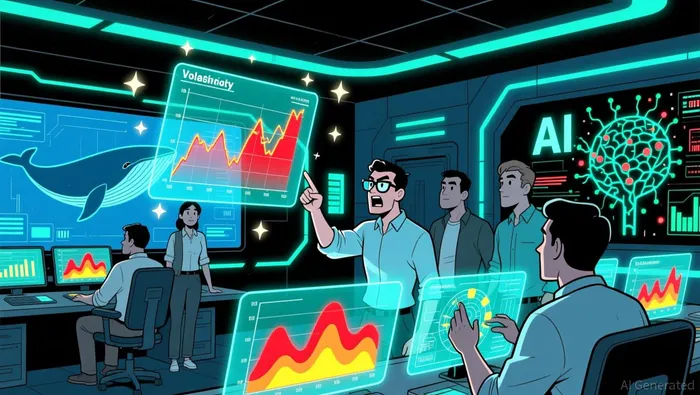
The potential rewards are staggering. If DeepSnitch AI achieves a user base of one million, analysts suggest the token could reach $3, representing a 100x return from its presale price. This is not just speculative hype: the platform has already launched tools like SnitchGPT and Token Explorer, with staking functionality live. However, the risks are equally pronounced. As a presale project, DSNT lacks a proven track record, and its success hinges on user adoption, technological execution and the volatile AI crypto market.
Critics argue that DSNT's value proposition is more aligned with the "moonshot" mentality of early-stage crypto projects than with sustainable utility. Unlike XRP, which is embedded in real-world financial infrastructure, DeepSnitch AI's impact is confined to the crypto trading ecosystem, making it more susceptible to market cycles.
The 2026 Crossroads: Risk vs. Reward in a Recovering Market
The contrast between XRP and DSNT mirrors a broader tension in the 2026 crypto market: pragmatic utility vs. speculative innovation. XRP is a safer, more predictable investment, anchored by institutional demand and regulatory progress. Its growth is tied to the normalization of blockchain in global finance, a trend that is likely to persist regardless of crypto's short-term volatility.
DeepSnitch AI, by contrast, is a high-risk, high-reward proposition. Its AI tools could redefine how retail traders interact with on-chain data, but the project's success depends on execution, adoption, and the broader AI crypto boom. analysts, DSNT's potential for 100x returns makes it an attractive "asymmetric bet" for risk-tolerant investors. However, the lack of historical performance data and the inherent volatility of presale tokens mean that DSNT is best suited for aggressive, short-term strategies.
Conclusion: Navigating the 2026 Crypto Recovery
For investors navigating the 2026 crypto recovery, the choice between XRP and DeepSnitch AI hinges on risk appetite and time horizon. XRP offers a stable, utility-driven investment with institutional backing and a clear path to growth. DeepSnitch AI, meanwhile, represents a speculative but potentially transformative opportunity for those willing to bet on AI's role in crypto trading.
In a market still grappling with regulatory and macroeconomic uncertainties, the key is diversification. XRP provides a floor, while DSNT offers a ceiling. As the crypto landscape shifts, the investor who balances both may find themselves best positioned to capitalize on the next wave of innovation.






Comentarios
Aún no hay comentarios