
XRP's Deepening Downtrend: Is $1.25 the Next Target?
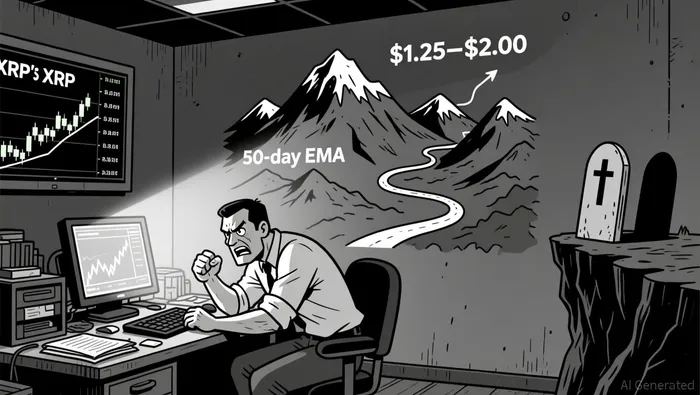
The XRPXRP-- price action in early 2026 has painted a complex picture of technical fragility and macroeconomic vulnerability. After a 30% surge in January 2026, the token has since entered a seven-day losing streak, dropping 13% from its peak of $2.357 to $2.058 as of January 13. This decline has pushed XRP below its 50-day exponential moving average (EMA) at $2.07, a critical technical threshold that often signals deeper corrections. With key support levels now under pressure, the question looms: Is $1.25 the next target?
Technical Breakdown: A Fragile Foundation
XRP's current technical structure is a mix of conflicting signals. On one hand, a recent breakout above a months-long descending channel has shifted the chart's structural dynamics, with $2.00 emerging as a pivotal psychological support level. Sustained bullish momentum above this level-particularly on the daily chart-is essential to validate the breakout and maintain a longer-term uptrend. However, the token's failure to hold above the 50-day EMA and the appearance of a gravestone doji on the weekly chart suggest short-term selling pressure.
The immediate risk lies in a breakdown below $2.00, which would trigger a cascade of lower targets. Analysts have identified a sequence of critical support levels: $1.90 (November lows), $1.80 (December lows), $1.61 (April minimums), and ultimately $1.25. A double bottom formation near $1.80 has been cited as a potential reversal catalyst toward $2.70, but this scenario requires a decisive close above $2.22 to confirm bullish momentum. Meanwhile, the $2.10–$2.18 zone remains a key consolidation area; a confirmed breakout here could push XRP toward $2.32–$2.50.
The technical narrative is further complicated by mixed expert opinions. Prominent analysts like John Bollinger and Peter Brandt have criticized XRP's recent rally as lacking the volatility compression and base-building seen in more robust trends. Bollinger noted that XRP's price pattern was "noisier" compared to Bitcoin's textbook squeeze, while Brandt emphasized the need for a $3.50 breakout to confirm a genuine trend. These warnings underscore the token's susceptibility to liquidity pockets and distribution pressures, with a drop to $1.62 or $1.25 deemed a realistic risk if key supports fail.
Macroeconomic Vulnerability: A Perfect Storm
Beyond technical indicators, XRP's trajectory is increasingly shaped by macroeconomic forces. The Federal Reserve's 2025 policy decisions and unexpected inflation readings have created a volatile backdrop for digital assets, with XRP mirroring broader market swings. A surge in tariffs during early 2025 triggered widespread risk-off sentiment, exacerbating downward pressure on crypto markets. While XRP's utility in cross-border payments has driven adoption during periods of macroeconomic uncertainty, its price remains sensitive to global risk appetite.
Regulatory developments have also played a dual role. The SEC's dismissal of the Ripple lawsuit in March 2025 provided critical clarity, enabling XRP to reach a seven-year high of $3.65 in 2025. However, this momentum was short-lived, with the token correcting 48% to $1.90 by year-end. The broader regulatory landscape-marked by the EU's MiCA and the U.S. GENIUS Act-has increased institutional confidence but also introduced new complexities for tokens like XRP, which face heightened scrutiny due to their utility and liquidity characteristics.
Institutional demand, however, remains a counterweight. U.S. spot XRP ETFs have logged 29 consecutive days of net inflows totaling $1.37 billion through December 2025, signaling long-term confidence. Ripple's ecosystem expansion, including the launch of its stablecoin RLUSD and strategic acquisitions, further demonstrates resilience. Yet, these positives must be weighed against ongoing regulatory uncertainty in certain jurisdictions and competitive pressures from other blockchain projects.
The Path to $1.25: A Convergence of Risks
The interplay of technical and macroeconomic factors suggests a plausible path to $1.25. If XRP fails to reclaim $2.00, the next line of defense at $1.90 could be tested, with a breakdown likely to accelerate the decline toward $1.80 and beyond. A failure to hold $1.80 would not only invalidate the double bottom reversal pattern but also expose the token to a 40% drop from current levels. Meanwhile, macroeconomic headwinds-such as rising interest rates or renewed risk-off sentiment-could amplify this technical vulnerability, creating a self-reinforcing downtrend.
Conversely, a successful defense of $2.00 and a breakout above $2.22 could reinvigorate bullish momentum, aligning with institutional inflows and regulatory tailwinds. However, given the mixed signals from technical indicators and the token's historical volatility, investors must remain cautious. The coming weeks will be critical in determining whether XRP's rally represents independent strength or a temporary reprieve within a broader bearish structure.
Conclusion: Navigating Uncertainty
XRP's journey toward $1.25 hinges on a delicate balance between technical resilience and macroeconomic stability. While institutional demand and regulatory clarity offer a foundation for long-term optimism, the token's short-term trajectory remains precarious. Investors should closely monitor key support levels, particularly $2.00 and $1.80, while staying attuned to global risk sentiment and regulatory developments. In a market where technical breakdowns and macroeconomic shocks can converge rapidly, prudence and adaptability will be paramount.






Comentarios
Aún no hay comentarios