
XRP's Death Cross and Deepening Bear Case: Is Now the Time to Buy the Dip or Avoid the Fall?
In the world of crypto, few patterns send shivers down the spine like a death cross. For XRPXRP--, the confirmation of this bearish signal in December 2025 has ignited a debate: Is this a buying opportunity for the bold, or a warning sign for the risk-averse? Let's dissect the technical breakdown and institutional selling signals shaping XRP's trajectory-and why the odds of a prolonged downturn are stacking up.
The Death Cross: A Technical Indicator of Prolonged Pain
A death cross occurs when a security's 50-day moving average crosses below its 200-day moving average-a historically bearish event. For XRP, this crossover in late 2025 marked a pivotal shift. The token fell below $2.20 in mid-November on weak volume, setting the stage for a potential drop to $1.80–$2.10.
Technical indicators corroborate the bear case. The RSI sits at 47, a neutral but subdued level, while the MACD has turned negative, signaling growing downside momentum. Bollinger Bands have narrowed, and trading volumes have softened, suggesting a consolidation phase ahead of a breakout. Price action tells the story too: XRP is forming lower highs and lower lows, a textbook bearish pattern where sellers dominate.
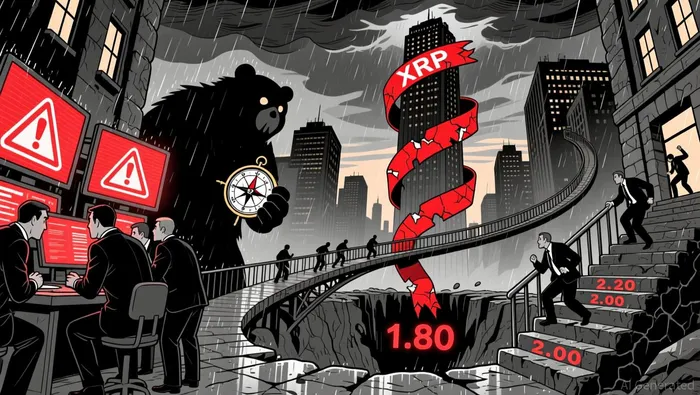
Key support levels are now in focus. The immediate defense is $2.20, with $2.00 acting as a critical psychological barrier. A break below $2.00 could trigger stop-loss selling but might also attract bargain buyers. However, the $1.80 level-a full retracement of XRP's recent uptrend-is a high-risk capitulation zone. Bulls, meanwhile, need a rebound above $2.20–$2.30 and a breakout through $2.50–$2.60 to rekindle optimism. Recent rallies, though, have been anemic and lack volume, weakening the case for a reversal.
Institutional Selling: The Hidden Hand Behind the Downturn
While technicals paint a grim picture, institutional selling is amplifying the bear case. In late 2025, XRP's price correction to $2.05 was driven by large-scale distribution, confirmed by elevated volumes. On-chain data reveals a 29% drop in exchange-held balances, signaling a shift in user behavior and potential large-scale withdrawals. This outflow contrasts with the $666.6 million in inflows from XRP-linked ETFs in a single month-a structural demand boost that hasn't yet offset selling pressure. According to market analysis, institutional demand is rising, but it's not enough to counteract the current selling pressure.
The institutional landscape is a mixed bag. Ripple's acquisition of Hidden Road for $1.25B and the SEC's August 2025 settlement boosted confidence, leading to a 11% price spike. Yet long-term holders continue to offload XRP, weakening its ability to break through resistance. Large institutional wallets are accumulating, but this hasn't translated into a bullish breakout. Instead, the token's on-chain picture remains "mixed," with declining exchange reserves and increased accumulation by whales.
The Big Question: Buy the Dip or Avoid the Fall?
For contrarian investors, XRP's pullback to $2.196-a critical juncture-presents a tempting entry point. A breakout above $2.459, where cost-basis clusters and Fibonacci levels align, could signal a shift in sentiment. However, the risks are stark. A breakdown below $2.119 could expose support at $1.772, deepening the bear case.
The ETF tailwinds and improved custody solutions are bullish catalysts, but they're not enough to counteract the current selling pressure. Institutional buyers may eventually step in, but the market's short-term focus is on distribution, not accumulation.
Conclusion: A Bear Case Gaining Momentum
XRP's death cross and institutional selling signals paint a compelling bear case. While ETF inflows and regulatory clarity offer hope, the technical indicators and on-chain data suggest the downtrend is far from over. For now, the market is pricing in a continuation of the $1.80–$2.10 range, with volatility likely to persist until a clear catalyst emerges.
Investors must weigh the risks: buying the dip could mean catching a falling knife, while avoiding the fall might mean missing a rebound. But in a market where sellers are in control, patience-and a healthy dose of caution-may be the wisest strategy.






Comentarios
Aún no hay comentarios