
XRP and the Dawn of Generational Wealth: Institutional Adoption Catalysts and Long-Term Price Potential in 2025
Institutional Adoption Accelerates
The launch of spot XRP ETFs in 2025 has marked a watershed moment for institutional participation. Grayscale's GXRP and Canary Capital's XRPC attracted over $422 million in combined inflows, providing U.S. investors with their first regulated on-ramp to XRP. Franklin Templeton, a behemoth managing $1.7 trillion in assets, further cemented this trend with its XRPZ ETFXRPZ--, which saw $62.59 million in first-day inflows. These products, structured as grantor trusts and custodied by entities like Coinbase and BNY Mellon, signal a maturation of XRP's institutional infrastructure. Ripple's acquisition of Hidden Road Partners and the launch of Ripple Prime have also streamlined trading and custody solutions, addressing prior friction points.
The scale of this adoption is unprecedented. Institutional investments in XRP grew 215% since January 2025, with a bullish sentiment score of 78/100, reflecting confidence in its utility and regulatory trajectory. This surge is not merely speculative-it is underpinned by XRP's role in real-world applications, particularly cross-border payments.
Regulatory Clarity as a Game-Changer
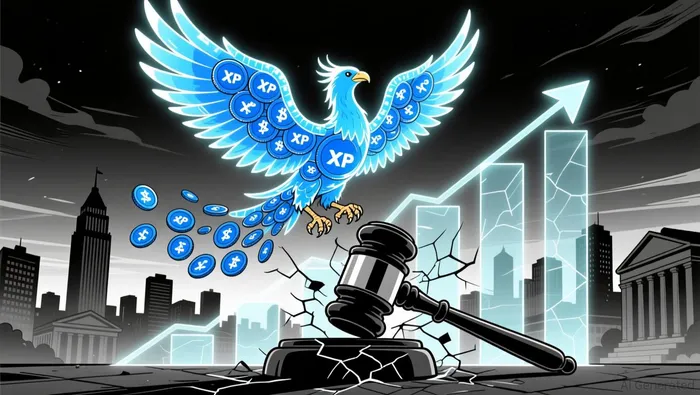 The resolution of the SEC vs. Ripple case in 2025 removed a critical overhang, ruling that secondary-market XRP sales are not securities. This decision unlocked a floodgate of institutional activity, as financial firms could now integrate XRP into portfolios without legal ambiguity. The $125 million settlement reached in May 2025 further stabilized the ecosystem, enabling broader participation from banks, asset managers, and fintechs.
Regulatory clarity has also spurred innovation. RippleNet, now adopted by over 350 financial institutions, leverages XRP's speed and low cost to settle cross-border transactions in seconds at a fraction of traditional fees. This utility is not theoretical-it is operational, with the XRP Ledger (XRPL) processing thousands of transactions per second for global clients.
XRP's Utility in Global Finance
XRP's technical advantages position it as a disruptive force in financial infrastructure. Unlike speculative assets, XRP's value is tied to its function: facilitating fast, low-cost international settlements. With transaction speeds of 3–5 seconds and fees of $0.0002 per transfer, it outperforms both traditional systems (SWIFT) and competing blockchains according to analysis. This efficiency has made it indispensable for institutions seeking to reduce friction in global commerce.
Franklin Templeton's endorsement of XRP as "foundational to global settlement infrastructure" underscores its strategic importance. By 2025, XRP is no longer a speculative token-it is a critical node in the world's financial networks.
Generational Wealth Creation: The XRP Thesis
For long-term investors, XRP represents a rare opportunity to participate in the digitization of global payments. Traders like The Bearable Bull argue that the token is nearing the end of an eight-year wealth-building phase, with a projected price target of $8. While this level may not yet be life-changing for most holders, it reflects a paradigm shift: XRP is transitioning from a niche asset to a mainstream component of institutional portfolios.
The case for generational wealth creation hinges on compounding adoption. As more institutions allocate to XRP-via ETFs, direct holdings, or integrated payment solutions-the token's demand and price will follow. Analysts project XRP could reach $5–$10 by 2026, with ETFs like XRPI and XRPR targeting $25–$30. These estimates assume continued inflows and expanding use cases, both of which are already materializing.
Macroeconomic Tailwinds
Beyond regulatory and institutional factors, macroeconomic trends favor XRP's long-term prospects. The global push for faster, cheaper cross-border payments aligns with XRP's core strengths. Meanwhile, the token's fixed supply of 100 billion coins creates scarcity, particularly as institutional demand grows.
Institutional confidence is further bolstered by XRP's compliance features. Ripple's partnerships with regulators and its emphasis on anti-money laundering (AML) tools have made it a "safe" entry point for traditional firms exploring blockchain. This alignment with compliance standards is critical for sustained adoption.
Conclusion
XRP's journey in 2025 is defined by a perfect storm of catalysts: regulatory resolution, institutional infrastructure, and real-world utility. For investors with a multi-year horizon, the token offers a compelling case for generational wealth creation. As ETF inflows accelerate and cross-border adoption deepens, XRP is poised to transcend its crypto origins and become a cornerstone of global finance.





Comentarios
Aún no hay comentarios