
XRP at the Crossroads: Is This the Setup for a Major Reversal in 2026?
XRP, the digital asset underpinning Ripple's cross-border payment network, finds itself at a pivotal juncture. After a 45% decline from its July 2025 peak of $3.66 to around $1.87–1.94 in early December 2025, the token has drawn both skepticism and intrigue. While short-term bearish sentiment persists-driven by derivatives deleveraging and macroeconomic uncertainty-contrarian indicators and institutional-driven dynamics suggest a potential reversal in 2026. This analysis explores the interplay of regulatory clarity, ETF-driven liquidity shifts, and on-chain metrics to assess whether XRPXRP-- is poised for a breakout.
Institutional Adoption: A Structural Tailwind
The most compelling catalyst for XRP's 2026 trajectory lies in its accelerating institutional adoption. The launch of U.S. spot XRP ETFs in November 2025-such as BlackRock's iShares XRPI and Fidelity's XRPR-has injected over $1.9 billion in assets under management, with inflows reaching $1 billion within four weeks of their debut. These ETFs have removed nearly 1% of XRP's circulating supply from exchange balances, tightening liquidity and mirroring Bitcoin's post-ETF dynamics.
Institutional confidence is further bolstered by Ripple's legal settlement with the SEC in late 2025, which reclassified XRP as a commodity under CFTC oversight. This regulatory clarity has attracted firms like Ripple Prime, a newly established global prime brokerage, and RLUSD, a regulated stablecoin integrating with institutional trading systems. Meanwhile, global adoption of Ripple's On-Demand Liquidity service-particularly in Brazil, Singapore, and the UAE-has reinforced XRP's utility as an infrastructure asset.
On-Chain Metrics and Contrarian Signals
On-chain data reveals a narrative of supply tightening and strategic accumulation. Exchange balances for XRP fell 45% over 60 days, from 3.95 billion to 2.6 billion tokens, as whales moved 800 million XRP into cold storage and ETF custody vaults. This reduction in circulating supply mirrors Bitcoin's post-ETF trajectory and could create a supply squeeze, historically a precursor to price surges.
Technical analysis also hints at a potential reversal. XRP's price action since July 2025 has formed a bearish consolidation pattern, but historical parallels to its 2017 breakout suggest a possible upward breakout if institutional buying persists. On-chain velocity metrics-a measure of transaction activity-have spiked, indicating growing real-world adoption. However, short-term indicators like the RSI and MACD show weakening bullish momentum, signaling caution for near-term traders.
Contrarian Rationale: A Case for 2026 Optimism
The current bearish sentiment, while valid in the short term, may represent a contrarian opportunity. XRP's decreasing correlation with Bitcoin-highlighted by Goldman Sachs-suggests its demand is driven by utility rather than speculative momentum. This decoupling could insulate XRP from broader crypto market volatility in 2026, particularly as macroeconomic conditions stabilize.
Moreover, the tokenization of real-world assets (RWAs) and improved custody solutions are shifting institutional focus from speculative trading to structured, long-term strategies. If XRP's supply continues to decline, reducing selling pressure-a sustained rebound could follow. Analysts have even projected ambitious price targets, including $15 or higher, if the current consolidation breaks upward.
Risks and Uncertainties
While the case for a 2026 reversal is compelling, risks remain. Macroeconomic headwinds, such as interest rate uncertainty and geopolitical tensions, could delay institutional inflows. Additionally, derivatives markets show little speculative activity, indicating a lack of conviction among traders. However, the structural shifts in ETF adoption, regulatory clarity, and on-chain metrics 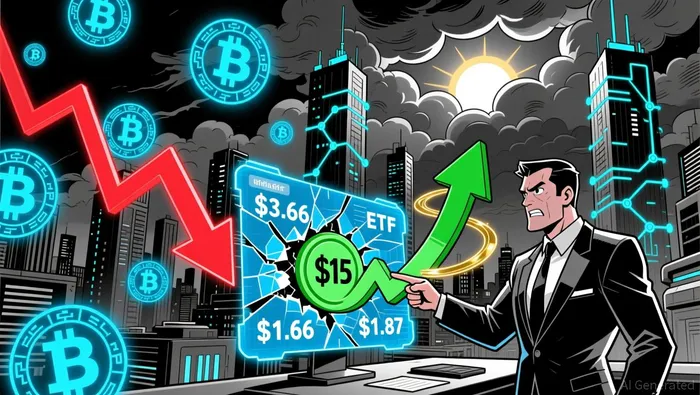 outweigh these near-term challenges for a long-term investor.
Conclusion: A Contrarian Play on Institutional Infrastructure
XRP's journey in 2026 hinges on its ability to capitalize on institutional infrastructure and regulatory tailwinds. The convergence of ETF-driven liquidity shifts, supply-side tightening, and real-world utility positions XRP as a potential breakout candidate. For contrarian investors, the current price correction may represent a strategic entry point, provided they align with the long-term thesis of institutional adoption and infrastructure-driven demand.
As the crypto market enters a new phase of institutional integration, XRP's crossroads moment could define its role in the evolving digital asset landscape.





Comentarios
Aún no hay comentarios