
XRP's Crossroads: Navigating Short-Term Volatility Amid Long-Term Institutional Transformation
The XRPXRP-- market in late 2025 finds itself at a pivotal juncture, balancing the turbulence of short-term price swings with the promise of transformative long-term fundamentals. As the token hovers near $2.25, institutional accumulation, regulatory developments, and technological innovation are converging to redefine XRP's role in global finance. This analysis dissects the interplay between immediate market dynamics and Ripple's strategic vision, offering a framework for assessing XRP's investment potential.
Short-Term Volatility: Catalysts and Constraints
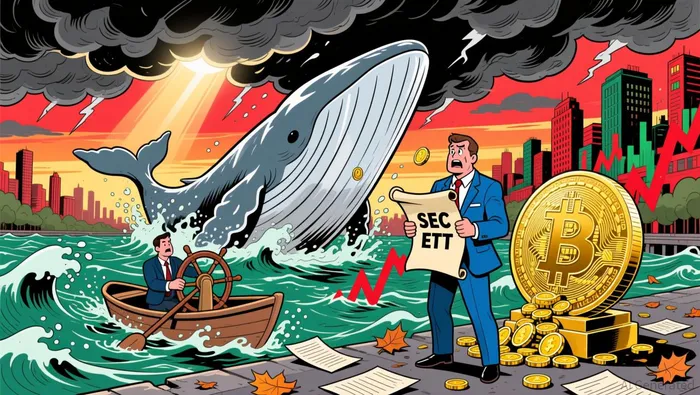
XRP's price trajectory in 2025 has been marked by sharp corrections and rapid rebounds, reflecting a market in flux. As of late October, the token's 30-day volatility stood at 7.35%, with on-chain data revealing that large whale investors accumulated 1.27 billion XRP-valued at $3.15 billion-signaling growing confidence in its institutional utility, according to a Timestabloid report. Technical indicators further complicate the short-term outlook: an RSI of 37.67 suggests oversold conditions, while Grok, Elon Musk's AI system, flagged a potential "Death Cross" pattern on daily charts, hinting at weakening momentum before a possible rally, according to the same report.
The most immediate catalyst lies in the pending approval of a spot XRP ETFXRPI-- by the SEC. Canary Funds' proposed product, slated for a November 13 launch, could unlock institutional liquidity by providing traditional investors with regulated access to XRP, per the Timestabloid report. If successful, this would likely trigger a short-term price surge, though the outcome remains contingent on regulatory clarity. Meanwhile, Bitcoin's performance and broader macroeconomic trends will also influence XRP's near-term trajectory, with Grok projecting a base-case target of $3.00–$4.00 for December 2025, alongside bullish and bearish scenarios of $4.00–$6.00+ and $2.00–$2.80, respectively, according to the same report.
Long-Term Fundamentals: Building Finance 2.0
While short-term speculation dominates headlines, Ripple's strategic moves position XRP as a cornerstone of what CEO Brad Garlinghouse calls "Finance 2.0." The company's 2025 acquisitions of Hidden Road and GTreasury have expanded its infrastructure to bridge blockchain and traditional finance, enabling cross-border settlements and liquidity solutions, according to a CNBC report. Ripple Prime, its U.S.-based institutional brokerage, and the RLUSD stablecoin further cement XRP's role in facilitating real-time, low-cost transactions, per the Timestabloid report.
A critical long-term narrative is XRP's potential to serve as a liquidity bridge in the $30 trillion tokenized asset market. As real estate, stocks, and commodities migrate onto blockchain platforms, XRP's utility could evolve from a payment rail to a foundational infrastructure asset. Finance commentator Zach Rector argues that this transition is already underway, with Ripple's partnerships with BlackRock and VanEck paving the way for XRP to underpin tokenized money market funds and cross-asset settlements, according to a Coinpedia report. Regulatory progress, particularly the proposed Clarity Act, could accelerate this adoption by providing legal certainty for blockchain-based financial products, per the Coinpedia report.
The Trump administration's pro-crypto policies have also created a favorable environment. Simplified tax treatments and incentives for domestic blockchain infrastructure have boosted investor confidence, with XRP Tundra-a cross-chain ecosystem leveraging both SolanaSOL-- and the XRP Ledger-benefiting from its audit-driven model aligned with regulatory priorities, per a Bitcoinist report. These developments suggest that XRP's long-term value is less tied to speculative trading and more to its integration into institutional-grade financial systems.
Balancing the Equation: A Realistic Investment Framework
For investors, the key lies in reconciling XRP's short-term volatility with its long-term institutional potential. The ETF approval, if granted, could act as a liquidity catalyst, but its impact will depend on broader market conditions and regulatory trends. Meanwhile, Ripple's strategic pivot toward tokenized assets and cross-border infrastructure offers a durable value proposition, even if price corrections persist in the near term.
The coming months will test XRP's resilience. A successful ETF launch, combined with continued institutional adoption and favorable policy shifts, could drive the token toward its bullish price targets. However, risks remain: regulatory delays, macroeconomic headwinds, or underwhelming tokenized asset adoption could prolong volatility. Investors must weigh these factors against XRP's unique position at the intersection of crypto and traditional finance.





Comentarios
Aún no hay comentarios