
XRP's Critical Support Levels and the Path to a Potential Rebound
The XRPXRP-- price narrative in November 2025 is defined by a fragile balance between technical vulnerability and institutional-driven optimism. After a prolonged bearish phase, the token has tested critical support levels, raising questions about its near-term trajectory. However, strategic entry points and evolving market dynamics suggest a potential rebound could materialize-if key technical thresholds hold.
Technical Vulnerability: A Bearish Cross and Fractured Support
XRP's recent breakdown below the $1.93 support zone has intensified bearish sentiment, with trading volume spiking to 246% above the 24-hour average as larger market participants repositioned their exposure. This move was compounded by the confirmation of a death cross on the daily chart, where the 50-day EMA crossed below the 200-day EMA-a classic bearish signal. While the $1.96 support level has historically shown resilience, a daily close below $1.90 would invalidate the bullish case and open the door to a retest of the $1.25 level.
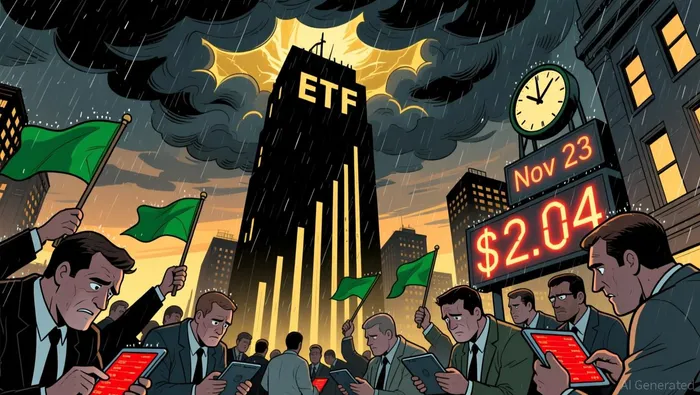
The token's recent rebound above $2.00, reaching $2.04 on November 23, offers a glimmer of hope. Analysts note that a sustained close above $2.10 could reignite short-term optimism, potentially pushing XRP toward the mid-$2 range. However, this remains contingent on holding above the $1.90 threshold, as a breakdown would signal a deeper correction.
Strategic Entry Points: Navigating Resistance and Institutional Momentum
Despite the technical headwinds, XRP's price structure reveals strategic entry opportunities for investors willing to navigate volatility. The $2.030 pivot point has become a focal area, with a descending channel on the 60-minute chart indicating a trend-driven decline rather than panic selling. A clean break above $2.05 would invalidate the bearish channel and rekindle bullish momentum, while a failure to reclaim $2.035 could lead to a retest of the $2.020–$2.025 zone.
Resistance levels at $2.05–$2.06 and the broader $2.55–$2.63 range represent critical hurdles. The latter, a convergence of moving averages, acts as a heavy ceiling. For XRP to transition from consolidation to a meaningful recovery, it must not only surpass these levels but do so with increasing volume and institutional participation.
Institutional demand, however, provides a counterbalance to the bearish technicals. U.S. spot XRP ETFs have attracted $906 million in net inflows since their launch, signaling growing confidence in the asset's utility and regulatory clarity. This inflow, coupled with RippleNet's expanding adoption and the RLUSD stablecoin's integration, could fuel a long-term re-rating of XRP's value proposition.
Investment Strategy: Balancing Risk and Reward
For traders, the immediate priority is to monitor XRP's interaction with key support and resistance levels. A short-term strategy might involve defensive positioning below $1.90, with stop-loss orders placed to mitigate downside risk. Conversely, a breakout above $2.05 could justify a measured long position, targeting the $2.55–$2.63 resistance zone.
Long-term investors, meanwhile, may find value in ETF-driven accumulation. Analysts project that sustained inflows and regulatory tailwinds could push XRP toward $3.00 in the near term, with more aggressive targets of $6.00–$8.00 dependent on macroeconomic catalysts like widespread RippleNet adoption. However, these outcomes hinge on XRP maintaining its psychological support at $2.00-a level that has historically acted as a floor during prior corrections.
Conclusion: A Delicate Rebound in the Making
XRP's path to a potential rebound is fraught with technical challenges but not without opportunity. The interplay between fractured support levels and institutional demand creates a complex landscape where caution and conviction must coexist. While the death cross and declining volume underscore near-term fragility, the confluence of ETF inflows and regulatory progress offers a foundation for optimism. For investors, the key lies in disciplined execution-capitalizing on strategic entry points while respecting the risks posed by a market still grappling with bearish momentum.






Comentarios
Aún no hay comentarios