
XRP's Critical Sell Signal: What Every Investor Must Watch Closely
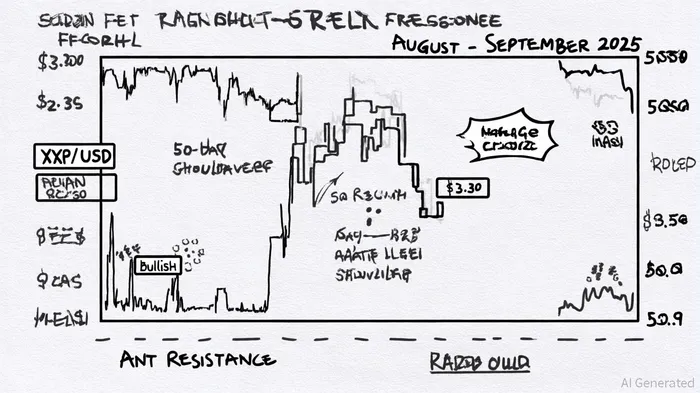
The Divergence in XRP's Technical Signals
XRP's price action in September 2025 has been a tug-of-war between bullish and bearish forces. On the surface, technical indicators like the golden cross—where the 50-day moving average ($3.00) crossed above the 200-day moving average ($2.50)—suggest a strong buy signal[1]. The RSI (52.9) and MACD line remaining above the signal line further reinforce bullish momentum[3]. However, these signals are not universally aligned.
A critical red flag emerges from the head-and-shoulders pattern forming near $3.30, a classic bearish reversal formation[2]. This pattern, combined with XRP's failure to break above the $3.07 resistance level, raises concerns about short-term distribution. Traders using the ADX (Average Directional Index) and CCI (Commodity Channel Index) have noted a shift toward neutral-to-bearish sentiment, with ADX below 25 and CCI entering negative territory[3]. These oscillators suggest weakening momentum, even as the price remains above the 20-day moving average[2].
On-Chain Red Flags: Accumulation or Distribution?
While technical indicators offer conflicting signals, on-chain data paints a more alarming picture. Binance's XRPXRP-- exchange reserves hit an all-time high of 3.57 billion tokens by September 7, 2025[1]. This accumulation by institutional and retail investors could signal either strategic positioning for a breakout or profit-taking under pressure. The latter is supported by the decline in Total Value Locked (TVL) on the XRP Ledger (XRPL), which dropped from $120 million to $98 million over two months[1].
Decentralized exchange (DEX) trading volumes on XRPL have also plummeted to $2.3 million daily, the lowest since April 2025[1]. This suggests a lack of retail and institutional engagement, compounding concerns about the token's ecosystem health. Meanwhile, Google Trends data reveals a 81% drop in search interest for XRP over two months, from a peak of 100 to just 19[1]. Such metrics often precede price corrections in speculative assets.
Risk Management: Navigating the Crossroads
For investors, the key lies in risk mitigation. A stop-loss order below the $2.80 support level—tested in early September—could limit downside exposure if the bearish head-and-shoulders pattern completes[4]. Additionally, monitoring whale activity is critical. While large holders accumulated 340 million XRP in the $3.20–$3.30 range[4], this accumulation may not offset broader distribution pressures unless catalyzed by regulatory developments (e.g., ETF approvals) or macroeconomic tailwinds (e.g., Fed rate cuts).
Diversification remains paramount. XRP's technical and on-chain signals highlight a fragile equilibrium: bullish momentum is underpinned by weak fundamentals. Investors should avoid overleveraging and instead treat XRP as a high-risk, high-reward asset with a clear exit strategy.
Conclusion: A Delicate Balance
XRP's September 2025 price action underscores the importance of holistic analysis. While technical indicators like the golden cross and MACD suggest a bullish bias, on-chain metrics and pattern formations (e.g., head-and-shoulders) signal critical sell signals. The divergence between these signals demands vigilance. Investors must watch key resistance levels ($3.07, $3.30), on-chain distribution trends, and ecosystem health metrics to avoid being caught in a potential 10% correction[4].
In a market where sentiment can shift overnight, the mantra remains: trade the chart, not the hype.






Comentarios
Aún no hay comentarios