
XRP as a Critical Infrastructure Asset in the Future of Global Payments
The global payments landscape is undergoing a seismic shift, driven by the need for faster, cheaper, and more efficient cross-border transactions. At the heart of this transformation is XRPXRP--, the native asset of the XRP Ledger (XRPL), which is redefining liquidity management and challenging legacy systems like SWIFT. By leveraging blockchain technology, XRP is not merely competing with traditional infrastructure-it is becoming a foundational layer for the next generation of financial systems.
The Liquidity Paradox: XRP vs. SWIFT
Legacy systems like SWIFT have long dominated cross-border payments, but their reliance on pre-funded nostro/vostro accounts-a practice requiring banks to hold foreign currency reserves in multiple jurisdictions-ties up trillions in dormant capital. According to a report by The Digital Banker, this model locks away approximately $27 trillion globally, capital that could otherwise be deployed for lending, development, or innovation. XRP disrupts this paradigm through Ripple's On-Demand Liquidity (ODL) service, which uses XRP as a bridge currency to enable real-time settlements without pre-funding. By converting fiat to XRP and back in seconds, institutions can free up liquidity while reducing operational costs by up to 85%.
In contrast, SWIFT transactions typically take 1–5 days to settle, with fees ranging from $10 to $50 per transaction, excluding foreign exchange spreads. While SWIFT's Global Payments Innovation (gpi) service has improved speed and transparency, it remains a messaging protocol that depends on correspondent banking networks, incurring intermediary costs and delays. XRP's ability to bypass intermediaries-settling transactions in 3–5 seconds at a cost of fractions of a cent-positions it as a superior solution for high-frequency, low-value payments.
Strategic Adoption: From Niche to Mainstream
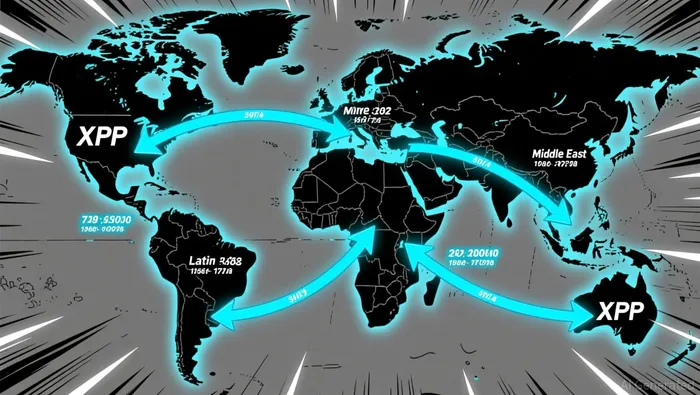
RippleNet, the network of financial institutions, using XRP, has processed $1.3 trillion in cross-border transactions as of 2025, with 40% of its partners leveraging XRP for ODL. This growth is particularly pronounced in high-impact corridors such as Southeast Asia, Latin America, and the Middle East, where financial institutions and fintechs prioritize speed and cost efficiency. For example, in the Philippines-a major remittance hub-XRP-based solutions have reduced settlement times from days to seconds, enabling real-time access to funds for millions of users.
The Asia-Pacific region alone accounts for 56% of RippleNet's global transaction volume, underscoring its appeal in markets where traditional infrastructure is either underdeveloped or prohibitively expensive. Smaller institutions, which often lack the capital to maintain SWIFT connectivity, are particularly drawn to XRP's low barriers to entry. This dynamic is reshaping the competitive landscape, forcing legacy players to innovate or risk obsolescence.
Regulatory Hurdles and the Path Forward
Despite its advantages, XRP's adoption has faced regulatory headwinds, particularly in the U.S., where the SEC's prolonged legal battle with Ripple created uncertainty. However, the resolution of this case in late 2024 has provided clarity, paving the way for institutional adoption. As of 2025, XRP is increasingly integrated into central bank digital currency pilots in over 20 countries, signaling its role as a complementary asset in the evolution of monetary systems.
SWIFT's entrenched position in large-value transactions and regions with stringent regulatory frameworks remains a challenge. However, Ripple's strategy is not to replace SWIFT but to coexist with it. High-value transactions requiring bank guarantees and regulatory certainty will continue to rely on SWIFT, while XRP will dominate in scenarios where speed and cost efficiency are paramount. This hybrid model is already taking shape, with institutions using both systems to optimize their payment portfolios.
Investment Implications: XRP as Critical Infrastructure
XRP's strategic position as a liquidity enabler and infrastructure asset is underscored by its growing adoption in institutional settings. With a market capitalization of $126–$128 billion by mid-2025, XRP has outperformed many of its peers, driven by its utility in real-world use cases. For investors, XRP represents more than a speculative asset-it is a key component of a decentralized financial infrastructure that is redefining global payments.
The long-term thesis hinges on XRP's ability to unlock liquidity, reduce friction in cross-border transactions, and integrate with emerging technologies like tokenized bankBANK-- liabilities. As financial institutions increasingly prioritize operational efficiency, XRP's role as a bridge between traditional and decentralized systems will only strengthen.






Comentarios
Aún no hay comentarios