
XRP and the Clarity Act: A Regulatory On/Off Switch for Institutional Adoption?
The U.S. crypto landscape in 2025 is defined by a pivotal legislative effort: the Digital Asset Market Clarity Act (H.R. 3633). As this bill moves through the Senate, its potential to redefine the regulatory boundaries between digital commodities and securities has become a focal point for investors, particularly for tokens like XRPXRP--. With the SEC's August 2025 dismissal of its case against Ripple and the Clarity Act's passage in the House, the stage is set for a regulatory framework that could either unlock or stifle institutional adoption of XRP. This analysis examines how the Clarity Act functions as a regulatory "on/off switch" for XRP, driven by its classification under the new framework and the token's expanding utility in real-world asset (RWA) tokenization and institutional infrastructure.
Regulatory Clarity: A Framework for XRP's Classification
The Clarity Act seeks to resolve the ambiguity surrounding digital assets by assigning the SEC jurisdiction over investment contracts (securities) and the CFTC over digital commodities. For XRP, this distinction is critical. The token has long been caught in a legal gray area, with the SEC arguing it functions as a security. However, the August 2025 court ruling, which dismissed the SEC's case against Ripple, effectively removed a major barrier to institutional adoption. The Clarity Act now offers a statutory pathway to formalize this separation.
Under the House version of the bill, XRP's classification as a digital commodity-rather than a security-would grant it regulatory clarity and align with the CFTC's oversight of spot markets. This shift is significant because it would allow institutional investors to engage with XRP without the risk of regulatory overreach. As stated by a report from Benesch Law, the Clarity Act's passage is seen as a "foundational step" in enabling compliant, large-scale XRP transactions. However, the Senate's broader definition of "digital commodities" in its discussion draft introduces uncertainty. If the final bill adopts a narrower definition, XRP's classification could hinge on its utility in cross-border payments and RWA tokenization, which are central to its value proposition.
Token Utility: From Payments to RWA Tokenization
XRP's utility has evolved beyond its original role as a bridge currency for cross-border payments. In 2025, the XRP Ledger (XRPL) became a key infrastructure for RWA tokenization, with adoption surging by 2,200%. This growth is driven by partnerships like Archax and Ripple's acquisition of Hidden Road, which provided institutional-grade custody and settlement solutions. While most XRPL transactions are settled via stablecoins like RLUSD, the network's ability to tokenize real-world assets-such as real estate, bonds, and commodities-validates its scalability and regulatory compliance.
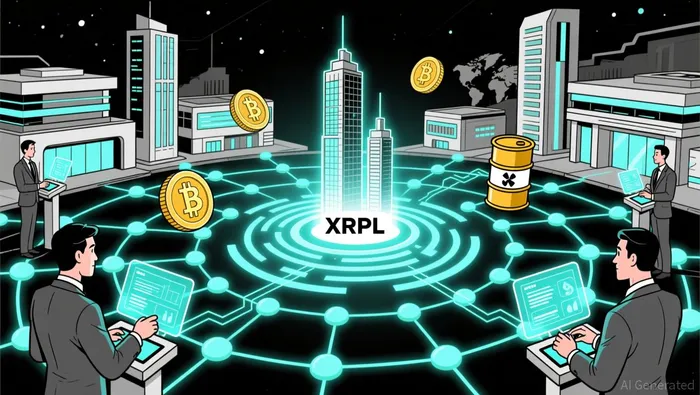 The Clarity Act's emphasis on digital commodity markets could further accelerate this trend. By creating a framework for regulated capital flows, the bill addresses a key concern for institutional investors: liability for illicit activities involving decentralized platforms. For XRP, this means its role in RWA tokenization is not just speculative but structurally aligned with the Act's goal of fostering innovation while protecting consumers. As of early 2026, $500 million in tokenized assets are hosted on XRPL, with projections of $2–3 billion by mid-2026 if adoption trends continue. This infrastructure-driven utility positions XRP as a critical component of the U.S. digital asset ecosystem.
Market Impact: ETFs, Supply Dynamics, and Price Projections
The Clarity Act's regulatory tailwinds are already reshaping XRP's market dynamics. The launch of seven U.S. XRP ETFs in November 2025 has created a $1.3 billion inflow, pulling XRP out of circulation and reducing supply. This supply compression, combined with institutional demand, has created a bullish narrative. Standard Chartered projects an $8 price target for XRP by 2026, citing ETF inflows, RLUSD adoption, and the token's role in RWA tokenization.
However, the market's response to the Clarity Act is not without risks. The Senate's ongoing debate over stablecoin rewards and DeFi liability could introduce regulatory friction. For instance, if the bill imposes strict limitations on yield-generating stablecoin platforms, it may indirectly affect XRP's liquidity. Coinbase's hesitation to fully support the bill highlights this tension. Yet, the urgency to pass the Act before the 2026 midterms suggests lawmakers are prioritizing innovation over short-term conflicts, which bodes well for XRP's institutional adoption.
Conclusion: A Regulatory On/Off Switch for XRP
The Clarity Act functions as a regulatory on/off switch for XRP by determining its classification and the broader market infrastructure it operates within. If finalized as a digital commodity under CFTC oversight, XRP will gain the legal certainty needed to attract institutional capital. Its expanding utility in RWA tokenization and cross-border payments further cements its role as a foundational asset in the U.S. digital economy.
For investors, the key variables are the Senate's final version of the bill and the pace of institutional adoption. While risks like stablecoin regulation and DeFi liability remain, the current trajectory-marked by ETF inflows, supply compression, and infrastructure growth-suggests XRP is well-positioned to capitalize on regulatory clarity. As lawmakers race to finalize the Clarity Act before the end of 2025, the token's future hinges on whether the U.S. can maintain its leadership in digital asset innovation.






Comentarios
Aún no hay comentarios