
Why XRP and Cardano's Midnight Are Positioning Themselves as 2026's RWA Market Leaders
The real-world asset (RWA) tokenization market is on the cusp of a $10 trillion inflection point, driven by institutional demand for programmable, liquid, and compliant digital representations of traditional assets. As blockchain platforms vie for dominance in this space, XRPXRP-- Ledger and Cardano's Midnight protocol are emerging as clear frontrunners, outpacing competitors like Canton and traditional finance systems in scalability, regulatory alignment, and community-driven innovation. This analysis dissects why these two ecosystems are uniquely positioned to capture the lion's share of the RWA tokenization boom by 2026.
Scalability: Speed and Throughput as a Competitive Edge
The XRP Ledger (XRPL) and Cardano's Midnight protocol have demonstrated infrastructure that rivals-and in some cases surpasses-traditional financial systems and institutional-grade blockchains.
The XRP Ledger, a high-performance blockchain designed for real-time payments, processes 1,500 transactions per second (TPS) with 3–5 seconds of finality under normal conditions, scaling to 65,000 TPS in testing environments according to Cryptorank. This speed is critical for RWA tokenization, where rapid settlement and low latency are non-negotiable for institutional players. By contrast, traditional systems like SWIFT average 523 TPS with settlement times spanning 3–5 business days according to ChainSpect, while Canton's metrics remain opaque despite its institutional partnerships as reported by Canton.
Cardano's Midnight protocol, a layer-2 solution built on CardanoADA--, offers 80 TPS with a 10-second block time and 2 MB block size, significantly outpacing Cardano's base layer (30 TPS with 20-second blocks) according to Cardano Chat. Midnight's design prioritizes instant finality and high throughput, making it ideal for RWA applications requiring frequent, small-value transactions-such as tokenized real estate dividends or fractionalized asset trading.
Canton, while leveraging partnerships with entities like DTCC, lacks transparent scalability benchmarks. Its institutional focus on privacy and interoperability is valuable but does not address the throughput demands of a $10 trillion market as noted by BVNK. Traditional finance systems, meanwhile, remain bottlenecked by centralized architectures and manual processes.
Compliance: Bridging the Gap Between Regulation and Innovation
Regulatory alignment is the linchpin of RWA adoption, and both XRP Ledger and Midnight have embedded compliance into their core architectures.
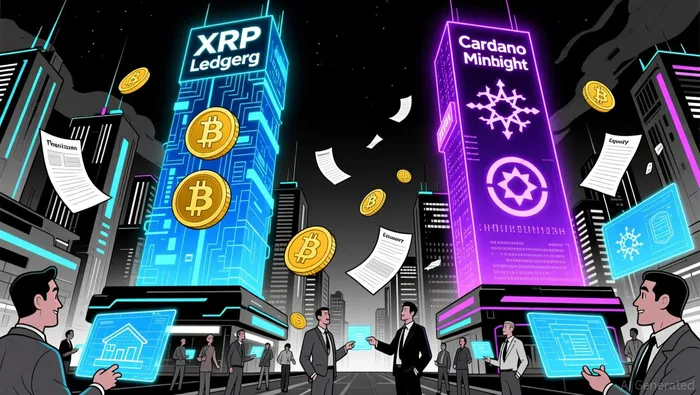
The XRP Ledger has aligned with global regulatory frameworks such as the EU's Markets in Crypto-Assets (MiCA) and the U.S. GENIUS Act, ensuring transparency, reserve requirements, and auditability for stablecoins and tokenized assets according to ChainUp. This positioning is critical for institutions seeking to tokenize treasuries, equities, or real estate without exposing themselves to legal risk. For example, INX.one, an SEC-registered exchange built on XRPL, already facilitates tokenized treasuries and equities, leveraging the ledger's compliance infrastructure as detailed by INX.
Cardano's Midnight protocol, meanwhile, introduces a structured regulatory framework that integrates traditional finance principles with blockchain innovation. Its Canton KYC and AML initiatives enable tokenized assets to meet international benchmarks, while its privacy technology allows selective disclosure of data to regulators as reported in Midnight's blog. This dual focus on compliance and privacy is particularly appealing for RWA use cases like tokenized private credit or reinsurance, where sensitive information must be protected.
Canton's collaboration with DTCC to tokenize U.S. Treasuries is a notable achievement as reported by DTCC, but its governance model prioritizes institutional participation over developer-driven innovation. Traditional finance systems, while compliant, lack the programmability and interoperability required to tokenize assets efficiently.
Community-Driven Innovation: Developer Activity and Governance
The XRP Ledger and Cardano's Midnight protocol are not only technically robust but also benefit from vibrant, community-driven ecosystems.
Cardano's governance model, now fully decentralized via on-chain governance (CIP-1694), has enabled 2,009 projects to be built on the platform by late 2025 as reported by Essential Cardano. The Cardano Foundation's allocation of ADAADA-- to Developer and Builder DReps has further incentivized innovation, with initiatives like Project Catalyst's Fund15 funding privacy-enabled DApps and RWA tools as detailed in Midnight's blog. Midnight's focus on programmable privacy-allowing developers to choose data visibility-has attracted projects in finance, healthcare, and governance as reported by Aidata Analytics.
The XRP Ledger, while less decentralized in governance, has seen explosive institutional adoption. Its low transaction costs and enterprise-grade infrastructure have drawn partnerships with firms like Backed Finance and DigiFT, which offer wallet-native tokenized assets to retail and institutional investors as reported by XBTO. The ledger's developer community is also expanding, with growing support for DeFi and cross-border payment solutions.
Canton's governance model, while institutional-centric, lacks the grassroots innovation seen in XRP and Cardano. Its reliance on entities like NASDAQ and Tradeweb for value creation limits organic growth as shared by Canton Foundation. Traditional finance systems, by design, are not built for community-driven development.
RWA Partnerships: Proving Market Readiness
The ultimate test of a blockchain's RWA viability is its ability to secure institutional partnerships and execute real-world use cases.
The XRP Ledger has already demonstrated its utility through platforms like INX.one and DigiFT, which tokenize treasuries, equities, and real estate as reported by OpenPR. These projects are supported by regulatory clarity and institutional-grade infrastructure, making them scalable solutions for global investors.
Cardano's Midnight protocol, in collaboration with Canton and DTCC, is tokenizing U.S. Treasuries custodied at DTC, with a $300 trillion global asset base as a long-term target as reported by DTCC. The successful on-chain settlement of U.S. Treasuries against USDCUSDC-- by Bank of America, Circle, and Tradeweb in late 2025 as reported by Canton underscores the platform's readiness for institutional adoption.
Canton's DTCC partnership is a strong start, but its focus on privacy and institutional collaboration does not yet translate to broad market penetration. Traditional finance systems, while established, lack the interoperability and programmability required for seamless RWA tokenization.
Conclusion: Capturing the $10 Trillion Opportunity
The RWA tokenization market is no longer a speculative concept-it is a $10 trillion reality driven by institutional demand for liquidity, efficiency, and compliance. XRP Ledger and Cardano's Midnight protocol are uniquely positioned to dominate this space due to their superior scalability, regulatory alignment, and community-driven innovation.
While Canton and traditional finance systems offer valuable infrastructure, they lack the throughput, privacy-preserving tools, and developer ecosystems required to scale RWA tokenization at the necessary pace. As the market matures in 2026, investors should prioritize platforms that combine technical excellence with institutional-grade compliance-XRP Ledger and Midnight are the clear choices.






Comentarios
Aún no hay comentarios