
XRP's Breakout Above $3.00: Strategic Implications for Institutional Investors
The recent surge of XRPXRP-- above the $3.00 psychological threshold in October 2025 has ignited renewed interest among institutional investors, signaling a potential inflection point in the asset's market structure. This breakout, driven by a combination of technical resilience, on-chain accumulation, and regulatory tailwinds, presents a compelling case for strategic positioning. Below, we dissect the mechanics of this move and its implications for capital allocation.
Market Structure: A Battle for $3.00–$3.30
XRP's price action in late 2025 reveals a textbook example of institutional-driven market structure. After a sharp rebound from $2.95, the asset consolidated between $3.00 and $3.20, a range characterized by heavy-volume flushouts that cleared leveraged longs and triggered aggressive accumulation by large holders, according to a CoinDesk report. Key resistance levels at $3.20 and $3.25 were tested multiple times, with the $3.30 mark emerging as a critical pivot for bullish momentum, a MarketMinute report observed.
Technical indicators further reinforce this narrative. The RSI hovering in the mid-50s and a bullish MACD crossover suggest a neutral-to-bullish bias, while on-chain data reveals whale accumulation of nearly 9.44% of the total XRP supply by late 2025-up from 8.24% at the start of the year, according to a TradingNews analysis. This accumulation, coupled with the observed transfer of 100,000 XRP ($300 million) from Binance to cold storage, underscores a shift toward long-term holding strategies, as the MarketMinute report also highlights.
Liquidity Catalysts: ETFs, Futures, and DeFi Integration
The introduction of XRP futures ETFs by the CME Group in February 2025 has added a layer of institutional-grade liquidity to the asset. Futures volume on the CME surpassed $1 billion in Q3 2025, with funding rates reaching 0.07%-outpacing Ethereum's 0.05%-highlighting leveraged bullish positioning among professional traders, according to a BTCC report. This surge in futures activity, combined with the launch of Ripple's EVM-compatible sidechain, has expanded XRP's utility in cross-border payments and DeFi, enabling 1,400 Ethereum-style smart contracts within a week of deployment, as the MarketMinute analysis noted.
Decentralized exchange (DEX) volumes on the XRP Ledger also grew 21% month-over-month in Q3 2025, driven by RLUSD, Ripple's USD-pegged stablecoin, which now holds a $90 million valuation - developments highlighted in the MarketMinute piece. These developments, alongside the Federal Reserve's dovish pivot, have created a favorable macroeconomic environment for XRP's adoption.
Strategic Implications for Institutional Investors
For institutional investors, XRP's breakout above $3.00 represents a confluence of structural and liquidity-driven opportunities. The asset's on-chain dynamics-marked by whale accumulation and cold storage inflows-suggest a potential undervaluation, historically preceding major price rallies, according to a CheekyCrypto analysis. If XRP sustains its position above $3.00 and breaches $3.30, it could trigger a cascade of stop-loss orders and algorithmic buying, propelling the price toward $4.00–$4.20, as the CoinDesk report notes.
Moreover, the pending approval of XRP-based ETFs by regulators could unlock a new class of institutional demand, mirroring Bitcoin's ETF-driven rally. Analysts project a $5.25 price target by 2030, contingent on Ripple resolving its SEC litigation and expanding its cross-border payment partnerships; that CheekyCrypto analysis lays out scenarios supporting this projection.
Conclusion
XRP's breakout above $3.00 is not merely a technical milestone but a reflection of deepening institutional conviction. The interplay of whale accumulation, regulatory clarity, and DeFi integration positions the asset as a high-conviction play for investors seeking exposure to the next phase of crypto adoption. However, risks remain tied to the SEC's legal stance and macroeconomic volatility, necessitating a balanced approach to risk management.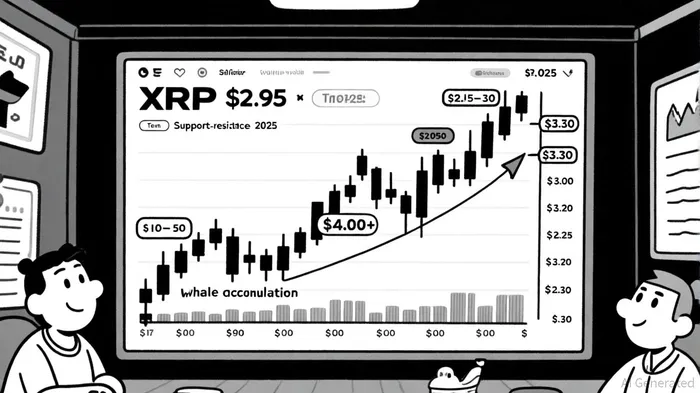






Comentarios
Aún no hay comentarios