
XRP vs. BlockchainFX (BFX): Is Ripple Still the Best Long-Term Bet in 2025–2030?
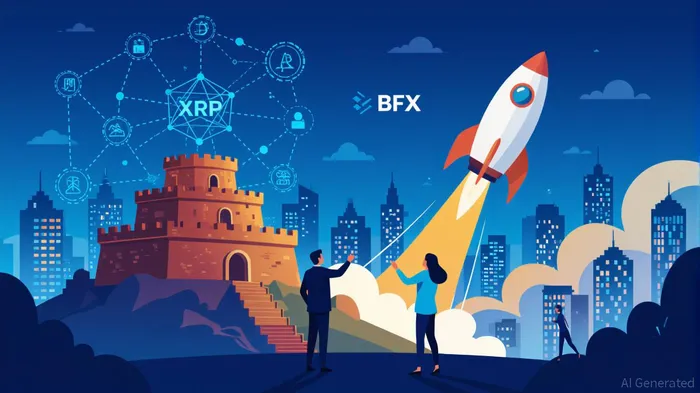
In the evolving crypto landscape of 2025, the debate between institutional-grade stability and high-risk, high-reward presales has taken center stage. Ripple's XRPXRP--, long celebrated for its regulatory clarity and institutional adoption, faces a formidable challenger in BlockchainFX (BFX), a presale project offering explosive passive income and ROI potential. This analysis examines whether XRP's established trajectory remains the optimal long-term bet or if BFX's disruptive utility and yield mechanisms warrant a strategic reallocation.
XRP: The Institutional Powerhouse
Ripple's XRP has solidified its position as a cornerstone of institutional-grade crypto assets. The August 2025 joint dismissal of SEC appeals confirmed that secondary XRP trading is not a security, unlocking a flood of institutional capital[1]. Financial giants like JPMorganJPM--, SBI Holdings, and BNY Mellon now integrate XRP for cross-border payments, with Ripple's On-Demand Liquidity (ODL) service processing $1.3 trillion in Q2 2025 alone[4]. This real-world utility is further amplified by the XRP Ledger's (XRPL) institutional-grade features, including automated market makers (AMMs), asset tokenization, and a permissioned DEX[2].
Ripple's RLUSD stablecoin, custodied by BNY Mellon, has also positioned XRPL as a hub for institutional-grade stablecoin activity, with five major stablecoins (USDC, XSGD, EURØP, RLUSD, USDB) now operating on the ledger[2]. Ripple's CTO David Schwartz envisions 2025 as a turning point for institutional adoption, with big-dollar transactions and infrastructure development paving the way for broader retail adoption[5]. While XRP's growth is projected to be steady—targeting $1.50 by 2030—its appeal lies in its role as a reliable, utility-driven asset rather than a speculative play[4].
BFX: The High-Yield Disruptor
BlockchainFX (BFX) has emerged as a polar opposite to XRP's measured growth, offering a presale model that combines live utility, passive income, and aggressive ROI projections. At $0.022 in its presale phase, BFX already generates 90% annual percentage yield (APY) through staking, with top holders earning up to $25,000 in daily USDTUSDC-- rewards[2]. The platform redistributes 70% of its trading fees to token holders, creating a deflationary model that ties value appreciation to real platform activity[1].
BFX's dual-earning mechanism—yielding both BFX and USDT—sets it apart from traditional passive income cryptos like ADAADA-- or XRP. Its “super app” supports 500+ assets (crypto, stocks, forex, commodities) and introduces consumer-focused tools like the BFX VisaV-- card, enabling global spending and ATM withdrawals[3]. The presale has raised $7.3 million from 10,000+ participants, with analysts projecting $1.8 billion in annual revenue by 2030[5].
ROI projections for BFX are staggering. A $5,000 investment at the presale price of $0.022 could grow to $1.4 million if the token reaches $5, a 500x return[1]. Limited-time bonuses like the BLOCK30 code (30% more tokens) further amplify returns[2]. While XRP's institutional adoption is a long-term play, BFX's explosive growth potential—backed by audits from CertiK and Coinsult—positions it as a high-upside alternative[5].
Risk vs. Reward: A Strategic Dilemma
The contrast between XRP and BFX reflects a broader tension in crypto investing: stability versus speculation. XRP's institutional-grade utility ensures resilience but limits upside to modest gains. BFX, by contrast, offers a high-risk, high-reward proposition with live utility and compounding yield mechanisms. However, presales inherently carry execution risk—whether the platform can scale its trading volume and maintain user growth remains unproven[3].
For conservative investors, XRP's role in cross-border payments and stablecoin ecosystems provides a hedge against market volatility. For those seeking aggressive growth, BFX's dual-earning model and ROI projections present a compelling case. The key lies in portfolio diversification: allocating a portion to XRP's institutional-grade stability while reserving capital for high-upside presales like BFX.
Conclusion: Reallocating for the Future
As 2025 unfolds, the crypto landscape is bifurcating. Ripple's XRP remains a bedrock for institutional adoption, but BlockchainFX's disruptive utility and yield mechanisms challenge the status quo. While XRP's growth is predictable, BFX's potential to 500x in a decade makes it a strategic play for risk-tolerant investors. The question is no longer whether XRP is the best long-term bet—it's whether investors are willing to reallocate a portion of their portfolios to projects like BFX, where innovation and ROI collide.






Comentarios
Aún no hay comentarios