
XRP-Based Platform Seeks to Unify Global Reward Systems
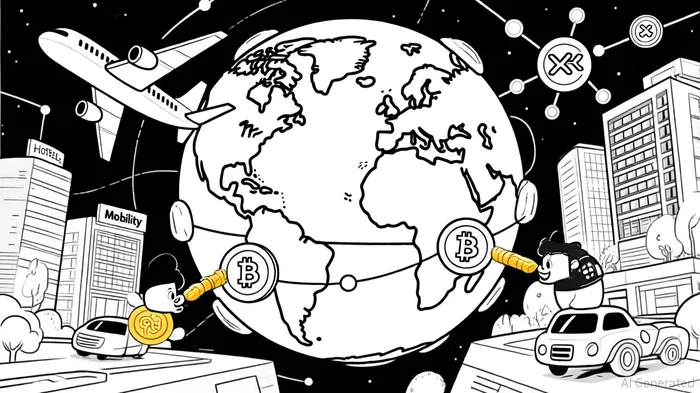
The global loyalty and rewards market-valued at over $20 billion-has long been plagued by fragmentation. Travelers are trapped in siloed ecosystems where airline miles, hotel points, and mobility credits cannot be easily exchanged or redeemed across platforms. This inefficiency stifles liquidity and innovation, leaving billions of dollars in value untapped. Enter Webus International, a Nasdaq-listed company leveraging the XRPXRP-- Ledger (XRPL) to build a tokenized travel-rewards platform that could redefine the industry. By integrating XRP-based stablecoin settlements, Webus aims to unlock real-time, borderless, and cost-efficient redemption of loyalty assets across airlines, hotels, and mobility networks, according to Webus' announcement.
XRP's Technical Edge in Loyalty Systems
The XRPL's design is uniquely suited to address the pain points of traditional loyalty programs. Unlike legacy systems that rely on opaque accounting and manual reconciliation, the XRP Ledger enables instant finality (settling in 3–5 seconds) and negligible fees (averaging $0.0001 per transaction), as detailed in an XRP Ledger analysis. This efficiency is critical for loyalty ecosystems, where users demand frictionless conversions between points and currencies. For example, Webus's platform tokenizes loyalty balances and allows travelers to redeem points for flights, hotel stays, or mobility services in real time, bypassing intermediaries and currency risk, as described in the Webus announcement.
Moreover, XRP's role as a bridge asset via stablecoins like RLUSD (Ripple's U.S. dollar-pegged token) further enhances its utility. By acting as an intermediary for cross-border settlements, RLUSD reduces the complexity of multi-currency transactions, a key bottleneck in global loyalty programs. This is particularly valuable for Webus's partnership with Air China, which integrates XRP into its Phoenixmiles loyalty program-potentially benefiting 60 million members with faster, transparent settlements, according to an Air China partnership report.
Competing with EthereumETH-- and Legacy Systems
While Ethereum's smart contract capabilities offer flexibility for complex loyalty programs, its lower throughput (50–60 TPS) and higher gas fees make it less ideal for high-volume, low-cost transactions, as noted in an Ethereum vs. XRP comparison. In contrast, the XRPL's 1,500 TPS and energy-efficient consensus mechanism position it as a superior infrastructure for real-time loyalty settlements, as observed in the same XRP Ledger analysis. However, Ethereum's robust DeFi ecosystem and Turing-complete smart contracts still provide an edge for applications requiring automated contract execution, such as dynamic reward distribution or gamified loyalty tiers, a point highlighted in the Ethereum comparison.
Critics argue that XRP's centralization risks-such as Ripple's control over validator nodes and a large XRP supply-could undermine trust, a concern raised in the Air China partnership report. Yet, Webus's pilot programs in Asia and North America suggest growing institutional confidence in the XRPL. The company's $100 million equity line from Ripple Strategy Holdings and its SEC filing for regulatory approval further signal legitimacy, as noted in the Webus announcement.
Investment Implications and Risks
Webus's initiative aligns with broader trends in XRP adoption, including institutional DeFi and cross-border settlements, according to a Pro-Blockchain analysis that examines the sector. If successful, the platform could capture a significant share of the $20+ billion loyalty market by 2026, driven by its ability to unify fragmented reward systems and reduce operational costs for businesses, the Pro-Blockchain analysis argues. However, regulatory scrutiny and competition from stablecoins or CBDCs remain risks, a point also raised in the Air China partnership report.
Conclusion
XRP's technical advantages-speed, low cost, and institutional-grade compliance-position it as a disruptive force in loyalty ecosystems. Webus's tokenized platform, if scaled effectively, could unlock $100+ billion in trapped value by 2026, according to the Pro-Blockchain analysis. While challenges like centralization concerns persist, the growing adoption of XRP in mainstream sectors (aviation, travel) suggests a compelling long-term narrative for investors. As the loyalty market evolves, XRP's role as a bridge between legacy systems and blockchain innovation may prove pivotal.





Comentarios
Aún no hay comentarios