
XRP-Backed Stablecoin Loans on Flare via Enosys: Strategic Implications for Institutional Adoption and DeFi Liquidity Expansion
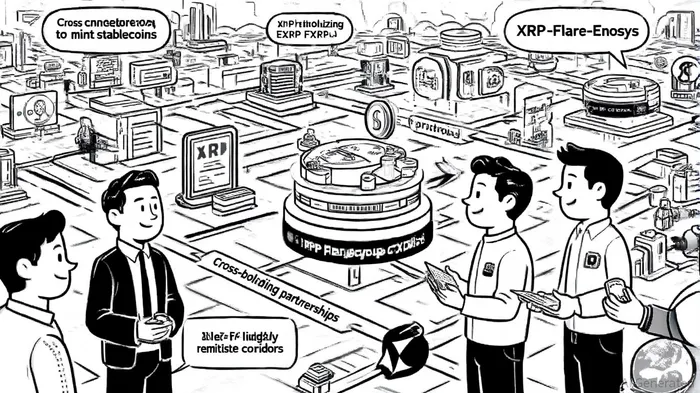
The launch of Enosys Loans on the Flare Network marks a pivotal moment in XRP's evolution from a cross-border payment asset to a cornerstone of decentralized finance (DeFi). By enabling XRPXRP-- holders to mint overcollateralized stablecoins without selling their underlying assets, this protocol bridges the gap between institutional-grade liquidity and decentralized innovation. For institutional investors and DeFi participants alike, the implications are profound: XRP's utility is no longer confined to remittances or speculative trading but now extends to yield generation, collateral management, and systemic liquidity provision.
Institutional Adoption: Yield Generation and Strategic Partnerships
The Flare Network's integration of XRP into a stablecoin protocol is underpinned by FXRP, a wrapped version of XRP, and wFLR (Flare's native token). Borrowers can now leverage these assets to mint stablecoins, earning rFLR staking rewards while retaining exposure to XRP's price action [1]. This dual-income model—yield from DeFi and appreciation from XRP—addresses a critical pain point for institutional investors: the need to monetize idle assets without ceding control.
Ripple's recent partnerships with SBI Holdings in Japan and Novatti Group in Australia further amplify this narrative. These collaborations leverage XRP's speed and low cost for cross-border settlements, while Enosys Loans introduces a parallel use case: XRP as collateralized capital. For institutions holding XRP as a reserve asset, the ability to generate yield through DeFi protocols like Enosys Loans creates a flywheel effect—increasing XRP's demand and reducing selling pressure [2].
DeFi Liquidity Expansion: CDPs, FTSO, and Stability Mechanisms
Enosys Loans is a fork of Liquity V2, a battle-tested Collateralized Debt Position (CDP) protocol known for maintaining a stable $1 peg even during market stress [3]. This reliability is critical for DeFi liquidity expansion, as it ensures that XRP-backed stablecoins can function as a medium of exchange and store of value. The protocol's use of Flare's Time Series Oracle (FTSO) adds another layer of security, providing decentralized, tamper-resistant pricing data for both collateral and stablecoins [4].
The stability pool mechanism further enhances liquidity resilience. Borrowers set their own APRs, with lower rates attracting higher risk of liquidation if the stablecoin's peg weakens. This dynamic creates a self-regulating system where lenders earn fees and liquidation proceeds, incentivizing participation and deepening the pool's capital base [5]. For DeFi, this means XRP-backed stablecoins can serve as a reliable liquidity source for traders, lenders, and even traditional financial institutionsFISI-- seeking decentralized alternatives.
Future Implications: StXRP and Ecosystem Synergies
Enosys's roadmap includes integrating stXRP (XRP staking derivatives) as collateral, allowing users to combine staking rewards with DeFi activities [1]. This innovation could redefine XRP's role in the ecosystem, transforming it from a passive asset to an active participant in yield strategies. For institutions, the ability to stake XRP while simultaneously leveraging it in CDPs would create a compounding effect, aligning with the goals of long-term holders and institutional custodians.
Moreover, the XRP Ledger's recent milestone of 7 million active accounts underscores growing adoption [6]. As more users interact with XRP-backed stablecoins, the network's liquidity and transaction volume will expand, creating a virtuous cycle that benefits both DeFi protocols and institutional players.
Conclusion: A New Paradigm for XRP Utility
The Enosys-Flare partnership represents more than a technical innovation—it signals a strategic repositioning of XRP as a DeFi-native asset with institutional-grade utility. By enabling yield generation, cross-border integration, and liquidity provision, this ecosystem addresses the limitations of traditional finance while respecting the principles of decentralization. For investors, the implications are clear: XRP's role in DeFi is no longer speculative but foundational. As institutional adoption accelerates and DeFi liquidity expands, XRP-backed stablecoins may emerge as a critical infrastructure layer for the next phase of blockchain finance.






Comentarios
Aún no hay comentarios