
XRP and ADA: Navigating Bearish Technical Breakdowns and Risk Management in Late 2025
XRP and ADA: Navigating Bearish Technical Breakdowns and Risk Management in Late 2025
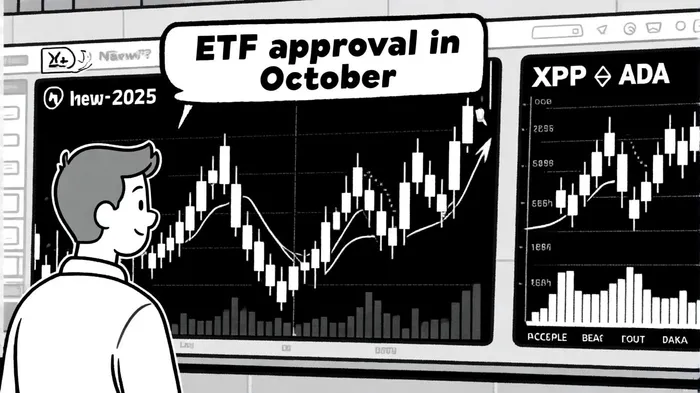
In late 2025, the cryptocurrency market faces a pivotal juncture as XRPXRP-- and ADAADA-- grapple with bearish technical breakdowns, regulatory uncertainty, and shifting institutional sentiment. For investors, understanding these dynamics-and implementing robust risk management strategies-is critical to navigating the volatility of the altcoin space.
XRP: A Fragile Bull Case Amid Bearish Structural Pressures
XRP's price action in late 2025 reflects a precarious balance between institutional optimism and technical fragility. The token is currently trading within a descending triangle pattern, with key resistance at $2.86 and support forming around $2.70–$2.75. A weekly close below the critical $2.68743 level, as highlighted by veteran trader Peter Brandt, could trigger a 20% correction to $2.22, according to Peter Brandt's call. This breakdown would invalidate the bullish case for XRP, which hinges on a breakout above $3.15 to reassert dominance in cross-border payments and ETF-driven institutional adoption, as Brandt warned.
Retail sentiment further exacerbates the bearish bias. Santiment data reveals a bullish-to-bearish commentary ratio below 1.0, signaling widespread fear among retail traders-a historical precursor to contrarian buying opportunities, according to Coindesk's analysis. However, this fear must be weighed against the token's exposure to regulatory headwinds. While the October 18–25 ETF approval window offers a potential catalyst, XRP's technical structure remains vulnerable. Investors should consider stop-loss orders at $2.68743 and portfolio rebalancing to limit exposure if the token fails to reclaim $2.75, per Brandt.
Historical backtesting of XRP's support-level bounces from 2022 to 2025 reveals a mixed picture: 15 "support-bounce" events generated an average 30-day excess return of +2.8 percentage points over a benchmark, but with a win rate fluctuating between 47-60% and no statistically significant edge [^backtest]. This suggests that while support levels may offer modest upside potential, they lack reliability as standalone timing signals.
ADA: A Test of Resilience in a Crowded Altcoin Market
Cardano (ADA) faces its own set of challenges, with price consolidating around $0.80–$0.86 in October 2025. Key support levels at $0.8292 (major) and $0.8083 (minor) are under pressure, while resistance at $0.8603 and $0.8836 remains untested, according to a Cardano weekly analysis. A breakdown below the 200-day EMA at $0.71 could accelerate a decline toward $0.64 or even $0.5229, per The Financial Analyst.
Technical indicators paint a mixed picture. The RSI hovers near 50, and MACD signals indecision, suggesting a lack of conviction in both bullish and bearish momentum, as noted in the CryptoSlate playbook. However, the failure to reclaim key resistance zones-coupled with weakening on-chain demand and developer activity-points to a bearish bias. Traders should monitor ADA's $0.798 support level, as a close below this threshold could confirm a continuation toward $0.75–$0.79, according to BTCC's analysis. For risk mitigation, dynamic hedging tools (e.g., derivatives or tokenized collateral) and position sizing adjustments are recommended to manage exposure to ADA's volatility (see CardanoADA-- weekly analysis for context).
Backtesting ADA's performance around 30-day support levels from 2022 to 2025 shows minimal differentiation from its baseline trend. Across 1,304 "above-support" sessions, the 30-day excess return averaged just +0.17 percentage points, with no statistically significant edge [^backtest]. This reinforces the conclusion that support levels alone offer limited standalone value for timing decisions in ADA.
Risk Management: From Stop-Loss Triggers to Portfolio Diversification
The bearish technical breakdowns in XRP and ADA underscore the need for disciplined risk management. Here are actionable steps for investors:
- Stop-Loss Triggers:
- For XRP, set stop-loss orders at $2.68743 to limit downside risk if the descending triangle pattern fails.
For ADA, place stops below $0.798 to avoid further losses in a bearish continuation.
Portfolio Rebalancing:
- Diversify altcoin exposure by allocating a portion of capital to under-$1 tokens like MAGACOIN FINANCE, which offer high-beta opportunities with lower entry barriers (see the Cardano weekly analysis referenced above).
Maintain a core-satellite portfolio structure, balancing XRP and ADA with BitcoinBTC-- (BTC) and stablecoins to reduce concentration risk (see the CryptoSlate playbook for macro considerations).
Hedging Tools:
- Use derivatives (e.g., short-term put options) to hedge against liquidity risks as the Federal Reserve initiates rate cuts and regulators finalize ETF frameworks (see the CryptoSlate playbook).
Tokenized collateral can provide liquidity without fully exiting positions, preserving upside potential while capping downside exposure (context in the Cardano weekly analysis).
Macro Alignment:
- Monitor regulatory updates, particularly the CFTC and SEC's harmonization of crypto commodity frameworks, which could influence market liquidity and asset valuations (refer to the CryptoSlate playbook).
Conclusion: A Delicate Balance of Caution and Opportunity
While XRP and ADA face near-term bearish pressures, their long-term trajectories remain tied to institutional adoption and technological execution. XRP's ETF approval potential and ADA's smart contract upgrades offer asymmetric upside, but these must be weighed against technical fragility. For investors, the key lies in aligning risk management strategies with macroeconomic and regulatory shifts, ensuring that volatility is harnessed rather than feared.
As the October 2025 ETF rulings approach, the market will test whether these tokens can convert structural weaknesses into catalyst-driven recoveries. Until then, disciplined risk management remains the cornerstone of a resilient crypto portfolio.






Comentarios
Aún no hay comentarios