
Is XRP's 7% Drop a Buying Opportunity or a Warning Sign?
The recent 7% decline in XRP's price has sparked a critical debate among investors: Is this a temporary correction offering a strategic entry point, or a red flag signaling deeper structural challenges? To answer this, we must dissect the token's technical indicators and institutional dynamics, which present contrasting narratives. While short-term technicals suggest caution, long-term institutional demand and regulatory clarity hint at a resilient foundation.
Technical Breakdown: A Bearish Near-Term Outlook
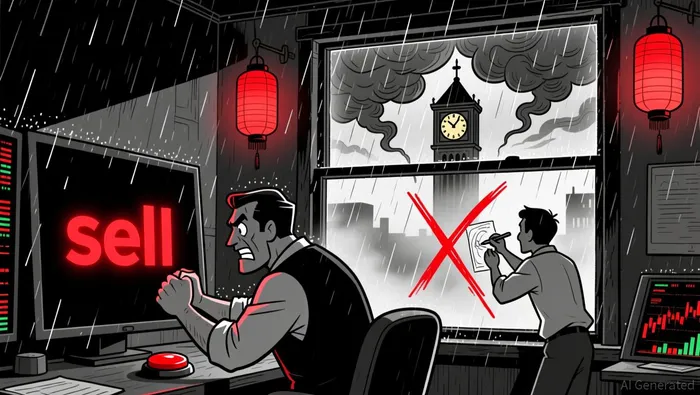
XRP's price action in late 2025 reveals a fragile balance between support and resistance. The token has fallen below the $2.20 threshold, triggering a death cross-a bearish signal where the 50-day moving average crosses below the 200-day moving average-amplifying selling pressure according to technical analysis. This breakdown has pushed XRPXRP-- toward a critical support zone known as the "red X," a historical liquidity pocket where buying interest has previously accumulated according to market analysis. However, the 14-day RSI of 25.24 indicates oversold conditions, reinforcing a "Strong Sell" bias based on moving averages.
Traders are closely monitoring whether XRP can reclaim $2.20 and break above the $2.23–$2.24 resistance range to rekindle upward momentum according to market analysis. Failure to do so risks a test of the $1.50 level, a scenario historically linked to deeper corrections. Meanwhile, on-chain data reveals a mixed picture: long-term holders and institutional desks are accumulating during weakness, but this has yet to counteract immediate liquidation flows according to market data. In short, technicals paint a cautionary tale for near-term bulls.
Institutional Demand: A Foundation for Long-Term Optimism
Despite the technical headwinds, XRP's institutional narrative remains robust. The 2025 resolution of the SEC vs. Ripple case-a landmark ruling clarifying that secondary-market XRP sales are not securities-has injected unprecedented legal clarity. This development, coupled with the launch of U.S.-listed XRP ETFs, has driven record inflows. Canary Capital's XRPC ETF, for instance, attracted $250 million in inflows and now holds $336 million in assets under management, outpacing all other U.S. spot XRP ETFs combined.
Ripple's strategic corporate moves further underscore institutional confidence. The $1.25 billion acquisition of Hidden Road to create Ripple Prime-a crypto-owned global prime brokerage-positions XRP at the intersection of traditional and digital finance. Clients can now use Ripple's stablecoin, RLUSD, as collateral, while partnerships with Mastercard, WebBank, and Gemini enable on-chain settlement of credit card payments according to financial reports. These integrations signal a broader adoption trajectory, aligning XRP with mainstream financial infrastructure.
Weighing the Signals: A Tug-of-War Between Cycles
The tension between technical indicators and institutional demand reflects a broader tug-of-war between short-term market psychology and long-term structural trends. While XRP's death cross and bearish RSI suggest a near-term risk of testing lower support levels, the surge in ETF inflows and corporate partnerships indicates a maturing ecosystem. Institutional players appear unfazed by volatility, treating dips as opportunities to deepen their exposure.
For investors, the key lies in time horizons. A technical breakdown below $2.20 could trigger further short-term pain, particularly if spot demand fails to absorb selling pressure. However, the growing institutional footprint-bolstered by regulatory clarity and innovative use cases-suggests that XRP's long-term trajectory remains intact.
Conclusion: A Calculated Opportunity for the Patient
XRP's 7% drop is neither a definitive buying opportunity nor an unambiguous warning. Technically, the token faces near-term headwinds, with critical support levels acting as a barometer for market sentiment. Yet, the institutional narrative tells a different story: ETFs are scaling, legal uncertainties are resolving, and corporate infrastructure is expanding.
For long-term investors, this divergence presents a calculated opportunity. If XRP holds above the "red X" zone and institutional inflows continue to outpace short-term liquidations, the current dip could serve as a low-cost entry point. However, those with shorter time horizons should prioritize risk management, using technical levels as guides for stop-loss placements. In the end, XRP's fate may hinge on whether the market can bridge the gap between its bearish near-term chart and its bullish institutional future.






Comentarios
Aún no hay comentarios