
XRP's $6 Price Target: A Data-Driven Case for Strategic Entry in the Final Leg of the Bull Cycle
Technical Patterns: Fibonacci Projections and Resistance Breakouts
XRP's price action has long exhibited cyclical consistency, with Fibonacci retracement levels and Gaussian Channel patterns serving as key guides. Analyst Mikybull highlights that XRP is currently in the final accumulation phase of its bull cycle, with Fibonacci projections pointing to an initial target of $7 and an extended range of $11–$15, according to Mikybull's analysis. These levels align with historical zones of exponential growth observed in 2017 and 2021.
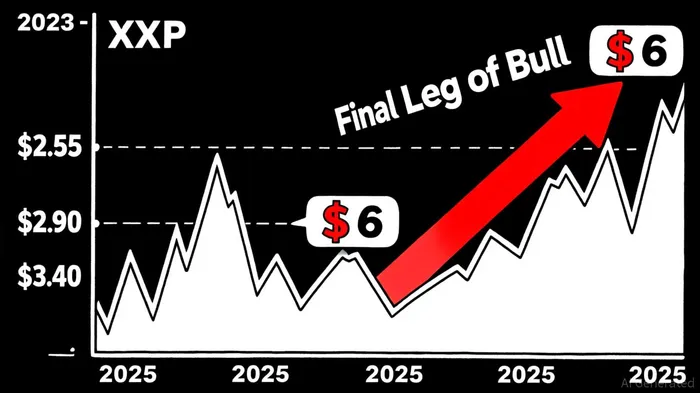
Meanwhile, EGRAG Crypto's 10% Theory-a framework extrapolating from the 2017 bull run-projects a potential 2,440% move from current levels, targeting $5.50–$6. This theory leverages Gaussian Channel patterns, which have historically predicted XRP's price trajectory with remarkable accuracy. On-chain data further reinforces this narrative: XRP has broken through key resistance levels at $2.55, $2.90, and $3.40, with sustained volume suggesting a high probability of a rally beyond $3, as shown by recent breakout signals.
Historical Resilience: Navigating Regulatory Challenges
XRP's journey through past bull cycles underscores its ability to thrive despite regulatory headwinds. In 2017, XRP surged 3,700% despite the SEC's lawsuit, while the 2021 cycle delivered 1,700% growth amid ongoing legal uncertainty, a pattern noted by the 10% Theory. This resilience is rooted in XRP's utility in cross-border payments, a sector where Ripple's technology remains unmatched.
A critical factor in XRP's endurance is its improving drawdown recovery. Historical data shows a 10% improvement in recovery per cycle: the 2017 bear market saw a 96% decline, followed by an 86% drop in 2021. By 2025, this trend suggests a potential 76% correction from a $5–$6 peak, stabilizing the bottom near $1.20–$1.40, as projected by the 10% Theory. This pattern implies that even in a downturn, XRP's fundamentals remain robust, making it a high-conviction play for long-term investors.
Final Leg Dynamics: Timing the Bull Run
The final leg of a bull cycle is often marked by rapid, exponential growth driven by institutional inflows and retail FOMO. EGRAG Crypto notes that XRP's historical bull runs typically feature two distinct peaks, with the second occurring 90–120 days after the first, as outlined in a timeline analysis. Given the current trajectory, this suggests a potential all-time high (ATH) within the same timeframe, with resistance levels at $66, $70, and $76 acting as psychological barriers mentioned in that timeline analysis.
Moreover, the resolution of the SEC lawsuit-a long-standing overhang-could catalyze a surge in institutional adoption. Ripple's recent discussions about inclusion in a U.S. strategic crypto reserve further underscore its growing legitimacy, a point echoed alongside coverage of the Lightchain AI presale. These developments, combined with XRP's role in global settlement infrastructure, position it to outperform peers in the final phase of the cycle.
Strategic Entry Points and Risk Considerations
For investors seeking entry, the current price range offers a favorable risk-reward profile. Key support levels at $2.50 and $2.20 provide downside protection, while the $3.40 resistance acts as a short-term target. However, the emergence of competitors like Remittix (RTX), which has raised $14.2 million in its presale, highlights the need for vigilance, as detailed in the Remittix presale coverage. RTX's PayFi model poses a long-term threat to XRP's dominance in cross-border payments, though its decentralized governance is still unproven.
Conclusion: A Confluence of Technical and Fundamental Drivers
XRP's $6 price target is not a speculative guess but a convergence of technical consistency, historical resilience, and macroeconomic tailwinds. As the market enters the final leg of the bull cycle, strategic investors should prioritize XRP's unique position in the cross-border payment ecosystem and its track record of overcoming regulatory challenges. With institutional adoption accelerating and on-chain metrics improving, the case for XRP is as compelling as it is data-driven.






Comentarios
Aún no hay comentarios