
XRP's 50x Rally by January 2026: Regulatory Clarity and Institutional Adoption Fuel a New Era
The cryptocurrency market has long awaited a regulatory inflection point that could catalyze mainstream adoption. For XRPXRP--, the token at the center of the U.S. Securities and Exchange Commission's (SEC) five-year legal battle with Ripple Labs, that moment arrived in August 2025. With the SEC's dismissal of its appeals and the subsequent affirmation of XRP as a non-security in public markets, the asset has entered a new phase of institutional legitimacy and utility. This regulatory clarity, combined with a surge in institutional adoption and product innovation, positions XRP for a potential 50x rally by January 2026.
Regulatory Clarity: A Foundation for Growth
The August 2025 settlement between Ripple and the SEC marked a watershed moment, as noted in the MEXC analysis. By distinguishing between programmatic retail sales of XRP and institutional offerings, the SEC effectively removed the cloud of uncertainty that had stifled XRP's adoption for years. Ripple's agreement to pay a $125 million fine and limit institutional sales under an injunction did not erase its value proposition but instead created a clear framework for compliance. This distinction has already spurred the launch of the first SEC-approved XRP ETF-the ProShares Ultra XRP ETF in July 2025-and triggered a wave of additional ETF applications from major asset managers, with a 95% approval probability by year-end 2025, according to that analysis.
The regulatory shift under SEC Chairman Paul Atkins' "Project Crypto" initiative further reinforces this trend. By prioritizing innovation-friendly oversight, the agency has signaled a departure from its historically adversarial stance toward crypto. This has translated into tangible outcomes: XRP's price surged to an all-time high above $3.40 in July 2025, and institutional investors have accumulated over 310 million tokens, signaling confidence in its long-term viability, as the MEXC analysis observed.
Institutional Adoption: From Speculation to Infrastructure
XRP's transition from a speculative asset to a foundational component of global finance is being driven by its real-world utility. Ripple's XRP Ledger (XRPL) has become a critical infrastructure layer for cross-border payments, with over 50 financial institutions leveraging RippleNet to process transactions. These institutions have collectively routed $40 billion in annualized volume through XRP-based corridors, demonstrating the token's role as a bridge currency that reduces settlement times and costs, according to a Kenson Investments analysis.
Ripple's strategic partnerships have further solidified its institutional credibility. Collaborations with firms like Guggenheim and ChainlinkLINK-- have enhanced XRP's integration into traditional financial systems, while the launch of Ripple's stablecoin, RLUSD, in February 2025, has provided a volatility hedge while maintaining XRP's utility in liquidity management, as covered in the Gate review. Additionally, Ripple's Singapore Major Payments Institution (MPI) license, granted in October 2023, has enabled the company to expand its regulated payment corridors in Asia, a region accounting for nearly 30% of global cross-border transaction volume - a development highlighted by Kenson Investments.
The institutional narrative is further amplified by the impending approval of multiple spot XRP ETFs. With applications expected to be finalized between October 18 and October 25, 2025, these products could unlock $5–$11 billion in institutional capital inflows within the first year alone, the MEXC analysis projects. Such liquidity injections, coupled with XRP's growing role in enterprise use cases, create a self-reinforcing cycle of demand and adoption.
Market Dynamics: Catalysts for a 50x Rally
To assess the feasibility of a 50x rally by January 2026, consider the interplay of regulatory tailwinds, institutional demand, and macroeconomic factors. XRP's price has already demonstrated resilience in 2025, trading in a $2.40–$2.60 range despite macroeconomic headwinds, as noted in The Crypto Alert post. However, the removal of regulatory uncertainty has significantly de-risked the asset, attracting a new class of investors.
Key catalysts include:
1. ETF Inflows: The approval of multiple XRP ETFs could replicate the BitcoinBTC-- ETF model, where institutional allocations drive exponential price appreciation. If XRP ETFs capture even 10% of the $11 billion projected inflow, the token could see a 10–15x increase by mid-2026.
2. Strategic Reserves: Former U.S. President Donald Trump's March 2025 announcement to include XRP in the U.S. national strategic reserve-alongside Bitcoin and Ethereum-sparked a 33% price surge. While policy follow-through has been delayed, the precedent could lead to broader government adoption, further legitimizing XRP as a reserve asset, as reviewed by Gate.
3. Network Effects: As XRP's utility in cross-border payments expands, its demand as a liquidity tool will grow. With Ripple's ODL service processing over $1 billion in monthly transactions, the token's intrinsic value is increasingly decoupled from speculative trading, the MEXC analysis notes.
Risks and Realities
While the bullish case is compelling, risks remain. Institutional sales of XRP are still subject to securities law, requiring exchanges to navigate compliance hurdles, as the MEXC analysis explains. Additionally, macroeconomic volatility-such as interest rate hikes or a broader crypto market downturn-could temper momentum. However, the regulatory clarity and institutional infrastructure built in 2025 mitigate these risks, creating a floor for XRP's price.
Conclusion: A New Paradigm for XRP
The convergence of regulatory clarity, institutional adoption, and real-world utility has transformed XRP from a legal liability into a cornerstone of digital finance. With ETF approvals on the horizon, expanding cross-border payment networks, and a growing list of institutional buyers, the token is uniquely positioned to capitalize on the next phase of crypto adoption. A 50x rally by January 2026 may seem ambitious, but the fundamentals-backed by concrete regulatory and market developments-suggest it is not only plausible but increasingly probable.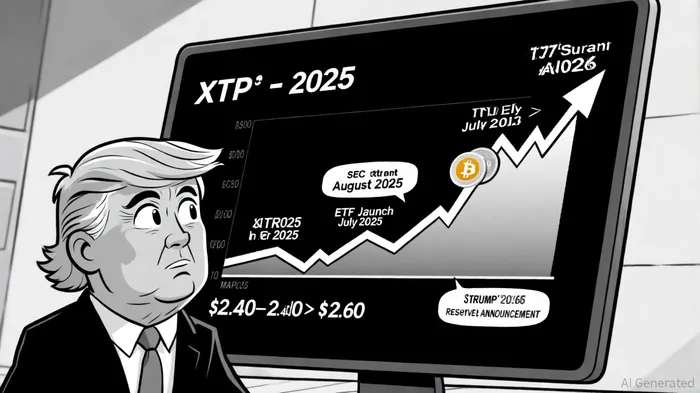






Comentarios
Aún no hay comentarios