
XRP's $3 Threshold: A Bearish Crossroads or a Bullish Rebound?
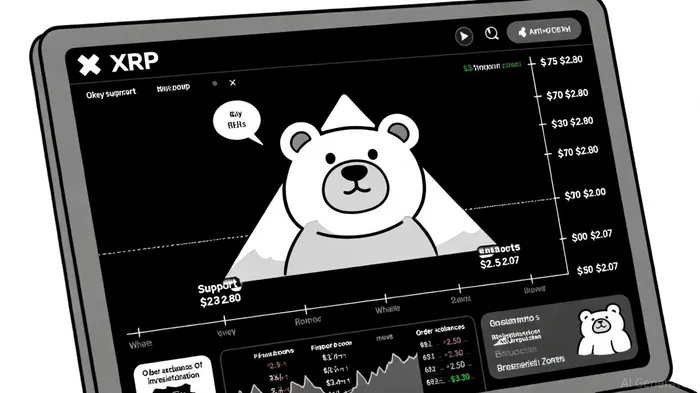
XRP's price action in September 2025 has become a microcosm of the broader crypto market's fragility, with the token teetering near critical psychological and technical thresholds. At $2.80 as of this writing, XRPXRP-- faces a pivotal test of its $2.80–$2.87 support zone—a level that, if breached, could trigger a 10% decline to $2.50 or even $2.20–$2.26, depending on macroeconomic and regulatory headwinds [1]. This analysis dissects the bearish and bullish forces at play, drawing on on-chain metrics, order book imbalances, and historical patterns to assess whether the bears have seized control or if a short-covering rally could yet defend XRP's lifeline.
Technical Resistance Failure: A Bearish Signal?
XRP's inability to reclaim the $2.93 pivot—a key Fibonacci retracement level—has reinforced a descending triangle pattern, a formation historically associated with further declines [2]. The token's repeated failures to push above $2.90–$2.92, coupled with a bearish RSI divergence (54) and a stochastic oscillator near overbought territory (70), suggest a consolidation phase with no clear directional bias [3]. However, the MACD's bearish crossover and the narrowing of the triangle's trendline indicate that sellers may dominate in the near term.
A breakdown below $2.75–$2.80 would expose XRP to a cascade of stop-loss orders and Fibonacci targets at $2.60 and $2.41 [4]. This scenario is compounded by the token's weak volume profile: while daily trading volume remains robust at $3.9 billion, the lack of sustained buying pressure—evidenced by a 26.16% drop in payments—highlights fragile demand [5].
Order Book Imbalances and Whale Accumulation
The order book at the $3 level reveals a critical imbalance: on Binance, sell volume (1.3 million XRP, 53%) slightly outpaces buy volume (1.1 million XRP, 51%) [6]. This suggests a precarious equilibrium, where a single large sell order could tip the scales. Yet, on-chain data paints a more nuanced picture. Whale accumulation of 340 million XRP in large wallets—concentrated near $2.81–$2.82—signals long-term confidence, potentially forming a base for a rebound [7].
However, recent data glitches—such as the $12 billion “exchange outflow” scare—underscore the volatility of analytics in a market prone to misinterpretation [8]. While Binance and Upbit's holdings remain stable, inconsistencies in Bybit and Bitfinex's reported flows highlight the need for caution. For now, XRP's price remains below $3, with traders fixated on ETF-related news and macroeconomic catalysts.
Historical Patterns and Institutional Catalysts
Historical chart patterns offer conflicting signals. A “cup and handle” formation and bull flag suggest a potential rally to $3.70–$4.00 if XRP breaks above $3.00–$3.10 [9]. Conversely, a 7-year ascending triangle and double bottom patterns project a bearish target of $2.17–$2.45 [10]. The token's resilience amid broader crypto outflows—such as its $3.4 million inflow in a week where BitcoinBTC-- faced $751 million in outflows—hints at niche demand, but this may not be enough to offset systemic risks [11].
Institutional developments, including pending XRP-based ETF approvals, remain a wildcard. Ripple's legal clarity in the U.S. and expanding tokenized finance partnerships could attract institutional capital, but regulatory delays or rejections would exacerbate bearish momentum [12].
Bears vs. Bulls: A Tenuous Balance
The bears currently hold the upper hand, with technical indicators, order book imbalances, and weak volume metrics favoring a breakdown. Yet, the accumulation by whales and the token's growing utility in decentralized exchanges (DEX volume up 17.64% year-over-year) provide a floor for short-term rebounds [13]. A successful defense of the $2.80 zone could trigger a rally to $3.30, but this hinges on macroeconomic conditions and ETF-related news.
For now, XRP sits at a crossroads. The bears are testing the resolve of bulls at critical support levels, while the market's sensitivity to real-time data and regulatory updates ensures that volatility will remain the norm. Investors must weigh the risks of a breakdown against the potential for a short-covering rally—a delicate balancing act in a market where every candlestick tells a story.






Comentarios
Aún no hay comentarios