
XRP's 2035 Price Potential in a Worst-Case Scenario: Strategic Investment Amid Regulatory Clarity and Market Realities
The resolution of the SEC vs. Ripple lawsuit in August 2025 marked a watershed moment for XRPXRP-- and the broader crypto ecosystem. By affirming that XRP traded on public exchanges is not a security, the ruling provided much-needed regulatory clarity, enabling XRP to reclaim its position as a foundational infrastructure asset. However, as we look ahead to 2035, investors must navigate a complex interplay of macroeconomic risks, competitive pressures, and strategic initiatives to assess XRP's worst-case price potential.
Regulatory Clarity: A Foundation for Growth
The 2025 settlement between Ripple and the SEC was a strategic win for the XRP ecosystem. By dissolving the injunction on institutional XRP sales and reducing the penalty to $50 million, the court signaled a shift toward a more innovation-friendly regulatory framework. This clarity has already catalyzed tangible outcomes: XRP's price surged from $0.5 to over $3 post-ruling, and Ripple launched RLUSD, a stablecoin with $1.3 billion in market cap, while securing approvals for XRP-based ETFs. These developments underscore XRP's transition from a speculative asset to a utility-driven infrastructure token.
Yet, regulatory risks persist. While the ruling sets a precedent for retail transactions, the SEC's broader approach to digital assets remains ambiguous. A future administration or appellate court could challenge the decision, reintroducing uncertainty. Investors must remain vigilant, as regulatory flip-flops could dampen adoption and liquidity.
Macroeconomic and Competitive Risks: Navigating the Storm
Even with regulatory clarity, XRP faces headwinds. Macroeconomic volatility-particularly in emerging markets-could undermine its role as a cross-border liquidity bridge. High inflation and geopolitical instability in regions like Latin America or Southeast Asia, where XRP's use cases are most relevant, could reduce demand for the token.
A more existential threat comes from Central Bank Digital Currencies (CBDCs). Governments like China and the European Union are advancing digital yuan and euro projects, which offer similar efficiency to XRP but with the backing of sovereign institutions. While Ripple has partnered with Palau and Bhutan on CBDC pilots, widespread adoption of state-backed digital currencies could marginalize XRP's role in cross-border payments.
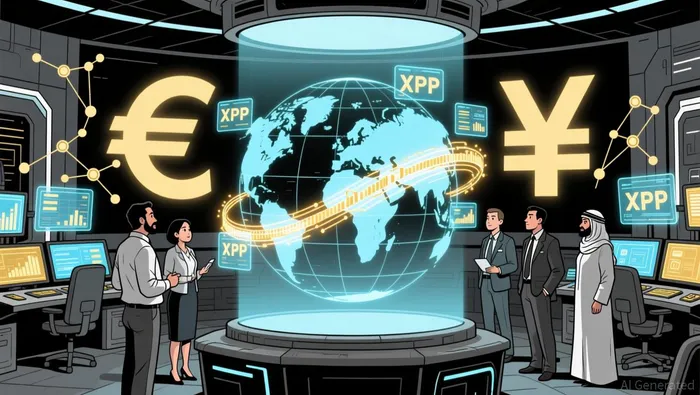
Competitive pressures from platforms like StellarXLM-- and Ethereum-based Layer 2 solutions further complicate the landscape. Stellar's XLM, with its zero-fee transactions, and Ethereum's scalable L2s are gaining traction in the cross-border payments market. The 475 billion cross-border payments sector is projected to grow at 8.12% CAGR through 2035, but XRP's market share will depend on its ability to differentiate itself through real-world utility and institutional partnerships.
Strategic Initiatives: Ripple's Path to Resilience
Ripple's post-2025 strategies are critical to mitigating these risks. The launch of RLUSD and XRP ETFs has already attracted $1.12 billion in institutional capital, positioning XRP as a regulated asset with diversification appeal. If XRP is added to major ETF baskets by 2035, capital inflows could mirror Bitcoin's ETF-driven surge, potentially pushing the price to $50–$100.
However, XRP's long-term success hinges on redefining its utility beyond cross-border payments. Ripple's CEO has emphasized expanding the XRP Ledger (XRPL) into decentralized finance and tokenized asset ecosystems, a move to compete with SolanaSOL-- and EthereumETH--. This pivot is essential: while on-chain activity has surged, XRP's price remains disconnected from its growing adoption, highlighting the need for broader use cases to justify valuation.
Worst-Case Projections: A Range of Outcomes
Analysts project a wide range of worst-case XRP prices for 2035, reflecting divergent views on macroeconomic and competitive dynamics. Google Gemini estimates $8, Bitget $3.8, and Telegaon $35.47. These disparities underscore the uncertainty surrounding XRP's trajectory. A worst-case scenario could materialize if:
1. CBDCs dominate cross-border payments, reducing XRP's relevance.
2. Regulatory headwinds resurface, stifling institutional adoption.
3. Macro risk-off sentiment persists, limiting demand for crypto assets.
Conversely, XRP's worst-case price could be mitigated by successful ETF integration, strategic partnerships, and a shift in XRPL's focus to DeFi and tokenization.
Strategic Investment: Balancing Risk and Reward
For investors, the key is to balance optimism with caution. In a worst-case scenario, XRP's price could stabilize in the $3–$8 range, supported by its role in cross-border infrastructure and ETF-driven demand. However, this requires:
- Diversification: Allocating XRP alongside other crypto and traditional assets to hedge against macro risks.
- Long-term focus: Prioritizing XRP's utility in tokenized assets and DeFi over short-term price swings.
- Regulatory monitoring: Staying attuned to shifts in the SEC's stance on digital assets.
Conclusion
XRP's 2035 price potential in a worst-case scenario is neither a foregone conclusion nor a speculative gamble. Regulatory clarity has laid the groundwork for growth, but macroeconomic volatility, CBDC competition, and strategic execution will ultimately determine its fate. For investors, the path forward lies in leveraging XRP's infrastructure role, capitalizing on ETF-driven inflows, and maintaining a diversified, long-term perspective. In a world of uncertainty, XRP's resilience will be tested-but so will its potential.






Comentarios
Aún no hay comentarios