
XRP's 2030 Price Trajectory: Is This the Next Institutional-Grade Play?
The cryptocurrency market has long been a playground for speculative bets, but the emergence of institutional-grade assets is reshaping the narrative. XRPXRP--, Ripple's native token, stands at a critical inflection point as macroeconomic tailwinds and institutional adoption converge. With the U.S. Securities and Exchange Commission (SEC) case resolved in August 2025, XRP's regulatory clarity has unlocked a new era of institutional interest, positioning it as a potential cornerstone of the global payments infrastructure by 2030.
Regulatory Clarity: The Catalyst for Institutional Confidence
The SEC's 2025 settlement, which affirmed XRP is not a security, marked a watershed moment. This legal resolution not only spurred an 11% price surge but also cleared the path for institutional investors to engage with XRP without regulatory ambiguity. The ripple effect (pun intended) was immediate: Ripple's acquisition of Hidden Road, rebranded as Ripple Prime, tripled activity in its services and introduced institutional-grade financial tools like clearing, financing, and OTC trading. By late 2025, over 300 global financial institutions were already leveraging RippleNet for real-time cross-border transactions, reducing reliance on capital-intensive pre-funding models.
Macro-Driven Utility: Payments, CBDCs, and ESG Alignment
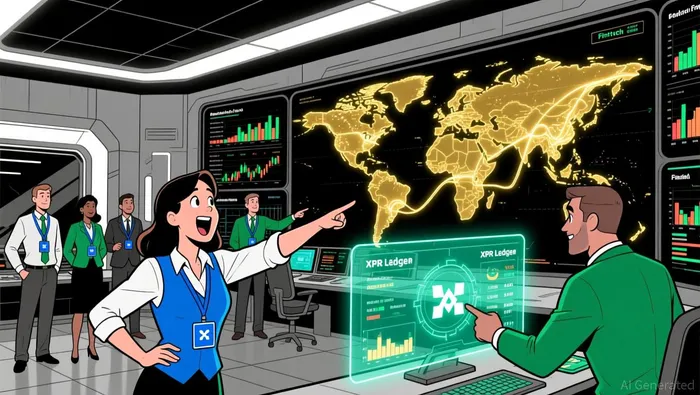
XRP's value proposition is deeply tied to macroeconomic trends. The global payment sector, projected to grow at a compound annual rate of 6.5% through 2030, is ripe for disruption. Ripple's XRP Ledger- processing 1,500 transactions per second with 3–5-second finality-offers a stark contrast to SWIFT's 1–5-day settlement cycles. This efficiency, combined with XRP's energy consumption being 99.99% lower than Bitcoin's, aligns with institutional ESG mandates.
Central bankBANK-- digital currencies (CBDCs) further amplify XRP's relevance. Ripple's participation in CBDC pilots across 20 countries positions it as a bridge between traditional finance and digital innovation. Analysts suggest that XRP's role in facilitating cross-border settlements could unlock up to $27 trillion in dormant liquidity globally, leveraging a liquidity multiplier effect akin to fractional reserve banking.
Institutional Adoption: From Speculation to Infrastructure
Institutional adoption has shifted from speculative hype to tangible infrastructure. Ripple's partnership with MastercardMA--, WebBank, and Gemini to settle Gemini credit card payments via RLUSD-a dollar-backed stablecoin- demonstrates XRP's integration into regulated payment systems. Meanwhile, nine asset managers filed spot XRP ETF applications by 2026, with inflows projected at $5B–$7B. These developments signal a transition from retail-driven volatility to institutional-grade utility.
2030 Price Projections: Scenarios and Drivers
Price forecasts for 2030 hinge on adoption trajectories. A conservative scenario assumes steady institutional uptake and regional focus, projecting XRP at $3–$4. A more aggressive outlook, driven by XRP's adoption as a SWIFT alternative and CBDC integration, could see prices reach $15–$25. Under a radical scenario-where XRP replaces SWIFT entirely- prices might surpass $50.
Standard Chartered's $8 target for 2026, based on 300% growth from current levels, underscores the potential for rapid acceleration if adoption accelerates. These projections are underpinned by XRP's technological edge, regulatory tailwinds, and macroeconomic tailwinds like inflation hedging and payment sector digitization.
Conclusion: A New Era for XRP
XRP's 2030 trajectory hinges on its ability to scale as a utility asset rather than a speculative token. With institutional infrastructure in place, regulatory clarity, and macroeconomic alignment, XRP is poised to transition from the fringes of crypto to the core of global finance. For investors, the question is no longer if XRP can become institutional-grade, but how quickly the market will price in its transformative potential.





Comentarios
Aún no hay comentarios