
XRP's 2030 Price Potential: A Convergence of On-Chain Resilience, Institutional Adoption, and AI-Driven Insights
The XRPXRP-- Ledger (XRPL) has emerged as a compelling case study in the evolving dynamics of institutional and retail participation within the crypto ecosystem. As we approach 2030, XRP's long-term price trajectory hinges on a unique interplay of on-chain activity, dormant balance reactivation, and AI-driven market analysis. This article dissects these forces, offering a roadmap for investors navigating the asset's structural transformation.
On-Chain Activity: A Foundation of Utility and Resilience
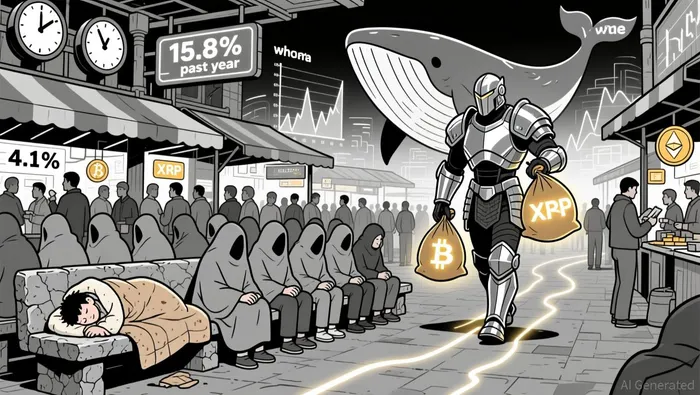
XRP's on-chain metrics in 2025 reveal a network that is both resilient and increasingly utility-driven. Daily active addresses averaged 23,000, with peaks exceeding 40,000 during price surges, while transaction volume stabilized at 1.7 million per day since April 2025. Notably, wallet distribution has shifted: large holders (wallets with ≥100 million XRP) decreased by 20.6% over eight weeks, signaling a redistribution of supply according to analysis. Meanwhile, dormant balances remain a fraction of BitcoinBTC-- and Ethereum's, with only 15.8% of XRP inactive for over a year and 4.1% for two years according to data. This low dormancy rate, coupled with 98.6% of whale wallets (≥1 million XRP) transacting within the past year, underscores XRP's role as a high-velocity asset as research shows.
Institutional Adoption vs. Retail Retreat
The divergence between institutional and retail participation has become a defining feature of XRP's 2025 landscape. Institutional demand surged via ETFs and regulated wrappers, with $1.2 billion in inflows since October 2025, including $70.2 million added in December alone according to reports. The Canary XRP ETF (XRPC) alone attracted $300 million in assets, leveraging XRP's integration into cross-border settlements and tokenized fund collaborations as data shows. Conversely, retail sentiment has soured, with declining participation and social media frustration over XRP's underperformance as noted in analysis. This institutionalization has also reduced XRP's tradable float, as ETFs and cold storage mechanisms lock up supply-a structural shift that could amplify price movements in response to renewed demand according to market analysis.
AI-Driven Insights: From Dormant Balances to 2030 Projections
AI models are increasingly pivotal in parsing XRP's future. For 2025, AI-driven trading robots achieved 49% annualized returns, leveraging Financial Learning Models (FLMs) to adapt to volatility according to reports. Dormant balance reactivation, while not explicitly tracked for XRP, is indirectly relevant: historical patterns in Bitcoin show dormant wallet activation correlates with price surges as research indicates. If similar dynamics apply to XRP, reactivated balances could signal renewed retail participation or institutional liquidity injections.
For 2030, AI models project a wide range of outcomes. Conservative estimates suggest $5.39–$15.87, driven by regulatory clarity and institutional adoption according to forecasts. More bullish scenarios, such as staking protocols locking 80% of XRP's supply, could push prices to $10.17–$83.33, assuming market cap growth to $500 billion–$1 trillion according to analysis. Ex-Goldman Sachs analyst Dom Kwok even forecasts $1,000 by 2030, contingent on RippleNet's dominance in cross-border payments and regulatory breakthroughs as noted in reports.
Strategic Entry Points Amid Shifting Dynamics
The current market environment presents a strategic inflection point for XRP. With retail investors sidelined and institutional demand surging, the asset's supply dynamics are tightening. The release of 1 billion XRP from escrow in early 2026, while adding short-term volatility, is expected to be re-escrowed, minimizing long-term float according to market analysis. Meanwhile, Ripple's RLUSD stablecoin and native lending protocols on the XRPL could enhance XRP's utility, positioning it to compete in tokenized asset markets as data shows.
For investors, the key lies in balancing short-term volatility with long-term structural trends. AI models suggest stabilization by early 2026, with price movements increasingly tied to macroeconomic catalysts like ETF inflows and macroeconomic shifts according to forecasts. Given XRP's lower dormancy rate and institutional-driven supply squeeze, entering the asset class now offers exposure to a market primed for compounding growth as adoption accelerates.
Conclusion
XRP's 2030 price potential is not a binary outcome but a spectrum shaped by institutional adoption, on-chain utility, and AI-driven insights. While retail sentiment remains fragile, the asset's structural advantages-low dormancy, high velocity, and expanding institutional use cases-position it as a candidate for significant appreciation. For investors, the current inflection point offers a rare opportunity to align with a market dynamic where supply constraints and utility growth could converge to unlock value.






Comentarios
Aún no hay comentarios