
Why XRP is the 2026 ETF Breakout Play: Bridging Speculation with Real-World Utility
In the ever-evolving landscape of digital assets, XRPXRP-- has emerged as a unique contender for 2026's ETF breakout story. Unlike Bitcoin's narrative as a "digital gold" or Ethereum's focus on decentralized finance (DeFi), XRP's value proposition is rooted in its dual role as both a speculative asset and a foundational infrastructure component for global financial systems. This convergence of institutional flow dynamics and real-world utility positions XRP to outperform peers in the ETF space, particularly as regulatory clarity and cross-border payment adoption accelerate.
Institutional Adoption: From Legal Uncertainty to ETF Momentum
The resolution of the SEC's lawsuit against Ripple in August 2025 marked a turning point. By ruling that XRP is not a security in public retail transactions, the decision removed a major regulatory overhang and paved the way for XRP ETFs to launch in November 2025. These ETFs attracted $1.3 billion in assets under management within 50 days, with 43 consecutive days of positive inflows-a stark contrast to BitcoinBTC-- and EthereumETH-- ETFs, which saw outflows of $1.09 billion and $564 million, respectively, during the same period.
This surge in institutional demand is driven by XRP's unique positioning. Unlike Bitcoin, which competes as a store of value, XRP's utility in cross-border payments provides a tangible use case that aligns with institutional risk management strategies. For example, Franklin Templeton, Grayscale, and Bitwise-major asset managers serving pension funds and sovereign wealth entities- have integrated XRP ETFs into their portfolios, signaling growing mainstream acceptance. Furthermore, the adoption of options strategies like covered calls and collars by institutional investors mirrors Bitcoin's playbook, indicating a shift toward sophisticated risk management practices.
Network Utility: Bridging the Gap Between Speculation and Infrastructure
XRP's real-world utility in cross-border payments is a critical driver of its institutional appeal. Ripple's On-Demand Liquidity (ODL) service, which uses XRP as a bridge asset, has processed $1.3 trillion in transactions in Q2 2025 alone, with the Asia-Pacific region accounting for 56% of this volume. By enabling instant currency conversion and settlement, ODL offers a faster and cheaper alternative to SWIFT, reducing the need for pre-funded nostro accounts and unlocking up to $27 trillion in global liquidity.
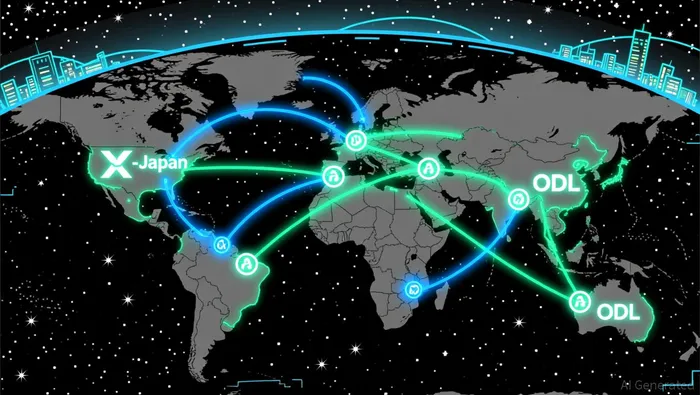
Institutional partnerships further validate XRP's infrastructure role. Santander's One Pay FX solution, American Express's RippleNet integration, and SBI Remit's use of ODL demonstrate how XRP is reshaping traditional finance. Ripple's acquisitions of Palisade and GTreasury-custody and treasury management platforms- have also expanded its capabilities, positioning XRP as a complementary layer to existing financial systems rather than a direct competitor to SWIFT.
Energy Efficiency and ESG Alignment: A Hidden Advantage
XRP's energy efficiency is another differentiator. The XRP Ledger (XRPL) processes transactions in 3–5 seconds with negligible fees (~$0.0002) and consumes 99.99% less energy per transaction than Bitcoin. This aligns with the growing demand for ESG-conscious investments, particularly among institutional players prioritizing sustainability. As global financial institutions face pressure to reduce carbon footprints, XRP's low-energy model offers a compelling value proposition.
2026 Outlook: ETFs, Macroeconomics, and the Path to $8
While XRP's price dipped 13% in 2025 despite regulatory clarity, institutional demand remained resilient. ETF inflows absorbed $483 million in December 2025, with institutions continuing to accumulate despite a 15% drop in spot price to $1.77. This suggests a focus on long-term positioning rather than short-term volatility.
Looking ahead, Standard Chartered projects XRP could reach $8 by year-end 2026, driven by sustained ETF inflows and broader adoption in cross-border corridors. This optimism is supported by quantitative metrics: RippleNet connects over 300 financial institutions, and XRP's role in central bank digital currency (CBDC) pilots in 20+ countries underscores its potential to capture 14% of SWIFT's $150 trillion annual payment volume.
Conclusion: A Dual-Engine Growth Story
XRP's 2026 ETF breakout potential stems from its ability to bridge speculative demand with real-world utility. Regulatory clarity has unlocked institutional access, while cross-border payment adoption and energy efficiency have solidified its role in financial infrastructure. As ETF inflows continue to outpace Bitcoin and Ethereum, and as Ripple's ecosystem expands, XRP is uniquely positioned to capitalize on both macroeconomic trends and technological convergence. For investors seeking exposure to a crypto asset with tangible use cases and institutional backing, XRP offers a compelling case for 2026.






Comentarios
Aún no hay comentarios