
XRP's 2026 Breakthrough: Regulatory Clarity and Institutional Adoption Fuel Price Optimism
The digital asset landscape in early 2026 is being reshaped by a confluence of regulatory clarity and institutional momentum, with XRPXRP-- emerging as a focal point of speculation and investment. After years of legal uncertainty, the resolution of the U.S. Securities and Exchange Commission's (SEC) lawsuit with Ripple in late 2025 has catalyzed a shift in market dynamics, positioning XRP for a potential surge in institutional adoption and price appreciation.
Regulatory Clarity: A Catalyst for Institutional Confidence
The SEC's final ruling in its long-standing case against Ripple Labs in late 2025 marked a watershed moment for XRP's legal status. By affirming XRP's non-security classification under U.S. law, the agency effectively removed a major barrier to institutional participation according to reports. This development was further bolstered by the passage of the Genius Act and the Digital Asset Market Clarity Act in late 2025, which provided a framework for distinguishing between securities and utility tokens. These legislative measures not only reduced ambiguity for investors but also signaled to institutional players that XRP's utility in cross-border payments and stablecoin ecosystems was now on firmer legal ground according to analysis.
The regulatory clarity has already spurred action in the ETF space. While no spot XRP ETFs have yet been approved, the groundwork laid by Ripple and its partners-including the launch of the XRP Ledger's enhanced energy efficiency and interoperability features-has intensified speculation about potential approvals in early 2026. BlackRock's rumored exploration of XRP ETF products, though unconfirmed, has further stoked market optimism according to market reports.
Institutional Adoption: From Speculation to Execution
Institutional interest in XRP is no longer confined to the realm of speculation. Ripple's strategic rollout of its RLUSD stablecoin in Japan in early 2026, supported by SBI Holdings, underscores the token's growing role as a bridge asset for real-time gross settlement (RTGS) systems and low-cost international transactions according to industry analysis. This move aligns with broader trends in global finance, where institutions are increasingly prioritizing solutions that reduce friction in cross-border payments.
The potential for XRP to become a mainstream financial tool is further amplified by its integration into institutional-grade custody solutions and compliance frameworks. According to a report by Financial Content, major asset managers are now evaluating XRP as a hedging instrument against fiat volatility, particularly in emerging markets where traditional banking infrastructure remains underdeveloped. This shift is critical: institutional adoption is no longer contingent on speculative trading but on tangible use cases that align with XRP's core value proposition.
Price Trajectory: Utility-Driven Optimism
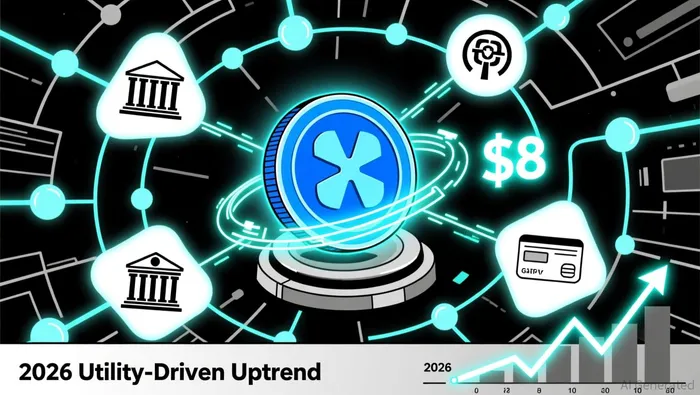
With regulatory hurdles receding and institutional demand rising, XRP's price trajectory in early 2026 is increasingly being tied to its utility rather than market sentiment alone. Analysts at Yahoo Finance have highlighted that the token's potential to reach $8 by year-end hinges on three factors: the approval of spot XRP ETFs, sustained adoption of RLUSD in global payment networks, and macroeconomic conditions favoring risk-on assets.
The $8 price target, while ambitious, is not without precedent. Historical data shows that XRP's price has historically surged during periods of heightened institutional activity, such as the 2021 bull run. However, 2026's dynamics differ: the token is now backed by a clearer regulatory narrative and a more mature ecosystem. For instance, Ripple's collaboration with central banks and financial institutions in Asia and Latin America has created a pipeline for XRP's integration into formal financial systems, a development that could drive demand independently of speculative cycles according to industry analysis.
Challenges and Risks
Despite the optimism, risks remain. Regulatory clarity in the U.S. does not guarantee alignment in other jurisdictions, where XRP's status may still be contested. Additionally, macroeconomic headwinds-such as interest rate volatility or a broader market correction-could temper institutional inflows. However, the growing emphasis on XRP's utility in real-world applications, rather than its speculative appeal, suggests that its long-term trajectory is less vulnerable to short-term market noise.
Conclusion
XRP's 2026 story is one of transformation. What began as a legal battle has evolved into a case study in how regulatory clarity can unlock institutional potential. As the token's role in cross-border finance and stablecoin ecosystems solidifies, its price performance will increasingly reflect its utility value rather than market sentiment. For investors, the key takeaway is clear: XRP's path to mainstream adoption is no longer a question of if, but how quickly institutions will act on the opportunities now available.






Comentarios
Aún no hay comentarios