
XRP's 2025 Price Potential: ETF Inflows and Macro-Driven Demand Reshape the Crypto Landscape
The cryptocurrency market in 2025 is witnessing a seismic shift, driven by regulatory clarity, institutional adoption, and macroeconomic tailwinds. At the forefront of this transformation is Ripple's XRPXRP--, which has emerged as a focal point for institutional investors and DeFi innovators alike. With the U.S. Securities and Exchange Commission (SEC) resolving its decade-long legal battle with Ripple Labs in August 2025-classifying XRP as a utility token rather than a security-the token has shed its regulatory ambiguity, unlocking a flood of institutional capital, according to a Currency Analytics analysis. This development, coupled with the launch of the first U.S. spot XRP ETFs, has positioned XRP as a linchpin in the evolving crypto-asset ecosystem.
Regulatory Clarity and ETF Inflows: A Catalyst for Institutional Adoption
The SEC's August 2025 ruling marked a watershed moment for XRP. By removing the "security" label, regulators effectively greenlit XRP's inclusion in institutional portfolios, paving the way for products like the REX-Osprey XRP ETF (XRPR) and Grayscale's XRP ETF. The XRPRXRPR-- ETF, which debuted on September 18, 2025, generated $37.7 million in trading volume on its first day, signaling robust demand from institutional players, Currency Analytics reported. Grayscale's approval further bolstered credibility, while upcoming ETFs from Franklin Templeton and Bitwise are projected to inject $1–2 billion into XRP, creating a "soft floor" for its price and enhancing liquidity, per Currency Analytics.
These inflows are not merely speculative; they reflect XRP's growing utility. Ripple's On-Demand Liquidity (ODL) service processed $1.3 trillion in cross-border transactions in Q2 2025 alone, while its RLUSD stablecoin, co-launched with BNY Mellon, has been integrated into tokenized funds like BlackRock's BUIDL and VanEck's VBLL, as noted by Currency Analytics. Such real-world applications, combined with XRP Ledger (XRPL) upgrades-such as EVM-compatible sidechains enabling 1,400+ smart contracts and $120 million in TVL-underscore XRP's transition from a speculative asset to a foundational infrastructure layer, according to Currency Analytics.
Macroeconomic Tailwinds: Interest Rates, Inflation, and Institutional Appetite
The macroeconomic environment in 2025 has further amplified XRP's appeal. Central banks, including the Federal Reserve, have signaled a shift toward neutral interest rates, reducing the cost of capital and incentivizing allocations to alternative assets, according to Natixis' 2025 institutional outlook. As inflation moderates but remains above targets, institutional investors are increasingly favoring active management strategies in fixed income and alternatives-a trend that aligns with XRP's ETF-driven liquidity profile, per the Natixis outlook.
Daily inflows into XRP-linked products reached $25 million in early 2025, reflecting a broader appetite for crypto assets amid a soft-landing narrative, the Natixis report observed. However, risks persist. The Trump administration's proposed tariffs and deregulation have introduced short-term volatility, while rising economic policy uncertainty has driven demand for safe-haven assets like gold, according to Natixis. Yet, XRP's unique value proposition-low-cost cross-border payments and DeFi integration-positions it to outperform in a low-rate environment where traditional assets face yield compression.
Geopolitical Dynamics: BRICS and the Rise of Alternatives
Geopolitical tensions, particularly in BRICS nations, have also reshaped XRP's adoption curve. As these countries seek alternatives to the U.S. dollar in cross-border transactions, XRP's speed and cost efficiency make it an attractive option, Currency Analytics observed. For instance, Brazil and India have seen increased ODL adoption in high-cost corridors, leveraging XRP's 4-second settlement times and negligible fees, per Currency Analytics. Meanwhile, Russia's alignment with China and India's strategic neutrality have created a fragmented global financial landscape, where XRP's decentralized infrastructure offers a hedge against currency volatility, as discussed in a Geopolitics analysis.
However, challenges remain. Regulatory uncertainties in jurisdictions like the EU and competition from stablecoins and CBDCs could dampen XRP's long-term growth, according to a Blockchain Review analysis. Institutions must also navigate the risk of policy shifts, such as potential U.S. tariffs, which could disrupt cross-border flows, as the Natixis outlook highlights.
The Road Ahead: Balancing Optimism and Caution
While XRP's 2025 trajectory appears bullish, investors must remain vigilant. Technological upgrades to the XRPL, including EVM compatibility, have expanded its DeFi footprint, but adoption hinges on developer activity and user growth, Currency Analytics warned. On the price front, XRP is trading in a bull-flag pattern near $3.08, with $3.65 as a critical resistance level, per Natixis. If institutional inflows continue at current rates, a breakout to $5 by year-end is plausible, though macroeconomic headwinds could temper this optimism.
Conclusion
Ripple's XRP is at an inflection point in 2025, driven by regulatory clarity, ETF-driven liquidity, and macroeconomic tailwinds. As institutions increasingly allocate to crypto assets and BRICS nations embrace alternatives to the dollar, XRP's utility in cross-border payments and DeFi positions it as a unique play on global financial innovation. However, the path to $5 or beyond will require navigating geopolitical risks, regulatory scrutiny, and competition from emerging technologies. For investors, the key lies in balancing optimism with a nuanced understanding of the macroeconomic and geopolitical forces at play.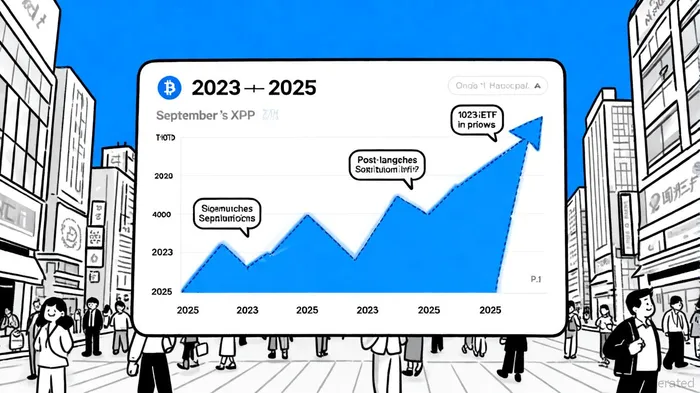





Comentarios
Aún no hay comentarios