
XRP's 2025-2026 Breakout Potential: Institutional Adoption and Regulatory Clarity Drive a New Era
Regulatory Clarity: A Foundation for Institutional Confidence
The U.S. Securities and Exchange Commission (SEC) finalized its landmark ruling in August 2025, classifying XRPXRP-- as a utility token rather than a security for secondary market transactions, according to a full case timeline. This decision, following a $50 million settlement with Ripple Labs, resolved a four-year legal battle and removed a critical barrier to institutional participation. The Currency Analytics reported that the ruling reinforced XRP's non-security status in public exchanges while maintaining regulatory scrutiny on institutional sales (The Currency Analytics). This clarity has already spurred the launch of the first U.S. spot XRP ETF, the REX-Osprey XRP ETF (XRPR), which generated $37.7 million in trading volume on its XRP ETF debut.
Blockchain Infrastructure: Scaling Institutional Utility
Ripple's XRP Ledger (XRPL) has evolved into a robust infrastructure for institutional-grade decentralized finance (DeFi). According to Ripple Insights, the XRPL now supports features like Automated Market Makers (AMMs) integrated with Central Limit Order Books (CLOBs), enabling efficient liquidity and price discovery. Strategic partnerships have further solidified XRP's role in global finance:
- BNY Mellon became a custodian for Ripple's stablecoin RLUSD, enhancing trust in digital asset management, as noted in a Coinpedia partnership list.
- SWIFT integration via Thunes expanded XRP's reach to 11,000 banks through a reported SWIFT integration.
- Central Bank Digital Currency (CBDC) pilots with Bhutan, Colombia, Japan, and Montenegro demonstrated XRP's adaptability to emerging financial systems, as covered in a CBDC pilots roundup.
These advancements position XRP as a bridge between traditional finance and blockchain, with Ripple processing $1.3 trillion in cross-border transactions via its On-Demand Liquidity (ODL) service in Q2 2025, according to The Crypto Alert.
Macro-Level Sentiment: ETFs and Market Dynamics
The approval of XRP ETFs in late 2025 has catalyzed a surge in institutional adoption. Data from Elevenews reveals that the REX-Osprey XRP ETF triggered a 762% increase in XRP exchange inflows, with over 11.57 million tokens entering exchanges. Analysts project that pending ETFs from Grayscale, Bitwise, and Franklin Templeton could inject $5–$8 billion in inflows within the first month of approval, per a Coinpedia projection. This influx, combined with XRP's historically low liquidity, may create a "supply shock," driving prices upward by 20–60% under moderate scenarios, according to an OKX analysis.
Comparatively, XRP's institutional adoption metrics outpace BitcoinBTC-- and EthereumETH-- in key areas:
- Futures Open Interest (OI): XRP futures reached $1 billion OI in three months, a feat SolanaSOL-- achieved in five months and Bitcoin in three years, as reported by CoinDesk.
- Price Performance: XRP surged 370% year-to-date in 2025, outperforming Bitcoin's 167% and Ethereum's 76% gains, per a Coinpedia price analysis.
- Transaction Volume: The XRP Ledger saw a 500% increase in daily transactions in Q3 2025, driven by institutional cross-border payment corridors, according to Bitget.
The Road Ahead: XRP as a Strategic Asset
With regulatory hurdles cleared and infrastructure partnerships expanding, XRP is poised to transition from a speculative asset to a functional financial tool. The SEC's updated ETF listing rules, which expedited approval timelines, have further lowered barriers for institutional access, as analyzed by The Currency Analytics. If XRP ETFs gain traction, the token could see sustained inflows, potentially pushing its price toward $5–$30 by mid-2026, according to a Currency Insider analysis.
However, risks remain. While Ethereum ETFs have attracted $13.6 billion in inflows since their launch, XRP's success hinges on maintaining its cross-border utility and avoiding regulatory headwinds in other jurisdictions. Nonetheless, Ripple's focus on compliance and its expanding CBDC collaborations suggest a long-term value proposition that extends beyond price speculation.
Conclusion
XRP's 2025-2026 breakout potential is underpinned by a confluence of regulatory clarity, institutional infrastructure, and macroeconomic tailwinds. As the first major crypto asset to secure a definitive legal status in the U.S., XRP is uniquely positioned to capitalize on the growing demand for efficient cross-border solutions and institutional-grade DeFi. With ETF inflows, CBDC partnerships, and technological upgrades, XRP is not just a speculative play-it's a strategic bet on the future of global finance.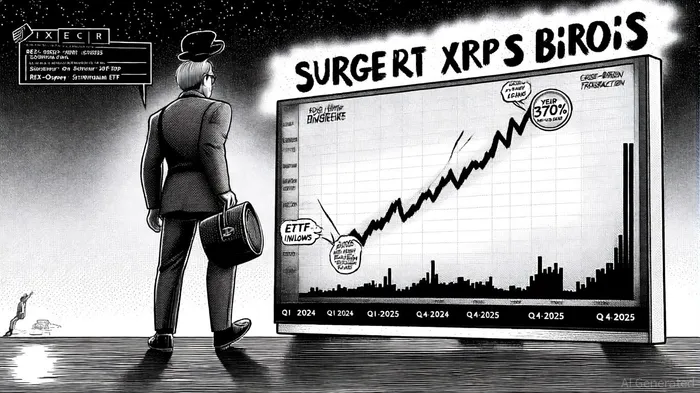






Comentarios
Aún no hay comentarios