
XRP's 2017 Fractal Repeats: A Precursor to Expansion in 2026
The cryptocurrency market has long been a theater of patterns-repeating cycles of euphoria, collapse, and rebirth. But in the case of XRPXRP--, the narrative is shifting from speculative chaos to a meticulously aligned convergence of technical and macroeconomic signals. As the token's price action mirrors its 2017 fractal patterns, the stage is set for a potential breakout in 2026. This alignment isn't just a coincidence; it's a collision of historical structure, institutional adoption, and regulatory clarity that could redefine XRP's trajectory.
The Technical Case: Fractals as a Blueprint for Expansion
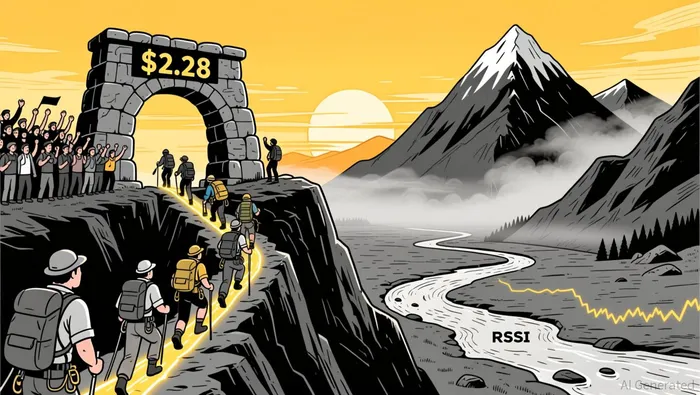
XRP's current price chart is a mirror of its 2017 rally, a fact underscored by technical analysts and on-chain data. The token has formed a falling wedge pattern, consolidating above the 50-week exponential moving average (EMA) on the weekly timeframe-a setup identical to its 2017 bull flag. This pattern, historically followed by a sharp rise from near $0.006 to $3.84, is now reemerging as XRP breaks above consolidation at $2.28 with expanding volume.
The RSI behavior further reinforces this narrative. A compressed flat zone between two spikes-a hallmark of 2017-suggests a potential second RSI peak and breakout. Overlaying the 2017 fractal onto current price action reveals a multi-year "W" pattern, a continuation of the bullish setup that preceded XRP's 2017 all-time high. If this pattern repeats, XRP could surpass $20, far exceeding its previous peak of $3.40 and establishing a new price floor above double digits.
Critically, volume expansion during the breakout is a key confirmation signal. In 2017, XRP's rally was fueled by surging on-chain activity and whale accumulation. Today, exchange-held XRP is at its lowest level since 2018, with ETFs removing billions of tokens from the open market. This supply compression mirrors the pre-breakout dynamics of 2017, suggesting a "spring-loaded" move is imminent.
The Macro Case: Institutional Adoption and Regulatory Tailwinds
Technical patterns alone aren't enough to justify a breakout. XRP's 2026 narrative is underpinned by macroeconomic forces that align with its historical fractal. The most significant of these is regulatory clarity. Following the resolution of the SEC lawsuit in August 2025, XRP was reclassified as a non-security in programmatic transactions, unlocking its re-listing on major U.S. exchanges. This development has attracted institutional capital, with XRP ETFs accumulating $1.3 billion in inflows within 50 days.
The Trump administration's pro-crypto stance and the impending CLARITY Act further reinforce this trend. These policies are expected to facilitate broader bank participation in XRP-related activities, normalizing its inclusion in institutional portfolios. Unlike BitcoinBTC-- and EthereumETH--, XRP's utility in cross-border payments (via Ripple's ODL service) provides a tangible use case that aligns with global financial infrastructure needs.
Macro liquidity conditions also play a role. The Federal Reserve's repo injections in late 2025-such as the $74.6 billion liquidity boost- have historically correlated with XRP price surges. In 2020, a similar repo surge drove XRP up nearly 50% in a week. With the Fed projecting one or two rate cuts in 2026, the reduced opportunity cost of holding risk assets like XRP could amplify ETF-driven demand.
The Fractal and the Future: A Convergence of Forces
The 2017 fractal isn't just a technical curiosity-it's a roadmap. In 2017, XRP's rally was driven by a combination of retail FOMO and early institutional interest. Today, the dynamics are more sophisticated: XRP is no longer a speculative token but a regulated, utility-driven asset with institutional-grade infrastructure.
This evolution is reflected in the token's on-chain behavior. While spot prices have faced macro headwinds (e.g., trading below $2.00 in late 2025), ETF inflows and whale accumulation suggest a late-cycle buildup. The divergence between spot price and on-chain strength mirrors 2017's pre-breakout phase, where retail capitulation was followed by institutional accumulation.
Looking ahead, the 2026 breakout will depend on three factors:
1. Technical confirmation-a sustained close above $2.28 with expanding volume.
2. Regulatory momentum-passage of the CLARITY Act and broader adoption of XRP ETFs.
3. Macro liquidity-Fed rate cuts and continued repo injections that ease systemic funding pressures.
If these conditions align, XRP could replicate its 2017 trajectory, scaling toward $4.00 by year-end. The fractal isn't just a pattern; it's a signal that XRP is transitioning from a niche asset to a cornerstone of the digital asset ecosystem.
Conclusion: A Fractal of Opportunity
The 2017 fractal isn't a guarantee of success, but it's a compelling framework for understanding XRP's potential in 2026. By combining historical price patterns with macroeconomic tailwinds-regulatory clarity, institutional adoption, and liquidity injections-the case for a breakout becomes more than speculative. It's a convergence of forces that could redefine XRP's role in the global financial system.
For investors, the key takeaway is clear: XRP's fractal isn't just a technical anomaly. It's a blueprint for expansion, one that could unlock a new chapter in the token's history-and the broader crypto market's evolution.






Comentarios
Aún no hay comentarios